PHILADELPHIA, PA – The cacophony of sneakers squeaking on hardwood, the reverberating thud of a perfectly placed outlet pass, the primal roar of a crowd witnessing a rising star—these are the sounds of autumn in the Mid-Atlantic. But this year, as the 11th Annual Black Cager Fall Classic prepares to take over the state-of-the-art Executive Fieldhouse on Saturday, October 17, 2026, the atmosphere carries a new weight. It is not merely the return of a premier preseason high school basketball showcase. It is the return of a vital compass for families navigating the most turbulent seas in the history of college athletics.
For over a decade, the Black Cager name has been synonymous with authentic, high-octane scholastic competition, curating a field that is the envy of regional event promoters. It has long been a high-stakes proving ground where legacies begin, scholarships are earned, and championship foundations are forged. Yet, in the annus horribilis of 2026, the tournament has ascended from a premier battleground to an indispensable lifeline. As the NCAA’s regulatory framework undergoes its most radical transformation since the advent of the forward pass, the Black Cager Fall Classic stands as a bulwark of clarity and opportunity for the student-athlete.
A Regulatory Perfect Storm
The college sports landscape has been upended. The traditional model of four seasons of competition over five years is officially a relic of a bygone era. In June 2026, the NCAA adopted a new “five-for-five” eligibility rule, granting Division I athletes five seasons of competition over a five-year period. This age-based model begins the eligibility clock the academic year following a student’s 19th birthday or upon high school graduation, whichever comes first. While intended to provide clarity, the implementation has been anything but.
The new rule has largely eliminated the redshirt year and almost all waivers for extended eligibility, except for narrow exceptions like religious missions or active-duty military service. More consequentially, the NCAA’s decision to exclude the high school Class of 2022 from this new model has triggered a cascade of litigation. Federal courts have issued nationwide injunctions, creating a chaotic patchwork of eligibility where some athletes are granted a fifth year while others are not. Lawsuits argue that these eligibility restrictions “unjustifiably restrain” an athlete’s ability to earn money through their name, image, and likeness (NIL).
Delgreco Wilson, Founder of Black Cager Sports
This legal tumult is compounded by the shifting focus of college coaches. As Delgreco Wilson, the founder of Black Cager Sports, astutely observes, “the recruitment process has changed so much in recent years, that many athletes and families find it very confusing. College coaches have shifted their focus to the transfer portal and there are far fewer opportunities for high school kids to go directly to the D1 level.” The premium on immediate contributors has risen sharply, while the traditional model of recruiting and developing high school players over multiple years has lost significant ground.
A Crucible of Competition and Clarity
It is against this backdrop of regulatory uncertainty that the Black Cager Fall Classic asserts its relevance. The event remains the ultimate live-action laboratory, providing answers that no summer workout or open gym ever could. For the attending coaching staffs, it offers a rare, pressure-filled environment to evaluate personnel. For the players, it is the unrivaled launchpad for uncommitted prospects. With a staggering lineage of over 200 alumni who have matriculated to NCAA Division I and II programs—including names like Collin Gillespie, Jalen Duren, and Derik Queen—the tournament’s pedigree as a pipeline to the highest levels of the sport is beyond dispute.
But this year, the stakes are higher than the box score. The event has evolved into a strategic symposium for families confronting the NIL era. As cash has flooded college and high school athletic recruiting, the potential for exploitation has grown exponentially. Coaches have warned of “street agents” exploiting athletes in NIL deals—former players, trainers, or parents who claim connections to collectives or sponsors. The Black Cager Fall Classic is directly countering this threat by bringing in some of the best NIL representatives in the business to engage parents and answer questions regarding athletic recruiting, the NCAA eligibility process, and NIL representation.
The Black Cager Guide: A Roadmap Through the Labyrinth
Perhaps the most profound contribution the tournament makes this year is its commitment to education. Every player on a participating team will receive a FREE copy of the Black Cager Guide for College-Bound Student-Athletes. This is not a pamphlet; it is a roadmap forged from three decades of experience. Over the past 30 years, Delgreco Wilson has helped well over 200 student-athletes successfully transition from high school to college—a list that reads like a who’s who of basketball talent, including Jameer Nelson, Dion Waiters, and the Morris twins.
In an era where the NCAA’s eligibility center is grappling with a new age-based model and proposed legislation like the Protect College Sports Act of 2026 is suggesting a five-year eligibility window, the guide serves as an essential tool. It provides families with the agency to develop and implement a strategy rather than simply reacting to a system in flux.
The Return of the Proving Ground
On October 17, the Executive Fieldhouse will once again become the epicenter of the basketball universe. It will be a day of fierce, live-game warfare where elite scholastic programs from the Mid-Atlantic and beyond engage in competition. But it will also be a day of learning, of strategy, and of empowerment.
The Black Cager Fall Classic is more than a tournament. It is a declaration that in an era of chaos, there is still a place where the future of the sport is not just showcased, but safeguarded. It is a reminder that while the rules of the game may change, the principles of hard work, education, and authentic competition remain the true foundations of a legacy. For the student-athletes of 2026, there is no better place to be.
Event Details:
The 11th Annual Black Cager Fall Classic Saturday, October 17, 2026 Executive Fieldhouse 555 Union Boulevard, Allentown, PA 18109
A full slate of elite matchups will be accessible to college coaches and fans globally via a live broadcast on iUNGOworld.com
Media Credentials & Inquiries: Jason Boggs, Tournament Director Black Cager Fall Classic jboggs501@yahoo.com – Email 484-522-2750 – Phone
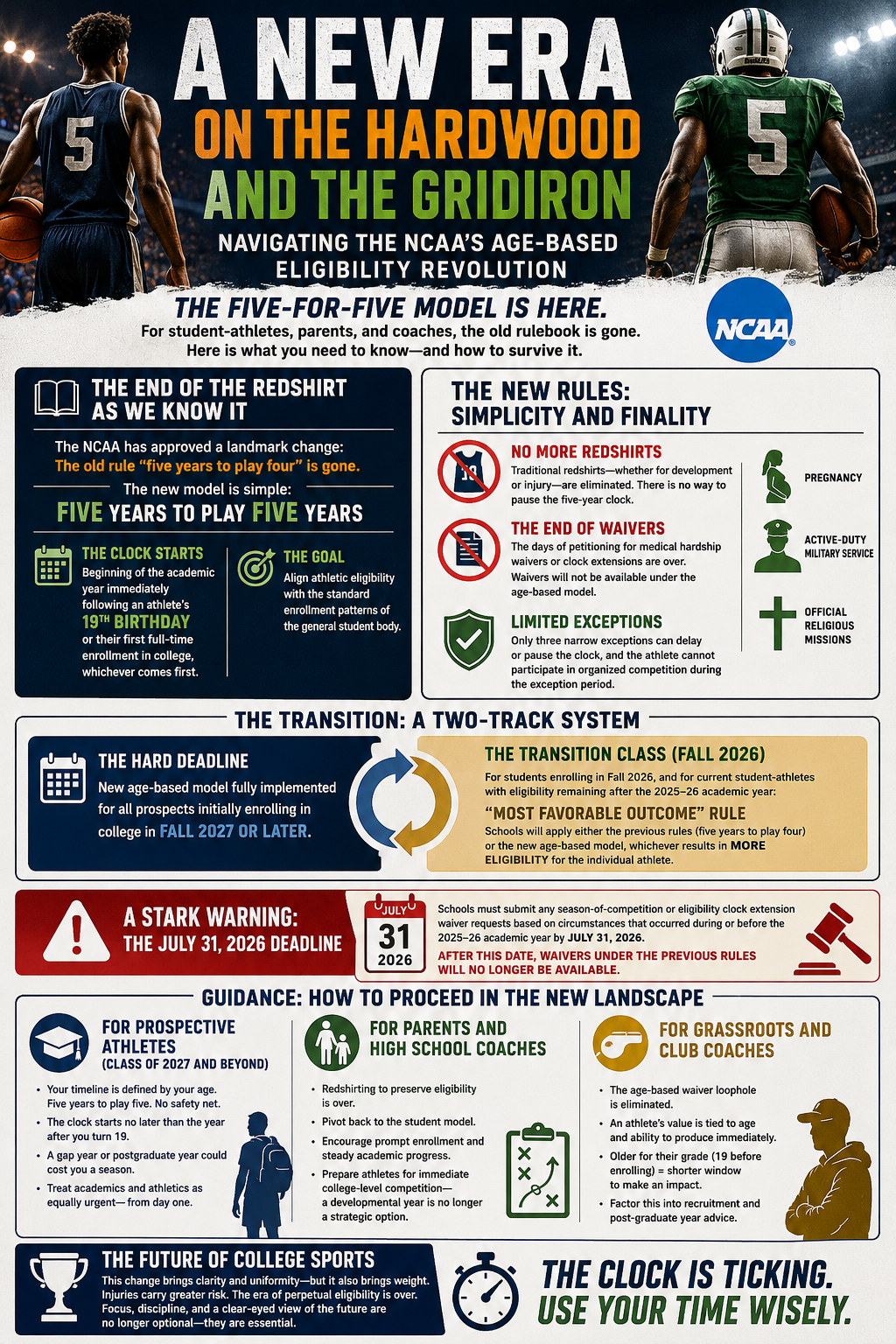
The five-for-five model is here. For student-athletes, parents, and coaches, the old rulebook is gone. Here is what you need to know about the new landscape—and how to survive it.
The End of the Redshirt as We Know It
For decades, the rhythm of college athletics was dictated by a simple, if often baffling, formula: five years to play four. It was a system rife with nuance, loopholes, and the occasional waiver wizardry that allowed star players to extend their collegiate careers into their mid-twenties. That era, for better or worse, is officially coming to an end. In a landmark move, the Division I Cabinet has unanimously approved a sweeping overhaul, ushering in an age-based eligibility model that fundamentally rewrites the rules of the game .
The new model is stark and simple: student-athletes are now permitted up to five years of eligibility, but those five years must be completed within a five-year window. This “five-for-five” model replaces the old system entirely . For the incoming class of fall 2027, the clock starts ticking based on a specific date: the beginning of the academic year immediately following an athlete’s 19th birthday, or their first full-time enrollment in college, whichever comes first . This is a seismic shift designed to align athletic eligibility with the standard enrollment patterns of the general student body .
The New Rules: Simplicity and Finality
The primary motivation behind this change is the elimination of complexity. In recent years, the NCAA’s waiver system became a source of frustration, legal challenges, and perceived inequity. Athletes in their mid-20s competing against 18-year-olds became a flashpoint for critics . The Cabinet’s decision, championed by Illinois Athletic Director Josh Whitman, aims to provide “rules that are simpler to administer and easier to predict for roster management decisions” .
Key changes include:
No More Redshirts: The traditional redshirt—whether for physical development or a season-ending injury—is eliminated. Unless an athlete falls under the specific exceptions listed below, there is no way to pause the five-year clock.
The End of Waivers: The days of petitioning the NCAA for a medical hardship waiver or a clock extension are over . The new rules specifically state that waivers will not be available under the age-based model, ending the practice of athletes seeking additional time for injuries or delayed enrollment .
Limited Exceptions: The Cabinet has defined only three narrow exceptions that can delay or pause the eligibility clock: pregnancy, active-duty military service, and official religious missions. Crucially, the athlete cannot participate in organized competition during the exception period .
The Transition: A Two-Track System for Current Athletes
The most critical detail for those currently in the system is the implementation timeline. The new rules are not a sudden cut-off. For the next two years, we will operate under a unique dual system.
The Hard Deadline: The new age-based model will be fully implemented for all prospects initially enrolling in college in fall 2027 or later.
The Transition Class (Fall 2026): For students enrolling in fall 2026, and for current student-athletes who have eligibility remaining after the 2025-26 academic year, a “most favorable outcome” rule applies. Schools will apply either the previous rules (five years to play four) or the new age-based model, whichever results in more eligibility for the individual athlete. This creates a critical strategic opportunity for those who might benefit from the old rules.
A Stark Warning: The July 31, 2026, Deadline
For those who have been relying on the old system, time is of the essence. The NCAA has set a hard deadline of July 31, 2026, for schools to submit any season-of-competition or eligibility clock extension waiver requests based on circumstances that occurred during or before the 2025-26 academic year . After this date, waivers under the previous rules will no longer be available. This is a final window of opportunity that must not be ignored.
Guidance: How to Proceed in the New Landscape
For Prospective Athletes (High School Classes of 2027 and Beyond)
Your timeline is now defined by your age. You have five years to play five. There is no safety net. You must plan your academic and athletic career with the understanding that your clock will start no later than the year after you turn 19. A gap year or a postgraduate year is now a luxury that could cost you a season of eligibility. Treat your academic progress and athletic development as equally urgent priorities from day one.
For Parents and High School Coaches
Advocacy is key. The days of “redshirting” a freshman to preserve a year of eligibility are over. As NCAA President Charlie Baker noted, 98% of student-athletes will “go pro in something other than sports” . This rule forces a pivot back to the student model. Encourage athletes to focus on enrolling promptly and maintaining steady academic progress. For high school coaches, this means preparing athletes for immediate college-level competition, as a developmental year is no longer a strategic option.
For Grassroots and Club Coaches
The elimination of the age-based waiver loophole is a significant development. You will need to advise families that an athlete’s value is now tied to their age and their ability to produce immediately at the collegiate level. Players who are older for their grade (19 before enrolling) will have a shorter window to make an impact. This should influence your advice on recruitment and the choice of a post-graduate year.
The Future of College Sports
This is not merely an administrative change; it is a philosophical one. The era of the perpetual student-athlete, sustained by a web of medical and hardship waivers, is over. While the shift brings clarity and uniformity, it also carries immense weight. Athletes who are injured will now face the grim reality that their playing careers could end without the possibility of a fifth-year waiver. The “litigious environment” mentioned by Charlie Baker is likely to respond to this new reality, as attorneys have already threatened legal action on behalf of athletes who feel they are being unfairly denied a fifth year .
Yet, for all its finality, this new rule provides a roadmap. It requires focus, discipline, and a clear-eyed view of the future. For the student-athlete stepping onto campus in 2027, the message is clear: the clock is ticking. Use your time wisely.
PHILADELPHIA, PA – In the chaotic theater of college athletics governance, the NCAA Division I Cabinet rarely deserves a standing ovation. Its recent history is a highlight reel of botched reforms, antitrust losses, and a grudging retreat from amateurism’s ruins. But last Friday, in a move that has gone almost entirely unnoticed outside the niche world of postgraduate basketball factories, the men and women in Indianapolis may have thrown a lifeline to an entire endangered business model.
They saved prep school basketball.
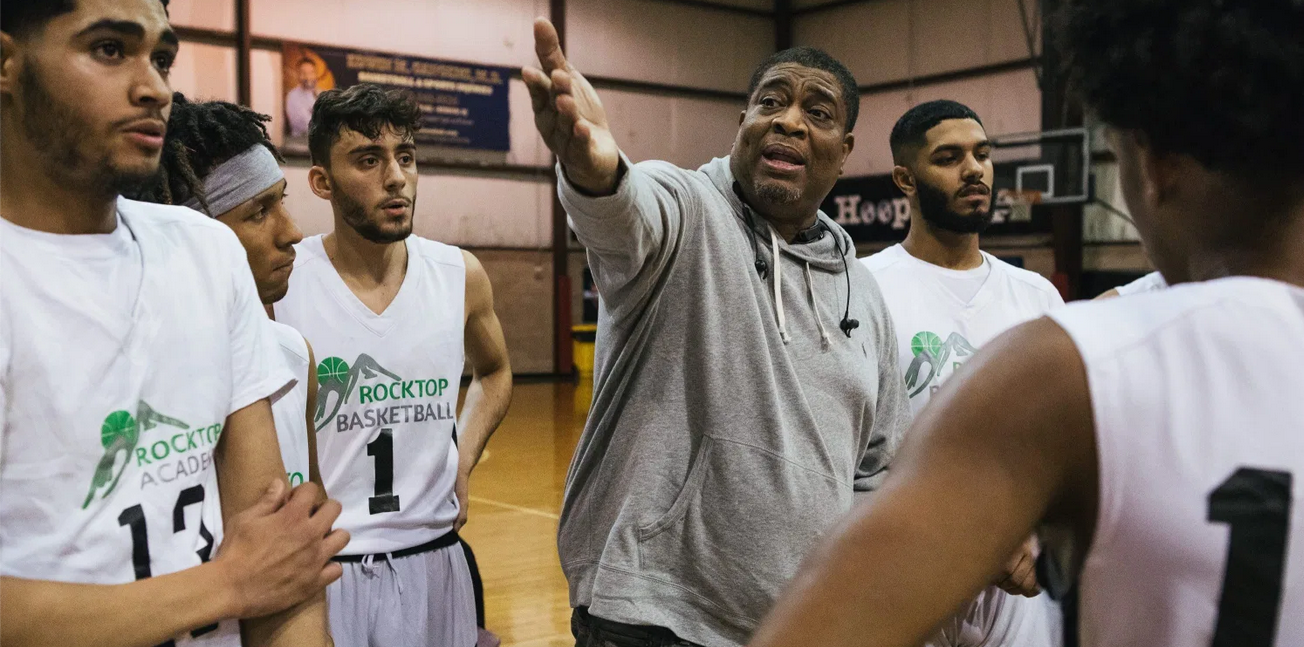
Rocktop Academy
Let that sink in. The same organization that spent decades clinging to an archaic one-and-done loophole, that watched its transfer portal become a Wild West, and that seems constitutionally incapable of keeping pace with reality, just made a decision so shrewd, so quietly counterintuitive, that it deserves a second look.
Here is the backstory that matters. For months, the NCAA has been wrestling with a new age-based eligibility model, colloquially known as the “five years to play five seasons” proposal. Under the original draft, the eligibility clock was set to start at high school graduation. On its face, that seemed reasonable. But for the prep school ecosystem—those expensive, yearlong finishing schools in New England, Florida, and the Midwest that churn out Division I prospects—it was an extinction-level event.
Under that old rule, a promising but academically raw 18-year-old who chose a fifth year of prep school would have been committing a kind of athletic seppuku. He would lose a full year of his precious five-year NCAA eligibility clock before ever stepping foot on a college campus. He would earn zero college credits. And he would pay $10,000 to $20,000 for the privilege. The rational economic choice was obvious: go to junior college, Division II, or Division III. Play immediately. Earn credits. Preserve your clock.
But then, the Cabinet pivoted. And in that pivot, an industry was spared.
The Clock Starts Later, Not Sooner
On Friday, the Cabinet announced a critical modification. The eligibility clock for student-athletes will now start upon “initial full-time enrollment in college or at the beginning of the academic year following their 19th birthday, whichever occurs earlier.” Read that again. Whichever occurs earlier.
What this means in plain English: If you are a prep school prospect who reclassifies or takes a postgraduate year, your clock does not start ticking the moment your high school principal hands you a diploma. It starts when you actually show up for college, or the fall after you turn 19. In practical terms, that gap—the year between turning 18 as a high school graduate and turning 19 as a prep school alum—has become a free square on the bingo card.
Covenant College Prep
Consider a typical prospect: born in July 2008. He graduates high school in June 2026, turns 18 that summer. Under the original proposal, his five-year eligibility clock would have started that June 2026. If he went to prep school for the 2026-27 academic year, he would arrive on a college campus in 2027 having already burned one of his five years. He would be a 19-year-old freshman with four years left. That is a terrible deal.
Under the new rule, his clock does not start until the fall after his 19th birthday—which would be the fall of 2026, exactly when he enrolls in college. He loses nothing. His five years to play four seasons begin the day he moves into the dorm.
The prep school year, in other words, has been transformed from a liability into a tax-free option. It is no longer a hole into which you throw a year of eligibility. It is now a holding pattern that costs you nothing but time—and given the maturation and recruitment advantages of being 19 versus 18, time is exactly what you are buying.
Why Junior College Just Lost Its Edge
When the original graduation-based clock was circulating among athletic directors and compliance officers, the smart money was on a mass migration to the junior college ranks. And for good reason. A JUCO offers what a prep school cannot: transferable credits, immediate playing time, and, crucially, an eligibility clock that remains mercifully paused until you sign a National Letter of Intent at a four-year school.
But the new rule narrows that advantage. The JUCO route still offers credits, which is not nothing. But consider the lifestyle. At a JUCO, you are one of dozens of mercenaries grinding through a two-year proving ground. The coaching turnover is high. The facilities are often spartan. And the academic rigor, while improving, is rarely mistaken for Choate Rosemary Hall.
Prep schools, by contrast, offer something that JUCOs cannot: relationships. They offer a handcrafted year of strength training, film study, and—let us be honest—transcript management. They offer a network of coaches who have direct lines to high-major programs. And now, they offer this without sacrificing a single year of NCAA eligibility.
For a family with $15,000 to $40,000 to invest in their son’s basketball future, the calculus has flipped. The prep school is no longer the sentimental choice. It is the rational one.
The Irony of the Service Academies
Perhaps the most delicious irony in all of this comes from the unlikely coalition that pushed for the change. According to the NCAA’s announcement, the adjustment “follows recommendations from stakeholders in men’s ice hockey, men’s basketball and the U.S. national service academies.”
Think about that. The service academies—West Point, Navy, Air Force—which typically recruit older, more mature prospects who have done postgraduate years at prep schools or military junior colleges, were instrumental in saving the very prep schools that feed them players. The same academies that produce future officers also produce the political cover for a rule that benefits elite basketball factories.
It is a strange bedfellows story worthy of a John le Carré novel. But it works. The service academies argued, correctly, that a graduation-based clock would penalize students who take a gap year for military prep. The NCAA, desperate for allies in its ongoing war against federal antitrust scrutiny, listened. And in listening, they extended that same grace to every fifth-year senior at Brewster Academy and IMG Academy.
Mt. Zion Prep
The Financial Reality: No One Is Paying to Lose
We must speak plainly about money. The prep school business model rests on a simple proposition: families will pay tuition in exchange for an improved athletic scholarship opportunity. That proposition collapses instantly if the cost includes a year of lost eligibility. No parent with a calculator is going to write a $20,000 check to reduce their child’s window for a free education. Under the old graduation-clock model, the expected value of a prep school year went negative. You would have been better off red-shirting as a true freshman, at least then you get a meal plan. But under the new age-based clock, the expected value is positive again. You get the physical development, the recruiting exposure, the academic reclassification, and you still arrive on campus with a full five-year clock. The only cost is the tuition itself—and for families betting on a high-major scholarship, that is a risk they are willing to take.
The NCAA did not just tweak a bylaw. It recalibrated an entire market.
What Happens Next
The Cabinet plans to consider the age-based eligibility model for a formal vote at its June 23-24 meeting. The implementation details for prospects who turned 19 before 2026 are still being ironed out. And the July 31 deadline for waiver submissions is looming for current student-athletes impacted by existing rules.
But make no mistake: the substantive work has been done. The NCAA has signaled, in its lumbering, bureaucratic way, that the eligibility clock is no longer a weapon against postgraduate development. It is a neutral arbiter. And for the prep school basketball industry—which has survived the one-and-done era, the G League Ignite, and the rise of Overtime Elite—that is the only victory that matters.
The prep schools will not be sending the NCAA a thank-you bouquet. They are too savvy for that. But they should. Because in a world where every other institution seems determined to tear down the traditional pathways to college basketball, the NCAA just built a fence around one of the last remaining ones.
Say what you will about the Association’s competence. On this one Friday in May, it got the math right. And an entire cottage industry breathed a sigh of relief.
PHILADELPHIA, PA – The transfer portal is often framed as a story of money and minutes—players chasing NIL deals or featured roles, often at the expense of their long-term development. But Joshua Wyche’s journey from Lafayette to VCU is a different kind of story. It is a story of a player who thought beyond basketball, who weighed his options with the precision of a business analyst, and who chose a path that balanced athletic ambition with intellectual growth.
Wyche is not a typical transfer. He is a highly intelligent Philadelphia kid who graduated from Lafayette College—home to one of America’s top business departments—in just three years. With an impeccable academic profile and two years of eligibility remaining, he was recruited by a wide range of programs, from Division III to high-major Division I. He could have been a featured player at a lower level, scoring 20 points per night and dominating lesser competition. He could have chased a larger NIL package at a program with more resources but less fit.
Instead, he chose VCU—a consensus top-25 program, widely considered the finest in the Atlantic 10—and Coach Phil Martelli Jr., one of the youngest and most respected coaches in college basketball. And he chose to pursue an MBA with a focus on business analytics, a degree that will allow him to bridge the gap between technical data science and corporate strategy. This is not a story about a player who transferred to maximize his basketball exposure, though that is part of it. It is a story about a player who used the transfer portal to build a career—on and off the court.
The Portfolio Problem: Weighed Against Uncertainty
Wyche’s decision to enter the transfer portal and commit to VCU must be understood as a strategic choice made under conditions of incomplete information, asymmetric power, and time pressure. He was not simply choosing a team. He was weighing short-term financial incentives, projected on-court opportunity, developmental infrastructure, exposure to professional pathways, and personal fit against long-term career risk.
His portfolio looked like this:
Immediate Returns: The opportunity to earn a Master’s degree in Business Analytics from VCU, a program with real-world applications Guaranteed NIL compensation (modest by high-major standards, but meaningful) A promised opportunity to compete for minutes—not a guaranteed role, but a chance
Speculative Assets: Brand growth from playing at a nationally ranked program that defeated ACC powerhouse North Carolina in the NCAA Tournament Skill development under Coach Phil Martelli Jr., one of the top young coaches in college basketball Competitive success in the Atlantic 10, a conference that regularly sends teams to the NCAA Tournament Professional pathway—not just in basketball, but in business analytics
Wyche could have chosen a different path. He could have transferred down to Division II or Division III, where he would have been a featured player, scoring 20 points per night, dominating lesser competition, and chasing a different kind of glory. That path would have offered immediate returns—playing time, scoring titles, the ego boost of being the man.
But it would have offered limited speculative assets. Division III does not attract NBA scouts. Division III does not provide the platform that VCU offers. And Division III would not have allowed him to pursue an MBA in Business Analytics from a nationally respected program.
Wyche chose the path of higher risk and higher reward. He chose to compete for minutes at a top-25 program rather than coast at a lower level. He chose to develop his analytical skills alongside his basketball skills. He chose to think beyond basketball.
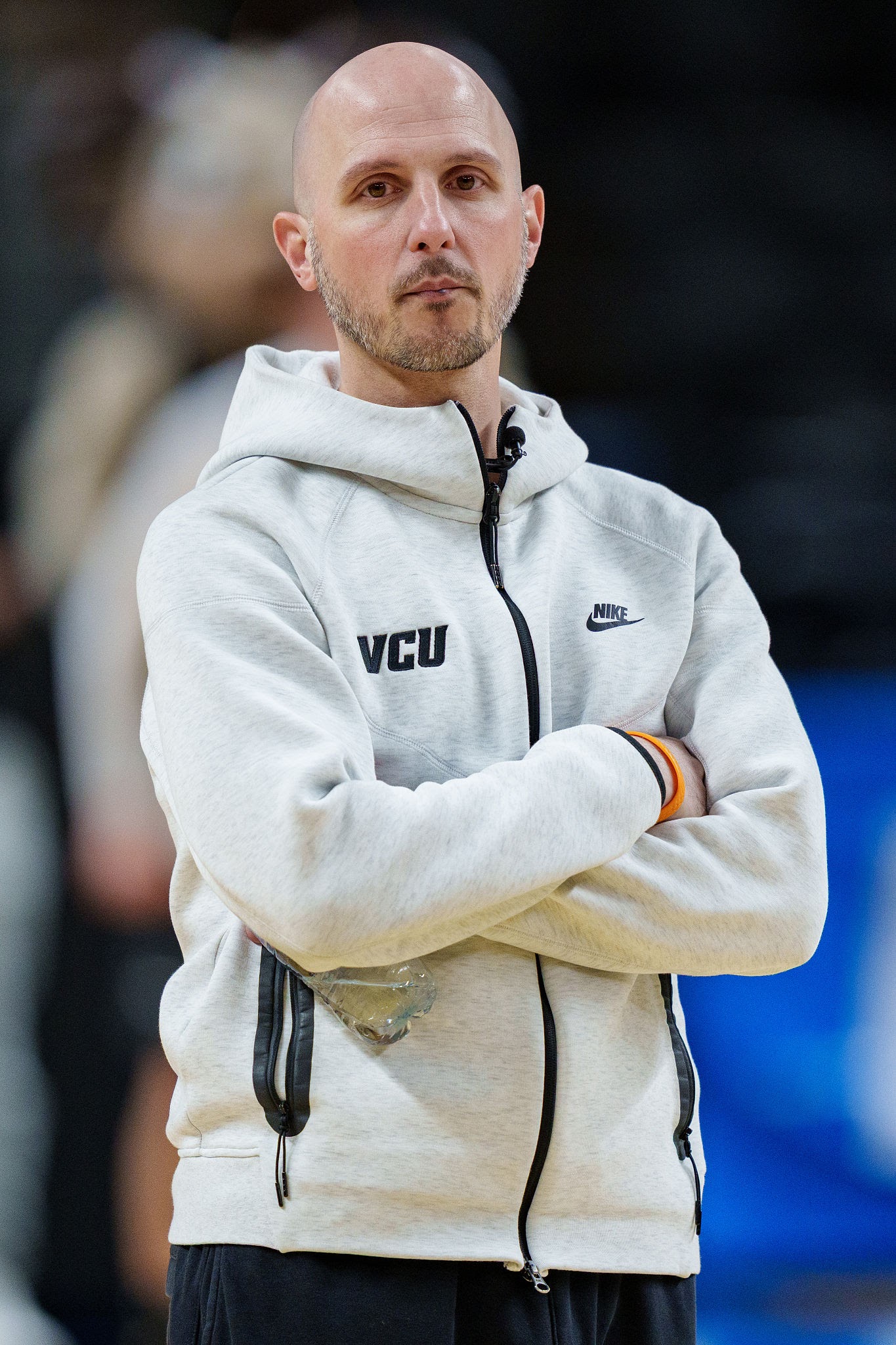
GREENVILLE, SOUTH CAROLINA – MARCH 18: Head coach Phil Martelli Jr. of the VCU Rams looks on during practice ahead of the NCAA Men’s Basketball Tournament at Bon Secours Wellness Arena on March 18, 2026 in Greenville, South Carolina. (Photo by Jacob Kupferman/Getty Images)
The Philly Connection: Martelli and Wyche
Phil Martelli Jr. is a Philadelphia guy. He grew up in the city’s basketball culture, the son of legendary St. Joseph’s coach Phil Martelli Sr. He learned the game in the Catholic League, on the playgrounds, in the gyms where toughness is currency and intelligence is underestimated.
Wyche is also a Philadelphia guy. He understands the same culture. He speaks the same language.
When Martelli recruited Wyche, he did not promise him a starting job. He did not promise him 30 minutes per night. He did not promise him a specific NIL number. He promised him two things: an opportunity to earn a Master’s degree in a highly valued field of study, and an opportunity to compete for minutes in one of the finest basketball programs in America.
That honesty—that refusal to make false promises—is increasingly rare in the portal era. And it is exactly what Wyche needed to hear.
Martelli is adding a mature, highly intelligent, and talented player to a program that just defeated ACC powerhouse North Carolina in the NCAA Tournament. Wyche is adding a coach who will develop him, a program that will challenge him, and a degree that will serve him long after his playing days are over.
The Data-Driven Decision
Wyche’s choice of academic program is not incidental. He is pursuing an MBA with a focus on business analytics—a field that examines and applies analytics to real-world decision contexts, emphasizing the use of data-driven methods to support, inform, and improve organizational decision-making.
In other words, Wyche is studying the very skills that will allow him to analyze his own career decisions. He is learning to weigh probabilities, assess risk, and optimize outcomes. He is practicing on himself.
This is the kind of player that Martelli wants in his program: someone who thinks critically, who understands that basketball is not an end in itself but a means to a larger goal, who will be a leader in the locker room and in the classroom.
A Win-Win Situation
This is truly a win-win.
VCU adds a mature, high-quality athlete to its roster. Wyche is not a project. He is not a one-and-done rental. He is a player who has earned a degree from one of America’s top business departments, who has battled through injuries, who has learned to contribute without a featured role. He will be a positive influence in the locker room, a player who understands that winning is more important than individual stats.
Wyche gets an opportunity to learn and play for one of the top young coaches in college basketball. He gets to compete at the highest level of the Atlantic 10, in a program that just defeated North Carolina in the NCAA Tournament. He gets to pursue a Master’s degree in Business Analytics from a nationally respected program. And he gets to do it all in his home region, close to family and friends.
And together, Martelli and Wyche are demonstrating that there is still more than NIL compensation driving smart college recruiting decisions. Fit matters. Development matters. Education matters. The pursuit of a career beyond basketball matters.
The Final Verdict: A Blueprint for the Student-Athlete
Joshua Wyche’s transfer to VCU is not the splashiest portal move of the offseason. He is not a five-star recruit. He is not chasing a seven-figure NIL deal. He is not guaranteed a starting job.
But it may be one of the smartest transfers of the year.
Wyche understood that his basketball career has a shelf life. He understood that the skills he develops in the classroom will serve him long after his playing days are over. He understood that competing at the highest level—even if it means competing for minutes—is worth more than dominating at a lower level.
He made a strategic choice, weighing his options with the precision of a business analyst. He chose VCU. He chose Martelli. He chose the MBA.
And in doing so, he demonstrated that the transfer portal can be used for more than chasing money or minutes. It can be used to build a life.
I know your reality. I know you spend countless hours on the road, in gyms, and on the phone, competing not just against the programs in your conference but against the perception that bigger is always better. I know how hard you work to get talented high school prospects and their families to truly see your program—to look past the division label and recognize the opportunity you’re offering: a quality education, a chance to play meaningful minutes, and a coaching staff that will develop them as players and people.
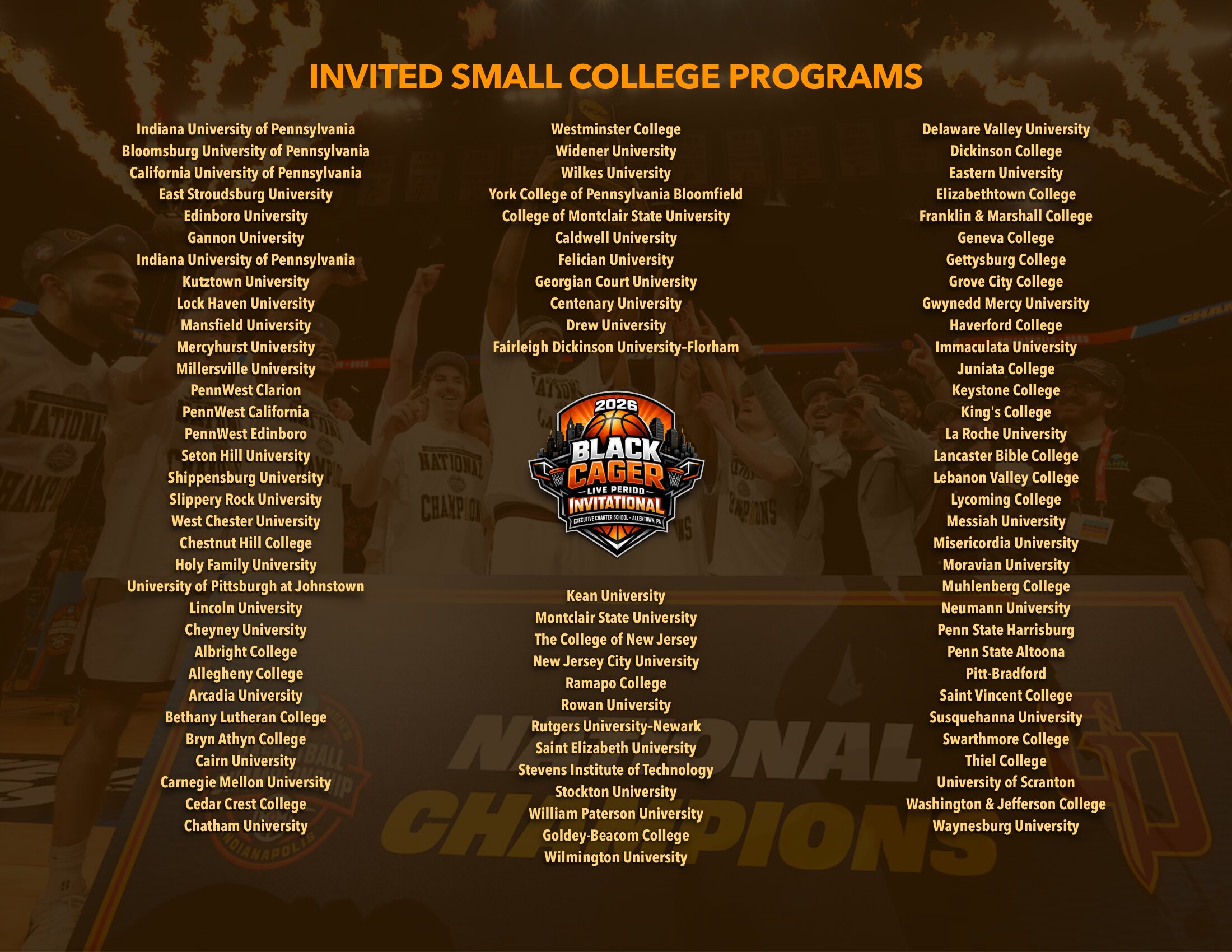
I’m writing to tell you that the recruiting landscape has shifted beneath everyone’s feet, and that shift is creating an unprecedented opportunity for programs like yours. I want to invite you to capitalize on it at the 2026 Black Cager Live Period Invitational.
The Portal Is Pushing Talent Downstream
The emergence of the NIL and Transfer Portal era hasn’t just changed Division I recruiting—it has turned it upside down. Division I staffs are now building their rosters primarily through the portal, reserving their high school recruiting efforts almost exclusively for the top 100-150 nationally ranked prospects. The talented high school senior who would have been a mid-major lock three years ago? He’s now a player the D-I staffs are passing over in favor of a 22-year-old transfer with college experience.
Here’s what that means for you: prospects who previously would have never been accessible to Division II, Division III, NAIA, or Junior College programs are now very much in play. The talent pool available to you has deepened considerably.
The 5-in-5 Model Will Accelerate This Trend
And it’s about to deepen further. The proposed “5 in 5” eligibility model will grant athletes five years of eligibility beginning after high school graduation or after turning 19, whichever comes first. With NIL compensation providing financial incentive to stay in school, older, physically mature players will absolutely use that extra year. They’ll occupy roster spots longer, clog the pipeline, and further shrink the number of D-I scholarships available to high school seniors.
The downstream effect on your programs will be significant—and positive. More quality high school prospects will be looking for homes. More families will need to be educated on the value of small-college basketball. Your opportunity to land difference-makers straight out of high school is growing in real time.
We’re Doing Something About It
Black Cager Sports, in partnership with Game Plan Intelligence Group, is inviting over 100 coaching staffs from Division II, Division III, NAIA, and Junior College programs to the 2026 Black Cager Live Period Invitational. This is not a showcase where you’ll be watching from the margins while the D-I staffs work the room. This event is built for you.
We are bringing together area prospects, their families, and high school coaching staffs who understand that the recruiting game has changed. These are players actively seeking opportunities at the levels you coach. These are families ready to have honest conversations about fit, playing time, development, and education—the conversations where your program shines.
We want to connect you directly with the prospects who can help you win games and graduate leaders. We want to help you identify the players who have been overlooked by a D-I system that is increasingly looking past high school talent.
We look forward to having you attend, evaluate, and build relationships with prospects who are ready to become the foundation of your next championship run.
Details on dates, venue, and registration will follow shortly. In the meantime, if you have any questions, please reach out directly.
The talent is there. The opportunity is now. Let’s go find your next program-changer together.
With respect and purpose,
Delgreco K. Wilson Founder, Black Cager Sports 856-366-0992
Jason Boggs Event Director, Black Cager Sports 484-522-2750
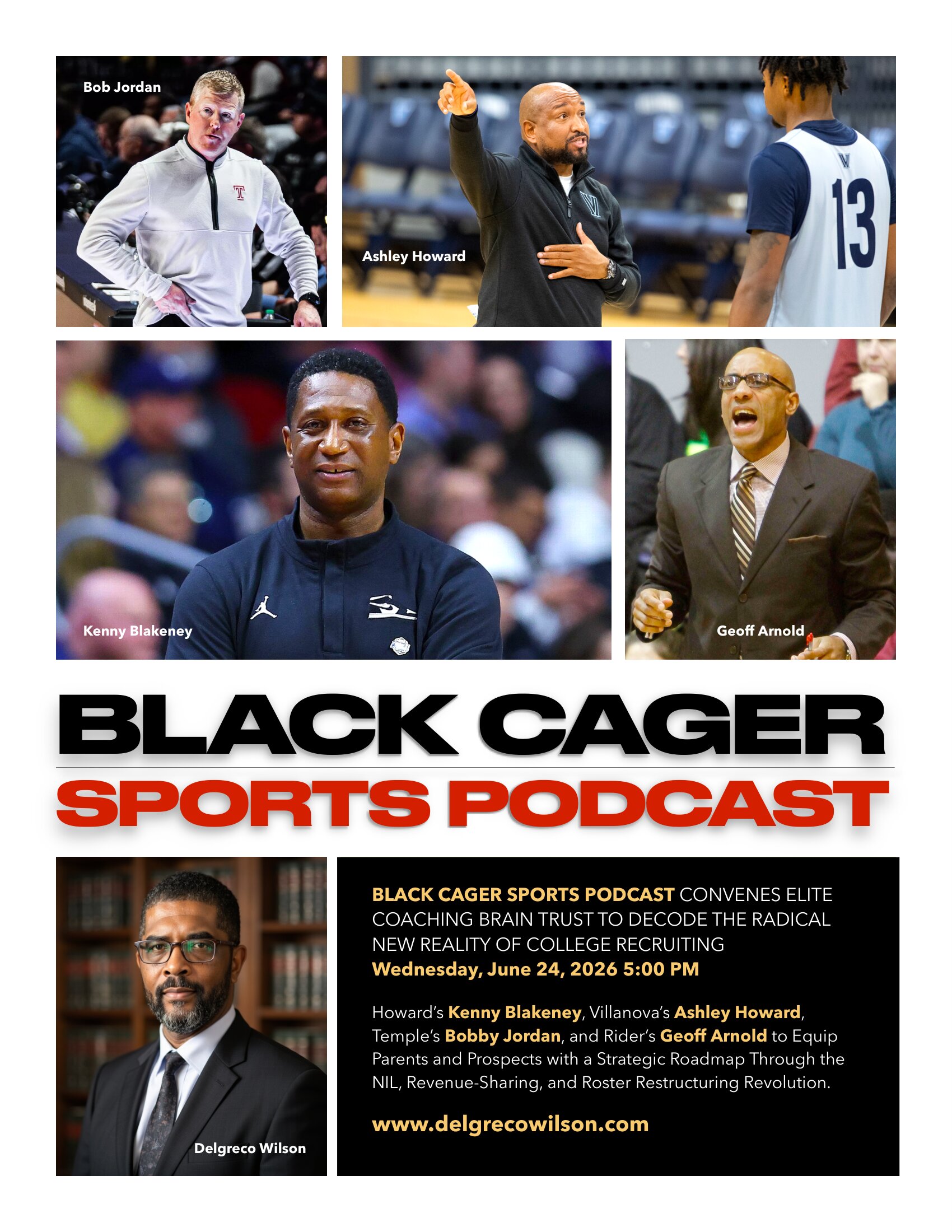
Howard’s Kenny Blakeney, Villanova’s Ashley Howard, Temple’s Bobby Jordan, and Rider’s Geoff Arnold to Equip Parents and Prospects with a Strategic Roadmap Through the NIL, Revenue-Sharing, and Roster Restructuring Revolution
PHILADELPHIA, PA – May 27, 2026 – The collegiate sports landscape has undergone a seismic, structural metamorphosis over the past decade, leaving even the most diligent parents and high school prospects disoriented. In a critical new episode, the Black Cager Sports Podcast is cutting through the noise to deliver an unflinching, insider’s guide to the new rules of engagement. The episode features a distinguished panel of Division I coaching royalty: Howard University Head Coach Kenny Blakeney, Villanova University Assistant Coach Ashley Howard, Temple University Assistant Coach Bobby Jordan, and Rider University Assistant Coach Geoff Arnold.
This is not a conversation about X’s and O’s. It is a masterclass in the political economy of modern college athletics, specifically designed to inform and empower high school athletes, parents, mentors, and advisors navigating a terrain defined by direct revenue-sharing, professional free agency tactics, and the extinction of the traditional walk-on.
“We are witnessing the death of amateurism in real-time, but with that comes a level of financial empowerment for our communities that we’ve never seen,” said Black Cager Sports Podcast host and founder Delgreco Wilson. “However, empowerment without information is chaos. We brought together four of the sharpest minds in the game—coaches who live in the living rooms, who sit at the negotiation tables, and who build rosters under these new mandates—to give our listeners a competitive advantage.”
The podcast unpacks the five structural pillars rewriting the recruiting rulebook, demanding a new level of sophistication from families:
The NIL Economy & Direct Revenue-Sharing: With landmark court rulings allowing schools to bypass collectives and make direct payments to athletes, recruitment has transformed into a pre-enrollment negotiation. The coaches detail how agents are securing complex, front-loaded financial packages months before a letter of intent is signed, treating high school commitment windows like professional free-agency periods. They will also decode the new 2026 NCAA rules allowing prospects to retain professional agents and accept prize money while still in high school without sacrificing eligibility.
Roster Architecture & The Death of Walk-Ons: The NCAA’s elimination of scholarship caps in favor of strict “hard roster caps” has turned roster construction on its head. While programs can now theoretically pay every athlete, the squeeze on spots has become brutal. The panel will discuss how bubble players and traditional walk-ons are being pushed out, making every roster decision a high-stakes financial calculation.
The Transfer Portal’s Infinite Loop: With unlimited immediate eligibility for transfers, the coaching relationship has fundamentally changed. The coaches will explain the brutal truth about how the portal now competes directly with high school recruiting, offering a pool of immediately eligible, proven collegiate talent that drastically shortens the timeline and narrows the window for prep prospects.
The 2026 “5-for-5” Eligibility Clock: The new age-based model—granting athletes a continuous five-year window to play five seasons beginning the academic year after they turn 19 or graduate high school—has eliminated strategic redshirting and delayed enrollment. The panel emphasizes why this “automatic clock” compels college staffs to bet heavily on prospects ready to contribute immediately.
Modernized Rules of Engagement: With the National Letter of Intent (NLI) abolished and commitment streamlined into financial aid agreements, and new rules delaying contact windows to junior year, the map for how to be seen and when to commit has changed entirely. The coaches will break down the new etiquette regarding unlimited official visits and the ban on early verbal offers during camps.
In an era where misinformation can cost a family a life-changing scholarship or a six-figure revenue-sharing agreement, this episode of the Black Cager Sports Podcast serves as the essential playbook. The four coaches provide not only a diagnosis of the chaos but a clear-eyed strategy for survival and success in the high-stakes world of modern college basketball. The episode drops June 24, 2026 on major podcast platforms, including Spotify, YouTube and Black Cager TV.
About Black Cager Sports Podcast: The Black Cager Sports Podcast is the premier destination for unfiltered, intelligent dialogue on the intersection of grassroots basketball, college athletics, and the culture that drives them. Hosted by Delgreco Wilson, the platform provides a vital voice for families striving to navigate the business of amateur sports.
###
MEDIA INQUIRIES:
Delgreco K. Wilson, M.A. , Managing Director, Black Cager Sports Media
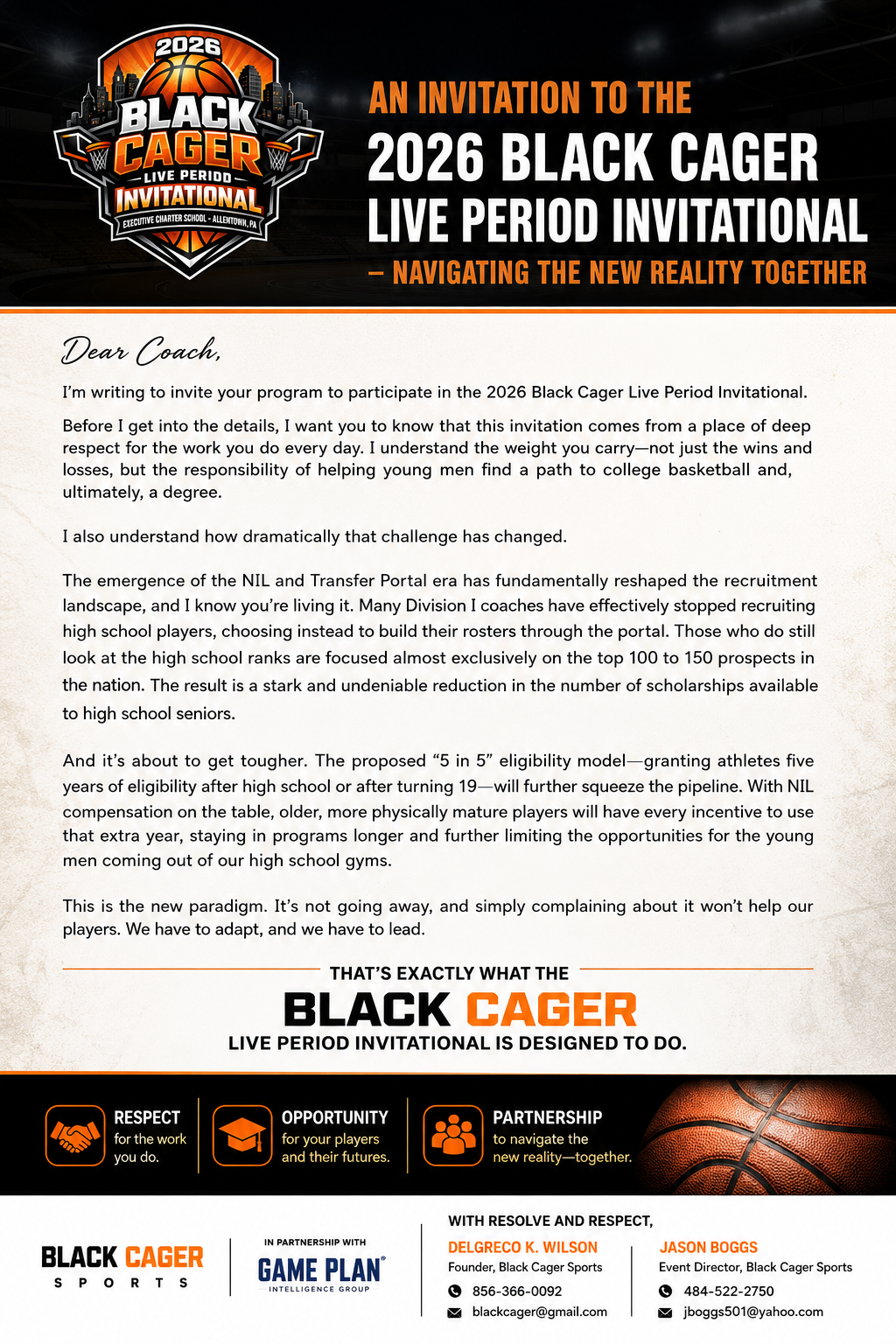
I’m writing to invite your program to participate in the 2026 Black Cager Live Period Invitational. Before I get into the details, I want you to know that this invitation comes from a place of deep respect for the work you do every day. I understand the weight you carry—not just the wins and losses, but the responsibility of helping young men find a path to college basketball and, ultimately, a degree.
I also understand how dramatically that challenge has changed.
The emergence of the NIL and Transfer Portal era has fundamentally reshaped the recruitment landscape, and I know you’re living it. Many Division I coaches have effectively stopped recruiting high school players, choosing instead to build their rosters through the portal. Those who do still look at the high school ranks are focused almost exclusively on the top 100 to 150 prospects in the nation. The result is a stark and undeniable reduction in the number of scholarships available to high school seniors.
And it’s about to get tougher. The proposed “5 in 5” eligibility model—granting athletes five years of eligibility after high school or after turning 19—will further squeeze the pipeline. With NIL compensation on the table, older, more physically mature players will have every incentive to use that extra year, staying in programs longer and further limiting the opportunities for the young men coming out of our high school gyms.
This is the new paradigm. It’s not going away, and simply complaining about it won’t help our players. We have to adapt, and we have to lead.
That’s exactly what the Black Cager Live Period Invitational is designed to do.
Black Cager Sports, in partnership with Game Plan Intelligence Group, is taking a deliberate and strategic approach to the new reality. We are not waiting for the old system to return. Instead, we are proactively inviting over 100 coaching staffs from Division II, Division III, NAIA, and Junior College programs to come directly to our event. These are the programs that still recruit and value high school players. These are the staffs actively looking to fill rosters with developing talent. And we are going to connect them directly with you, your players, and their families.
We want to help you help your kids. We want to take the lead in helping young players and their families navigate this unfamiliar terrain, opening their eyes to the outstanding opportunities that exist across all levels of college basketball. A scholarship isn’t defined by the division; it’s defined by the fit, the education, and the chance to keep playing the game you love. We look forward to having you play with us. Let’s work together to make sure the players in your program aren’t left behind in this new era. Let’s identify those opportunities, make the connections, and show our young men that the dream of playing college basketball is still very much alive—the path just looks a little different now.
We will follow up shortly with schedule/opponent information. In the meantime, if you have any questions, please don’t hesitate to reach out.
Thank you for the work you do. Let’s get to work together.
With resolve and respect,
Delgreco K. Wilson Founder, Black Cager Sports 856-366-0992
Jason Boggs Event Director, Black Cager Sports 484-522-2750
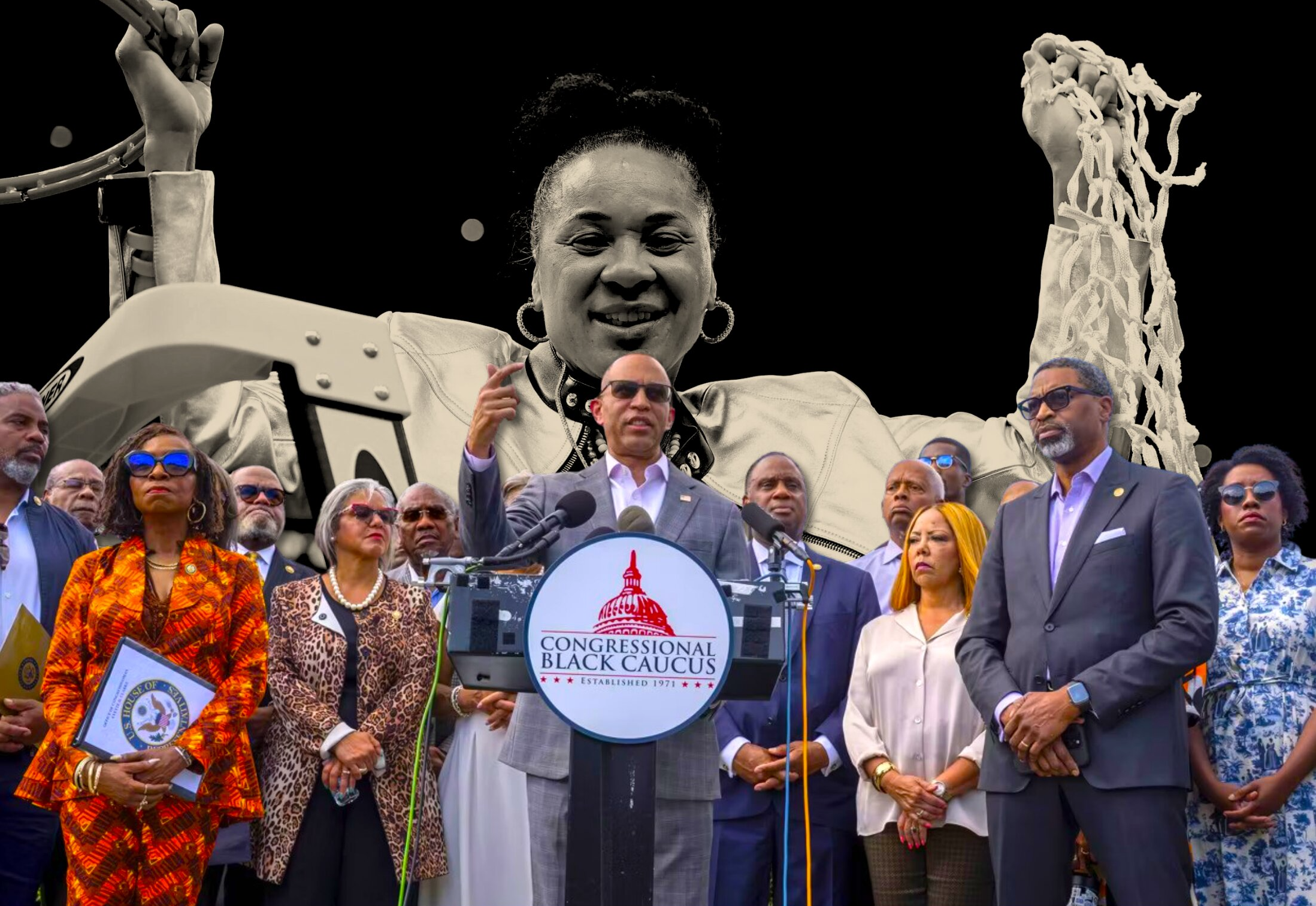
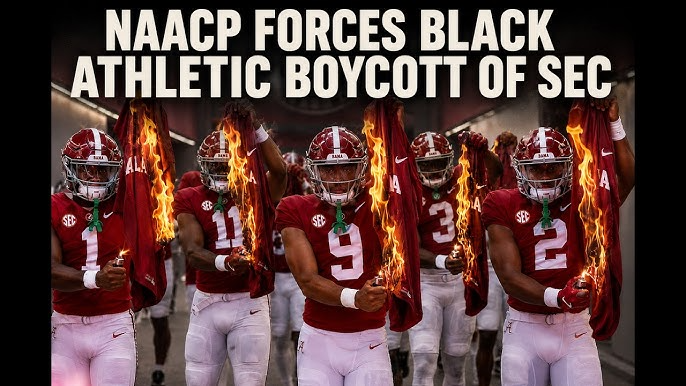
The NAACP Has Issued a Call for Black Athletes to Boycott the SEC. Asking a Young Prospect to Turn Down Dawn Staley Feels Insane. That Is the Measure of the Crisis.
PHILADELPHIA, PA – The NAACP, the nation’s oldest and most venerated civil rights organization, has now made it official. On Tuesday, it launched the “Out of Bounds” campaign, a direct and unambiguous call for Black athletes, their families, alumni, and fans to “withhold athletic and financial support” from major public universities in states that “have moved to limit, weaken or erase Black voting representation.” The target is clear: the powerhouse athletic programs of the Southeastern Conference(SEC) and their counterparts across the former Confederacy. The logic is searing. If the white political structures of these states have declared war on the franchise that Black Americans bled and died to secure, then the Black labor and Black fandom that sustain those states’ most cherished cultural and economic institutions must be redeployed as a weapon of collective self-defense. This is not a request for a symbolic gesture. It is a call to economic warfare, and it demands a sacrifice so profound that to state it plainly is to feel its weight in the pit of your stomach.
That sacrifice is measured most acutely not in dollars forfeited or championships deferred, but in a single, almost unthinkable question that will now confront Black families around dinner tables from Philadelphia to Houston: Should a gifted young Black woman pass on the opportunity to play for Dawn Staley?
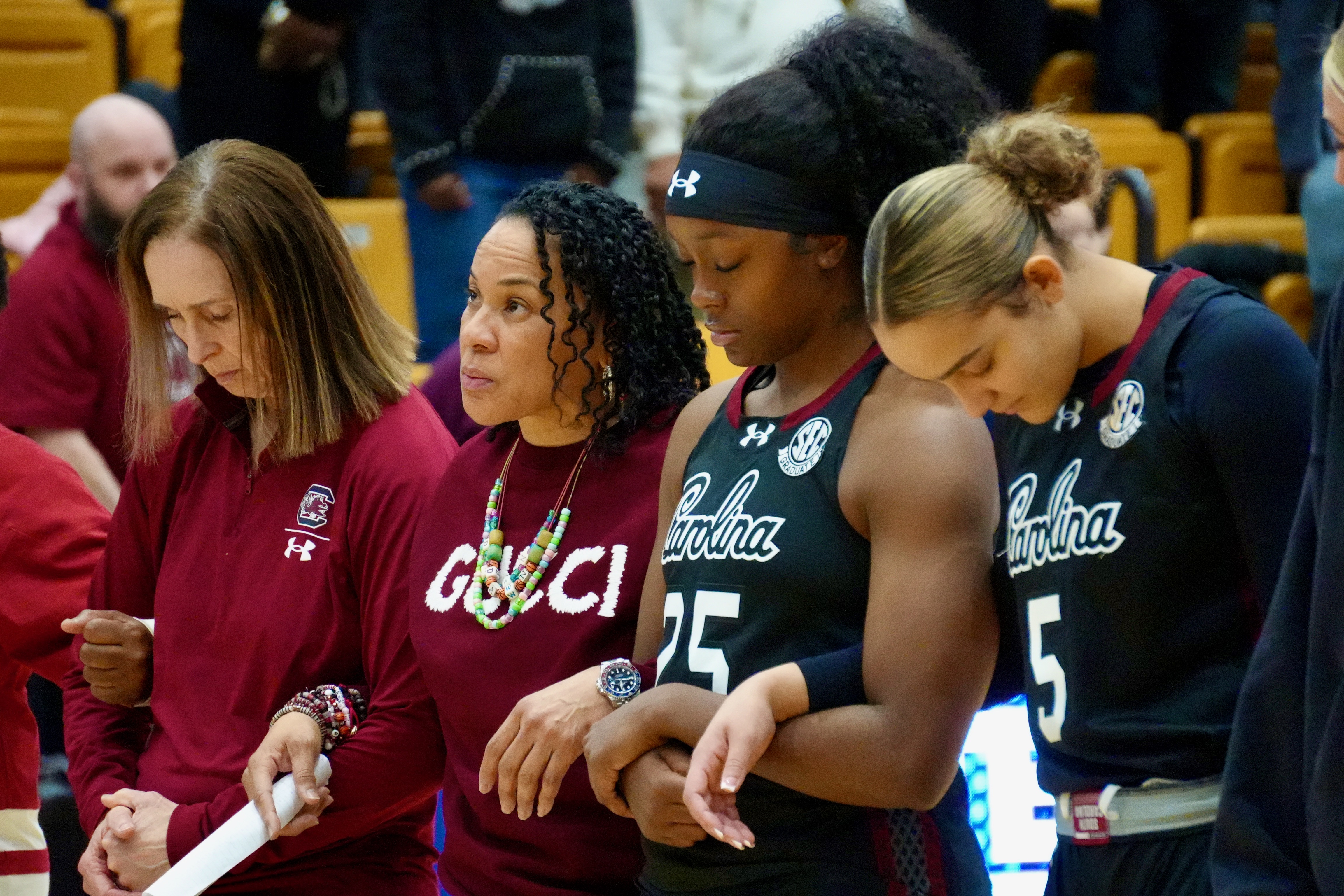
To ask the question is to stand at the edge of a moral chasm. Dawn Staley is not merely a basketball coach. She is the living embodiment of a lineage that has produced the most towering figures in Black athletic leadership. She emerged from the Raymond Rosen Housing Projects in North Philadelphia, navigated every obstacle a society could place in her path, and ascended to the absolute pinnacle of her sport. At the University of South Carolina, she has built a dynasty with a dignity, grace, and unapologetic Black pride that was previously unimaginable. She has filled the enormous shoes of John Thompson, the Georgetown patriarch who showed that a Black coach could win with an all-Black starting five while demanding his players graduate. She carries the torch of John Chaney, the Temple legend who spoke truth to power in a gravelly baritone that made white administrators tremble. She extends the legacy of Nolan Richardson, who brought his “40 Minutes of Hell” to Arkansas and dared to say publicly that the SEC operated on a plantation model. In the 2025-26 season, Staley was one of five Black women head coaches in the SEC, a sisterhood that includes Yolett McPhee-McCuin at Ole Miss, Nikki Jones at Kentucky, Joni Taylor at Texas A&M, and the newly appointed Pauline Love at Alabama. These women are not tokens. They are the very best the Black community has produced—shining stars, guiding lights, proof that excellence and integrity can penetrate even the most historically hostile institutions.
To ask a young Black woman to forgo the chance to be molded by Dawn Staley is, on its face, an insane request. It is tantamount to asking a young Patrick Ewing to pass on John Thompson. It is asking Marc Macon to turn his back on John Chaney. It is asking a family to reject not just a coach but a cultural mother, a role model whose very existence is a rebuke to the white supremacy that still suffocates so many corners of American life. The NAACP, prominent Black activists, and the architects of “Out of Bounds” are standing before the Black community and saying, in effect: Target the best we have ever produced. Boycott Staley’s Gamecocks. Withdraw from the institutions where our own heroes have finally fought their way into positions of influence. This is the moral complexity that must not be sanitized or evaded. It is agonizing. It is dizzying. And it is the precise measure of the emergency we now face.
The Severity of the Threat: Why Callais Changes Everything
We must understand why the calculus has shifted so dramatically that such a request is no longer unthinkable but necessary. The Supreme Court’s decision in Louisiana v. Callais is not a legal disagreement among reasonable minds. It is a deliberate, result-oriented act of judicial nullification, a 6-3 power play that disembowels Section 2 of the Voting Rights Act with a precision that must be called what it is: a betrayal of the Constitution, of Congress, and of the multiracial democracy this nation has always promised but never fully delivered. For sixty years, the VRA stood as the federal government’s most consequential acknowledgment that the franchise is not a gift from white power structures but a right that must be actively protected from them.
The Callais ruling declares, with the calm violence of legalese, that this era is over. In Louisiana, a map that finally gave Black voters a fair shot to elect a candidate of their choice has been discarded. Across the former Confederacy, legislative chambers are reading the signal clearly: the judiciary will no longer impede your efforts to make Black votes count less. The guardrail has been removed. The road to minority rule is paved and open.
This is the context that transforms a seemingly irrational ask into a rational, painful, and necessary strategy. When the courts have abdicated, when the legislature is gerrymandered into unaccountability, and when the ballot box itself is the very mechanism being rigged, the only remaining leverage lies in the economic and cultural spheres. The SEC is not merely a sports conference; it is the central nervous system of the white conservative political project in the South. Saturday afternoons in the fall and winter are not just games; they are rituals of regional identity, unmatched engines of fundraising, and the most powerful branding apparatus the states of the old Confederacy possess. A sustained boycott by a critical mass of Black athletes would hit this machinery precisely where it hurts: the balance sheet and the collective psyche. It would force university presidents, athletic directors, and corporate sponsors to make a choice between their profits and the political regimes that enable them. The goal is not to punish Dawn Staley; it is to make the state of South Carolina feel the cost of disenfranchising its Black citizens so acutely that the political calculus is forced to change.
The Impossible Choice: Weighing the Individual Against the Collective
Let us sit with the discomfort, for it is the heart of the matter. A Black mother in Atlanta has a daughter who is a generational point guard. She has been offered a full scholarship to play for Dawn Staley at South Carolina. To accept is to place her child under the wing of a woman who will not only develop her into a WNBA prospect but will teach her how to navigate a hostile world with her head held high. Staley’s program graduates players, builds character, and serves as a model of Black feminine power in a society that routinely denigrates both Blackness and womanhood. To turn down that offer is to potentially alter the trajectory of a young life in ways that cannot be calculated.
Yet that same mother must also reckon with the fact that her daughter’s presence in a Gamecocks uniform will be used by the state of South Carolina to project an image of racial harmony and opportunity that is a lie. Her daughter’s image, her excellence, her joy on the court will be monetized and deployed as propaganda for a regime that is actively working to ensure that Black grandmothers in Charleston and Columbia cannot elect representatives who care about their hospitals, their schools, or their air. The scholarship her daughter receives is funded, in part, by a state budget crafted by legislators elected from districts drawn to dilute Black voting strength. The arena she plays in was built with bonds backed by a taxpayer base that includes Black citizens who have been systematically robbed of their political voice. The NIL money that may come her way flows from booster collectives populated by white businessmen who write checks to voter suppression politicians on Monday and pose for pictures with her daughter on Saturday.
This is the impossible math that “Out of Bounds” forces Black families to calculate. It is the same brutal arithmetic that faced the parents who pulled their children out of segregated schools to march in Birmingham, who watched their livelihoods destroyed so that a generation might know freedom. The individual cost is real, intimate, and potentially devastating. The collective benefit is abstract, distant, and uncertain. And yet, every major advance in Black freedom in this country has been purchased by people who chose the abstract over the intimate, the collective over the individual, the long game over the short fix. The question is whether this generation, at this juncture, is prepared to make a similar accounting.
The Necessity: Why a Boycott Is the Only Language Power Understands
We must dispense with the fantasy that this legal assault can be countered through the ordinary channels it has just demolished. The Court has foreclosed legislative remedy by ignoring Congress’s intent. It has rendered future litigation a costly funeral procession for dead claims. The political leaders who gerrymander, disenfranchise, and suppress do not fear editorials or trending hashtags. They fear one thing: a disruption to the flows of money, prestige, and emotional allegiance that sustain their power. When a four-star recruit from Atlanta chooses the University of Georgia, she is not just selecting a coach; she is injecting her talent, her likeness, and her family’s story into a narrative that bolsters the state’s economy and its political legitimacy. A sustained boycott, even by a disciplined minority of elite prospects, would force a reckoning. It would make the crisis their crisis. That is the definition of leverage, and it is the only currency that buys real change when voting booths have become facades.
The Possibility: Restructuring the Incentives of the Modern Athlete
The objection is immediate: the athletes will never do it. The modern economics of college sports, with Name, Image and Likeness deals and the frictionless transfer portal, has created a generation of rational individualists. This critique correctly identifies the collective action problem—the prisoner’s dilemma where the individual’s best short-term move is to defect from any group sacrifice—but it misunderstands that this dilemma is an engineering problem, and it can be solved.
First, the financial terror that blocks action must be neutralized through a Freedom Fund, capitalized by wealthy Black entertainers, progressive philanthropists, and the broad coalition that fuels movements like the Equal Justice Initiative. This fund guarantees the NIL income of any participating athlete. If a booster collective yanks a sponsorship in retaliation, the fund covers the loss, dollar for dollar. The prisoner’s dilemma collapses when the cost of cooperation is zero. This is not a fantasy; it is the logic of every strike fund in American labor history.
Second, the movement must manufacture selective incentives. A campaign celebrating “Freedom Riders 2.0” can make participation a career-defining marker of legacy and historical greatness. The free-rider who stays on the field becomes an object of quiet contempt. The blue-chip recruit who turns down an SEC offer for a program in a democracy-respecting state must be publicly honored and financially celebrated. For young adults attuned to public perception, these social costs and rewards can be as powerful as money.
Third, the strategy must exploit the power of small, high-trust groups. A call for every Black athlete in the SEC to walk out is a logistical mirage. A surgical intervention is far more plausible. The 2015 Missouri football strike that toppled a university president involved roughly 30 players. It required a cohesive, committed minority willing to occupy a facility and refuse to play. A similar action at a single flagship program, coordinated in the tight, accountable space of a locker room, would be an earthquake no media rights deal could insure against.
The Likelihood of Success: Why This Moment Is Ripe
Skeptics will mutter that this is improbable. But history instructs us. Successful boycotts—from Montgomery to the United Farm Workers’ grape strike—are forged by a catalytic moment, a sense of existential threat, and a disciplined core. Callais provides the existential shock. This generation of athletes is not apathetic; it is institutionally anxious, perfectly aware of its commodification, and digitally equipped to control its own narrative.
Moreover, the target is uniquely brittle. The SEC’s business model is a Jenga tower of media contracts, gambling partnerships, corporate sponsorships, and donor ego. It would take remarkably few strategic defections to introduce a crisis of confidence among the corporate partners who underwrite the spectacle. An insurance company does not want its logo on a screen where a star athlete explains why she is sitting out in defense of democracy. A soft drink conglomerate does not want its halftime show transformed into a teach-in on voter suppression. The leverage is structural, and it has never been priced into the asset because the asset has never flexed its full strength.
The Crossroads
Even with all of this, the moral agony of the choice remains. To ask a young Black woman to turn down Dawn Staley is to ask her to sacrifice a dream that is good and beautiful and earned. It is to ask her to walk away from a Black woman who fought through every barrier to stand where she stands, who represents the very excellence and self-determination the Voting Rights Act was meant to protect. It feels like a betrayal of Staley herself, a punishment of the very leader we should be celebrating.
And yet, Staley’s own journey—from the projects of North Philadelphia to the pinnacle of her profession—was made possible by a generation that made sacrifices precisely like the one now being asked. John Thompson did not get to build his Georgetown program in a vacuum of individual ambition. He built it on the shoulders of a movement that boycotted, that marched, that risked. The Voting Rights Act that Callais has now gutted was not handed down by benevolent white lawmakers. It was extracted by collective action so costly that it left blood on the Edmund Pettus Bridge.
The athletes of the SEC stand at a generational crossroads. On one path, they accept the deal on offer: individual wealth and achievement that makes them comfortable exceptions to a rule of communal political subjugation. It is a gilded silence, purchasing a fleeting scholarship and a first-round draft pick with the currency of a people’s disenfranchised future. On the other path lies something far more audacious and far more durable. It is the recognition that the power they hold is not a gift from the system but a muscle the system cannot function without.
The NAACP’s call is not an act of disrespect toward Dawn Staley, nor toward the four other Black women leading SEC programs with distinction. It is, in its most profound sense, an acknowledgment that their very presence has not been enough to change the political calculus of the states that employ them. Their excellence has been absorbed, celebrated, and ultimately neutralized by a machinery that is happy to crown Black queens on the court while stripping Black citizens of their crowns at the ballot box. The boycott is a demand that the contradiction be faced, that the celebration and the subjugation cannot coexist indefinitely.
A targeted, funded, and courageously executed boycott is not a withdrawal from the game. It is the ultimate assertion of ownership over the game—and over the democracy it has been used to undermine. The blueprint is there. The need is absolute. All that remains is the will to recognize that the true cost of a championship is now measured in the integrity of a vote, and the time to call that debt is now. The choice is heartbreaking. But the greatest heartbreak of all would be to discover, a generation from now, that the moral authority to act was squandered in exchange for a trophy that has long since gathered dust.
The Black Cager Invitational — June 20, 2026 — Executive Fieldhouse, Allentown, PA
Coach,
Let’s cut through the noise.
On June 20, 2026, the inaugural Black Cager Invitational will transform the state-of-the-art Executive Fieldhouse into the most efficient, recruit-rich environment small college basketball has ever seen. This is not a high-major sideshow. This is your gym. Your evaluations. Your prospects.
We are issuing a direct invitation to every Division II, Division III, NAIA, and JUCO head coach, assistant coach, and program recruiter within driving distance of Allentown, Pennsylvania. This is the Live Period event where you are the main attraction.
NO D1 COACHES. NO DISTRACTIONS. NO PORTAL DRAMA. The high-major world has made its pivot abundantly clear. Rick Pitino said it. Others have followed. Division I coaching staffs are funneling their resources into the transfer portal, leaving an extraordinary collection of talented, coachable, academically qualified high school seniors and post-graduates overlooked and under-recruited. That reality is your program’s competitive advantage — but only if you can find those players.
The Black Cager Invitational is the only Live Period event that exclusively prohibits Division I attendance. We didn’t water down the invitation list. We eliminated the gatekeepers. When you walk into the Executive Fieldhouse, every prospect in the building is there because they want to be evaluated by you. Every conversation, every handshake, every follow-up phone number exchanged belongs to the small college ecosystem.
WHAT YOU WILL FIND IN ALLENTOWN:
A Curated Talent Pool: The Mid-Atlantic region’s most promising unsigned seniors and qualified post-graduates. City guards who can create their own shot. Long, athletic wings who defend multiple positions. Skilled bigs who run the floor. These are players who can contribute to a winning rotation as freshmen — not projects, not reaches, but immediate-impact small college athletes.
Academic Fit: We prioritize prospects positioned to succeed at institutions that emphasize the student in student-athlete. You will meet recruits with the transcripts, test scores, and character profiles that match your admissions standards.
Unfettered Access: The Executive Fieldhouse features multiple competition courts, designated viewing areas, and on-site meeting space. Coaches will receive a digital team packet upon registration, including verified measurables, academic summaries, and game schedules. You arrive prepared to evaluate, not to wander.
THE ECONOMICS OF THE MOMENT BELONG TO YOU. While Division I programs gamble millions on one-year rentals through the portal, your program can secure a four-year cornerstone — a player who grows in your system, graduates from your institution, and builds your culture. Those players are here. They need a coach willing to look them in the eye and believe in them. That coach is you.
EVENT DETAILS & REGISTRATION:
Date: Saturday, June 20, 2026
Location: Executive Fieldhouse — Allentown, PA (centrally located at the intersection of the PA/NJ/DE recruiting triangle)
Eligibility: Invitation extended exclusively to accredited Division II, Division III, NAIA, and Junior College coaching staffs. Institutional identification and coaching credentials required at check-in.
Cost to Coaches: $20.00 – Complimentary team packet and hospitality suite access.
Registration Deadline: June 6, 2026 (space is limited to maintain a premium evaluation environment)
Secure your staff’s credentials today by contacting Delgreco Wilson at blackcager@gmail.com or 856-366-0992.
The Black Cager Invitational was built on a simple belief: small college basketball is not a fallback plan. It is the destination for serious coaches who develop serious men. On June 20, the spotlight belongs to you.
Come find your next program pillar.
Sincerely,
Delgreco Wilson
Founder, Black Cager Invitational blackcager@gmail.com 856-366-0992
Elite New Jersey Academy Relaunches Under Founder Ian Turnbull to Address “Confusing” NCAA Landscape and Transfer Portal Disruption
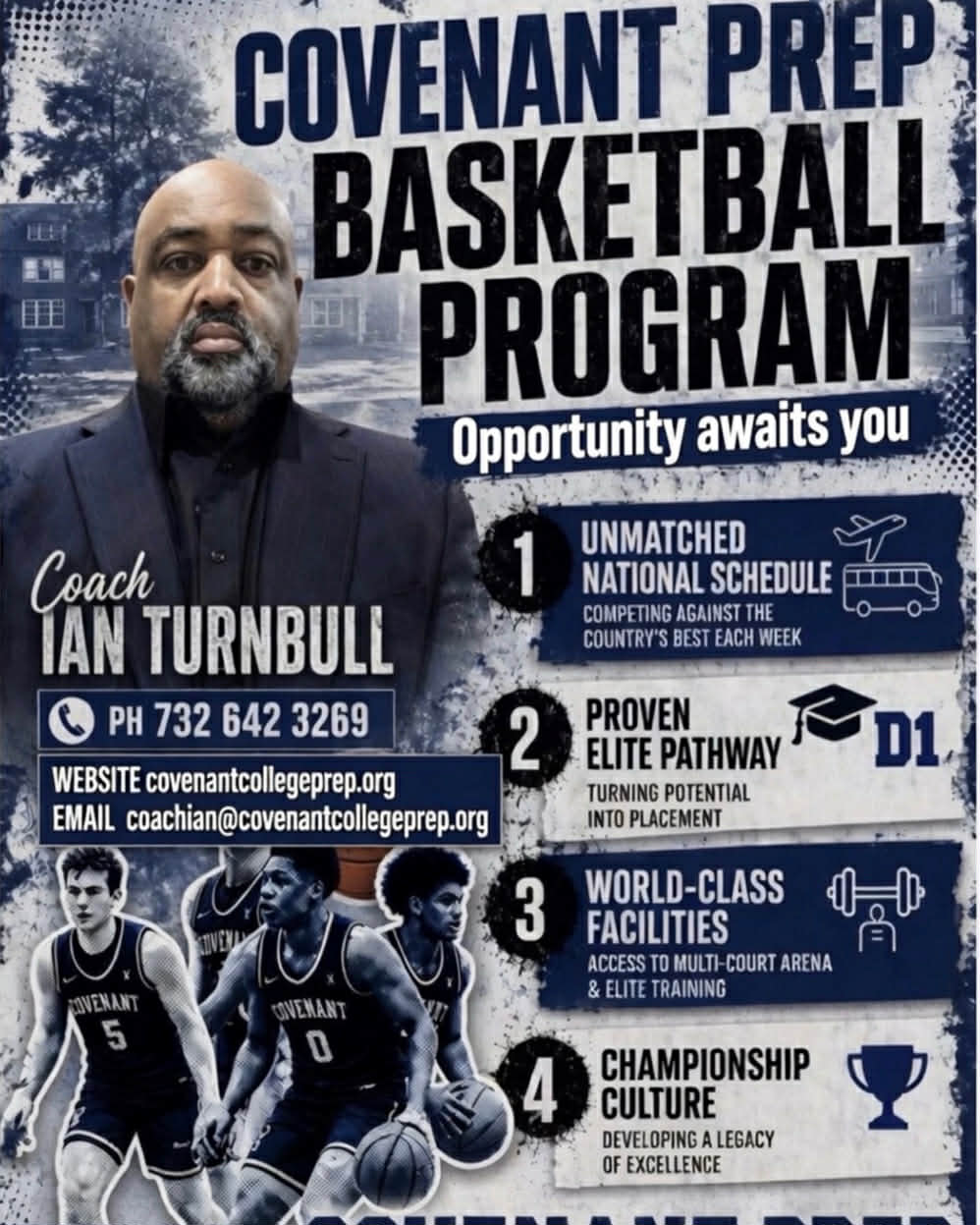
BELMAR, NJ – April 27, 2026 – Covenant College Prep, one of the nation’s most proven pipelines for collegiate basketball talent, today announced the official return of its basketball program following a one-year hiatus. The program, founded and led by Executive Director Ian Turnbull, will resume operations immediately, offering high school and postgraduate student-athletes a structured, high-performance pathway to NCAA Division I, Division II, NAIA, and JUCO competition.
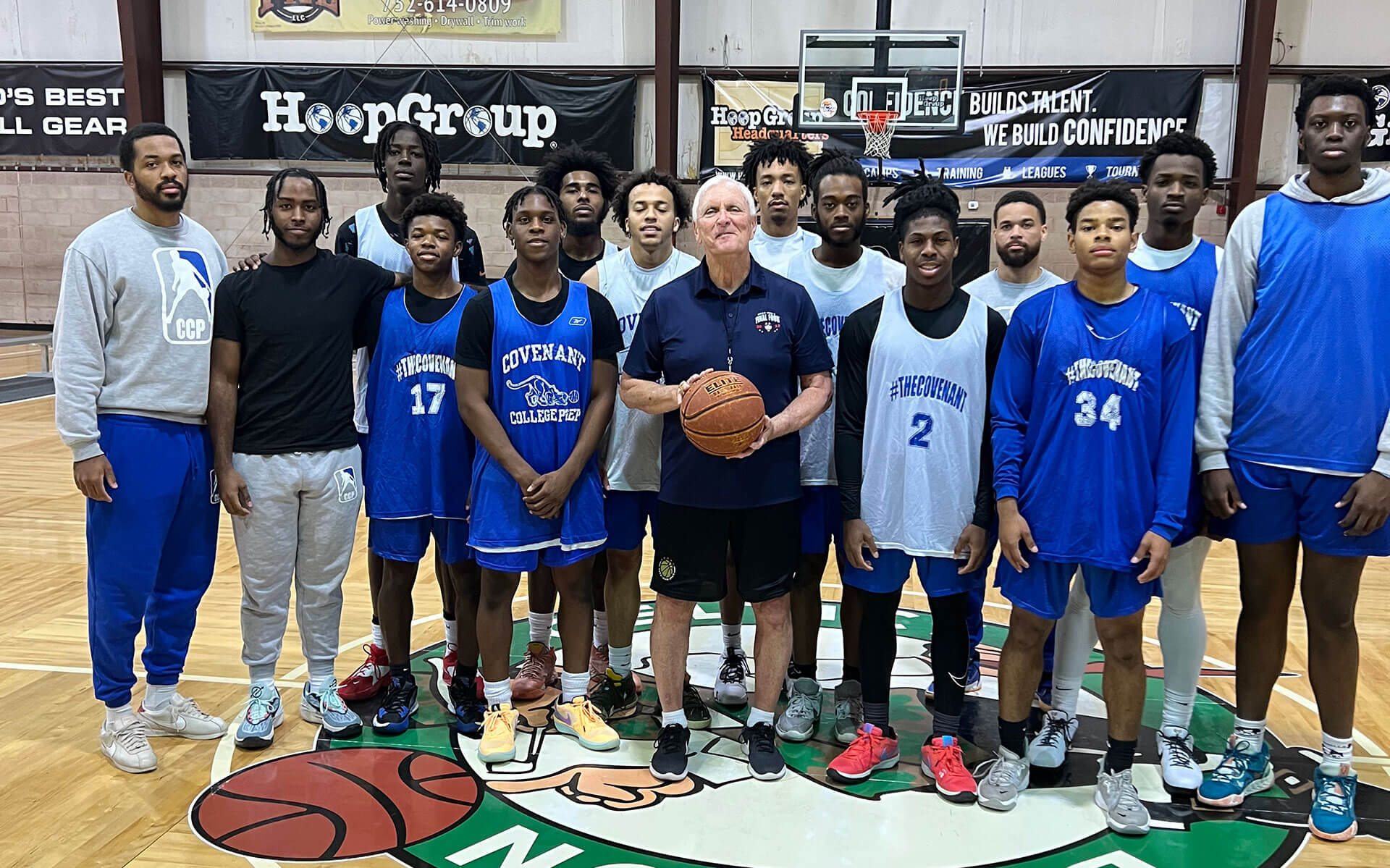
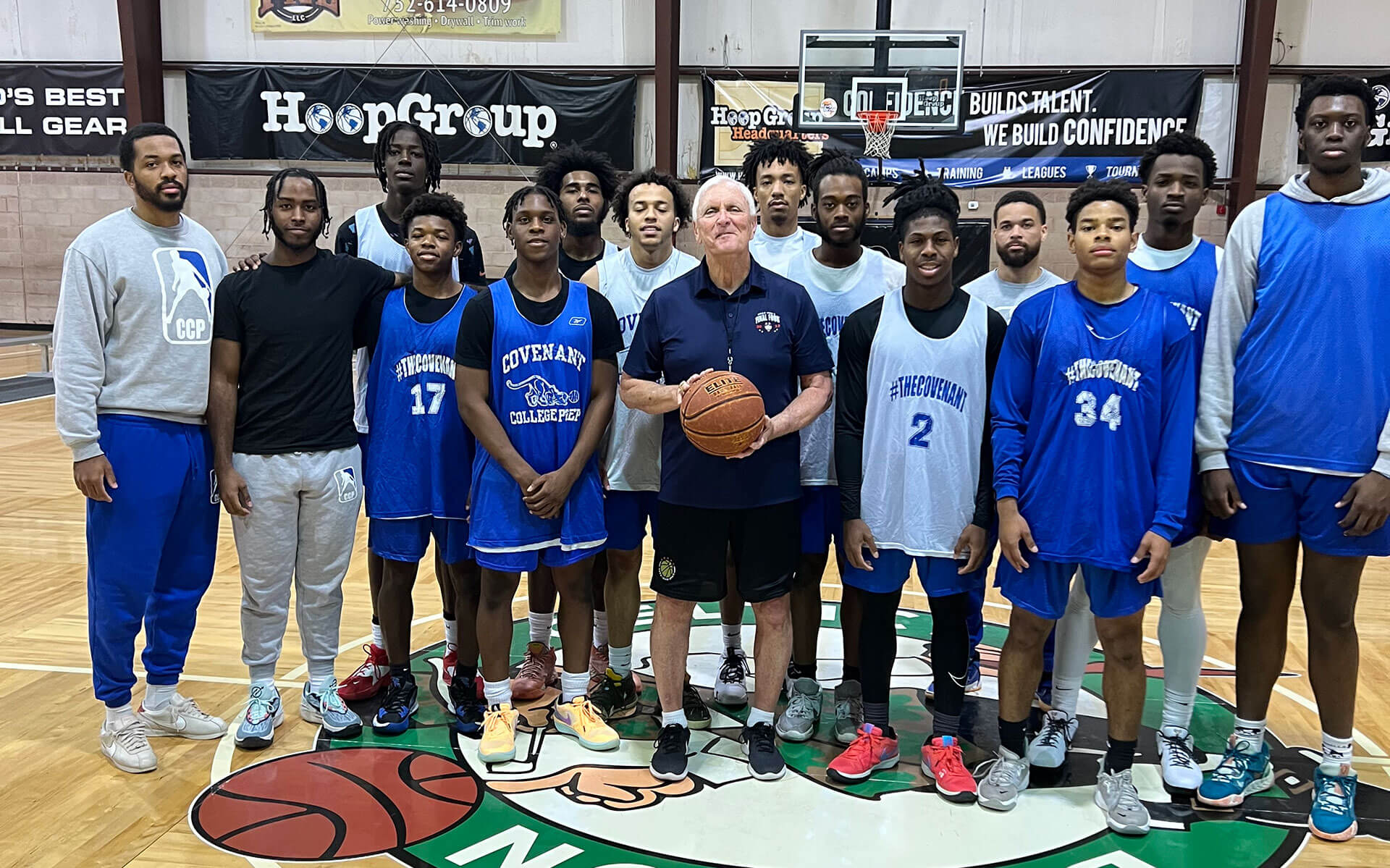
Naismith Hall of Fame Coach, Bob Hurley with Covenant College Prep players
Since its inception, Covenant has produced scores of players who have gone on to play at high major and mid-major Division I programs, in addition to over 100 scholarship athletes at the Division II, NAIA, and JUCO levels. Notable alumni include Nick Jourdain (Memphis University), Shavar Reynolds (Seton Hall University), and A.J. West (University of Nevada).
Turnbull cited the rapidly shifting NCAA regulatory environment as a primary catalyst for the program’s revival.
“The rapidly changing NCAA regulatory environment is confusing and frequently overwhelming for many talented players and their families,” said Turnbull. “With college coaches like Rick Pitino explicitly declaring that they are not recruiting high school players, and thousands of experienced athletes available in the transfer portal, the recruitment process has been transformed. We take a lot of pride in offering counsel and guidance to our players, as well as an opportunity to improve and compete against top-level competition.”
Covenant College Prep is modeled after the prestigious New England Preparatory School Athletic Council (NEPSAC) and operates on five core principles: Appropriate Behavior, Fair Play, Good Sportsmanship, Excellence, and Competition. The program’s “Commitment to Excellence” philosophy emphasizes continuous improvement and innovation, propelling athletes toward high performance in academics, social development, and athletics.
On-Court Identity & Development
Defense-First System: Stifling team defense built on individual accountability, designed to generate offense from defensive pressure.
Attack-Mode Offense: Fast-paced, matchup-exploiting schemes with innovative sets to outwit opponents.
College-Level Training: Daily team practices, “Skills Only” workouts, and position-specific instruction.
Strength & Conditioning: Measurable on-court performance improvements through elite S&C programming. Program Advantages for Student-Athletes
NCAA-approved classes (Full 48H credit structure)
Opportunity to earn college credits
National schedule with significant exposure opportunities
Housing & Meals
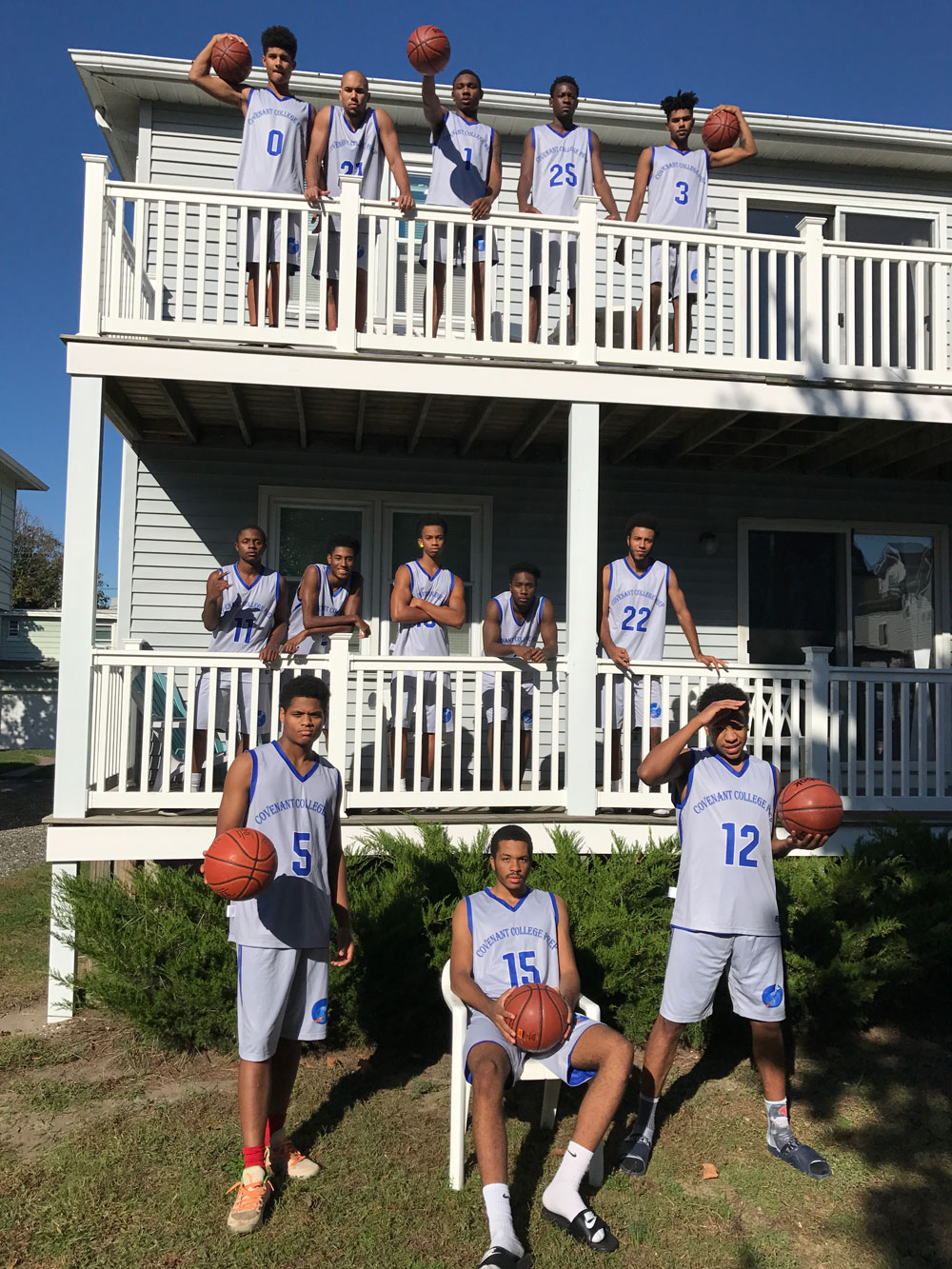
Student-athletes will reside in two dedicated team houses located two blocks from the ocean in scenic Belmar, New Jersey:
House 1: 8 bedrooms, 3 bathrooms, 3,500 sq. ft. House 2: 5 bedrooms, 2 bathrooms, 3,000 sq. ft. The two houses are situated two blocks apart.
Breakfast, lunch, and dinner will be provided daily at the team house by Covenant College Prep.
Enrollment & Contact
Interested players and parents are invited to contact Ian Turnbull directly for tryout and enrollment information.
Ian Turnbull, Executive Director
Phone: 732-642-3269
Covenant College Prep is a premier basketball academy committed to preparing young men for the challenges of collegiate athletics through superior instruction, competition, and character development.









 The Black Cager