The five-for-five model is here. For student-athletes, parents, and coaches, the old rulebook is gone. Here is what you need to know about the new landscape—and how to survive it.
The End of the Redshirt as We Know It
For decades, the rhythm of college athletics was dictated by a simple, if often baffling, formula: five years to play four. It was a system rife with nuance, loopholes, and the occasional waiver wizardry that allowed star players to extend their collegiate careers into their mid-twenties. That era, for better or worse, is officially coming to an end. In a landmark move, the Division I Cabinet has unanimously approved a sweeping overhaul, ushering in an age-based eligibility model that fundamentally rewrites the rules of the game .
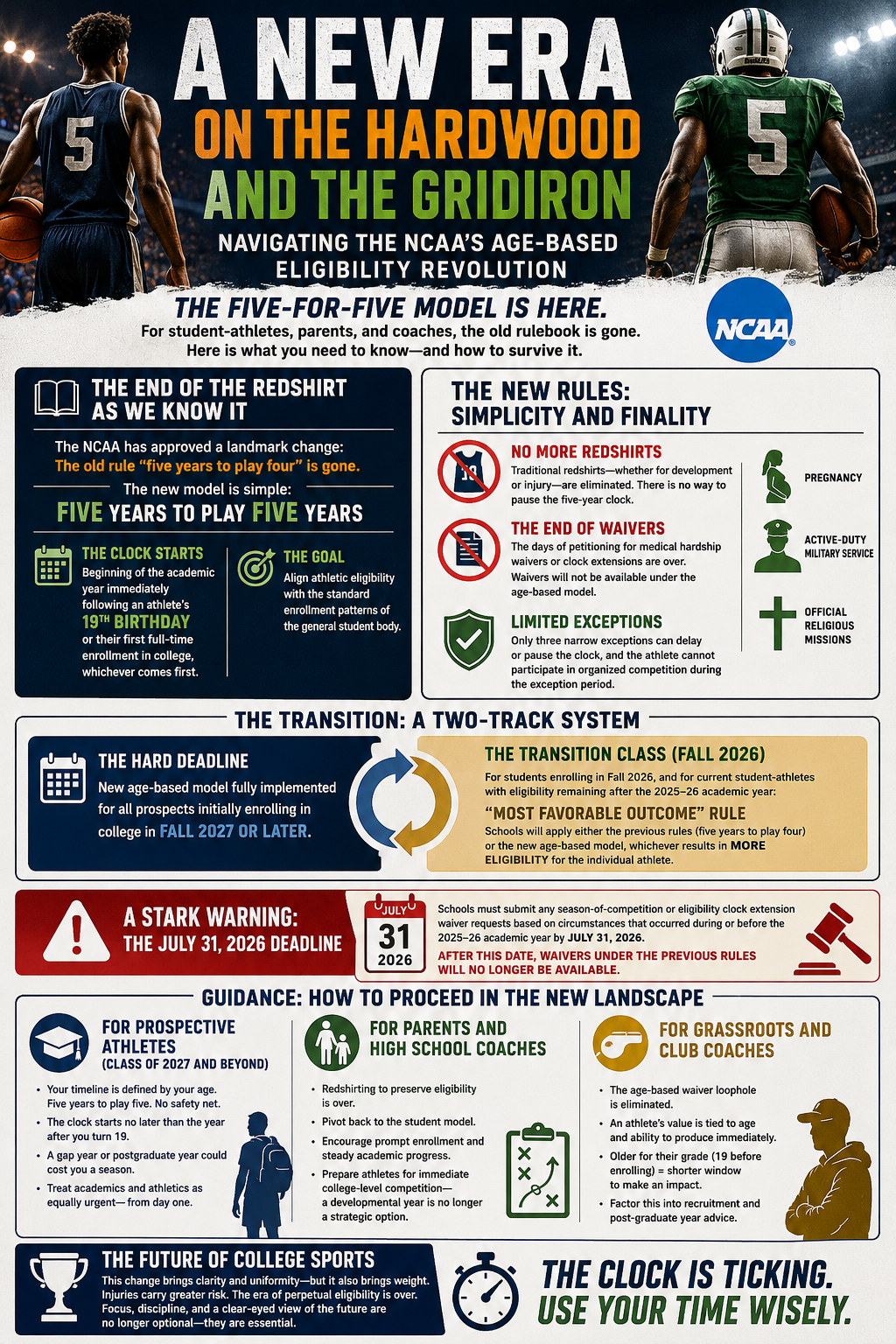
The new model is stark and simple: student-athletes are now permitted up to five years of eligibility, but those five years must be completed within a five-year window. This “five-for-five” model replaces the old system entirely . For the incoming class of fall 2027, the clock starts ticking based on a specific date: the beginning of the academic year immediately following an athlete’s 19th birthday, or their first full-time enrollment in college, whichever comes first . This is a seismic shift designed to align athletic eligibility with the standard enrollment patterns of the general student body .
The New Rules: Simplicity and Finality
The primary motivation behind this change is the elimination of complexity. In recent years, the NCAA’s waiver system became a source of frustration, legal challenges, and perceived inequity. Athletes in their mid-20s competing against 18-year-olds became a flashpoint for critics . The Cabinet’s decision, championed by Illinois Athletic Director Josh Whitman, aims to provide “rules that are simpler to administer and easier to predict for roster management decisions” .
Key changes include:
- No More Redshirts: The traditional redshirt—whether for physical development or a season-ending injury—is eliminated. Unless an athlete falls under the specific exceptions listed below, there is no way to pause the five-year clock.
- The End of Waivers: The days of petitioning the NCAA for a medical hardship waiver or a clock extension are over . The new rules specifically state that waivers will not be available under the age-based model, ending the practice of athletes seeking additional time for injuries or delayed enrollment .
- Limited Exceptions: The Cabinet has defined only three narrow exceptions that can delay or pause the eligibility clock: pregnancy, active-duty military service, and official religious missions. Crucially, the athlete cannot participate in organized competition during the exception period .
The Transition: A Two-Track System for Current Athletes
The most critical detail for those currently in the system is the implementation timeline. The new rules are not a sudden cut-off. For the next two years, we will operate under a unique dual system.
- The Hard Deadline: The new age-based model will be fully implemented for all prospects initially enrolling in college in fall 2027 or later .
- The Transition Class (Fall 2026): For students enrolling in fall 2026, and for current student-athletes who have eligibility remaining after the 2025-26 academic year, a “most favorable outcome” rule applies. Schools will apply either the previous rules (five years to play four) or the new age-based model, whichever results in more eligibility for the individual athlete . This creates a critical strategic opportunity for those who might benefit from the old rules.
A Stark Warning: The July 31, 2026, Deadline
For those who have been relying on the old system, time is of the essence. The NCAA has set a hard deadline of July 31, 2026, for schools to submit any season-of-competition or eligibility clock extension waiver requests based on circumstances that occurred during or before the 2025-26 academic year . After this date, waivers under the previous rules will no longer be available. This is a final window of opportunity that must not be ignored.
Guidance: How to Proceed in the New Landscape
For Prospective Athletes (High School Classes of 2027 and Beyond)
Your timeline is now defined by your age. You have five years to play five. There is no safety net. You must plan your academic and athletic career with the understanding that your clock will start no later than the year after you turn 19. A gap year or a postgraduate year is now a luxury that could cost you a season of eligibility. Treat your academic progress and athletic development as equally urgent priorities from day one.
For Parents and High School Coaches
Advocacy is key. The days of “redshirting” a freshman to preserve a year of eligibility are over. As NCAA President Charlie Baker noted, 98% of student-athletes will “go pro in something other than sports” . This rule forces a pivot back to the student model. Encourage athletes to focus on enrolling promptly and maintaining steady academic progress. For high school coaches, this means preparing athletes for immediate college-level competition, as a developmental year is no longer a strategic option.
For Grassroots and Club Coaches
The elimination of the age-based waiver loophole is a significant development. You will need to advise families that an athlete’s value is now tied to their age and their ability to produce immediately at the collegiate level. Players who are older for their grade (19 before enrolling) will have a shorter window to make an impact. This should influence your advice on recruitment and the choice of a post-graduate year.
The Future of College Sports
This is not merely an administrative change; it is a philosophical one. The era of the perpetual student-athlete, sustained by a web of medical and hardship waivers, is over. While the shift brings clarity and uniformity, it also carries immense weight. Athletes who are injured will now face the grim reality that their playing careers could end without the possibility of a fifth-year waiver. The “litigious environment” mentioned by Charlie Baker is likely to respond to this new reality, as attorneys have already threatened legal action on behalf of athletes who feel they are being unfairly denied a fifth year .
Yet, for all its finality, this new rule provides a roadmap. It requires focus, discipline, and a clear-eyed view of the future. For the student-athlete stepping onto campus in 2027, the message is clear: the clock is ticking. Use your time wisely.

