Carrying the Weight of History: Why Black America Sees Itself in Shedeur Sanders

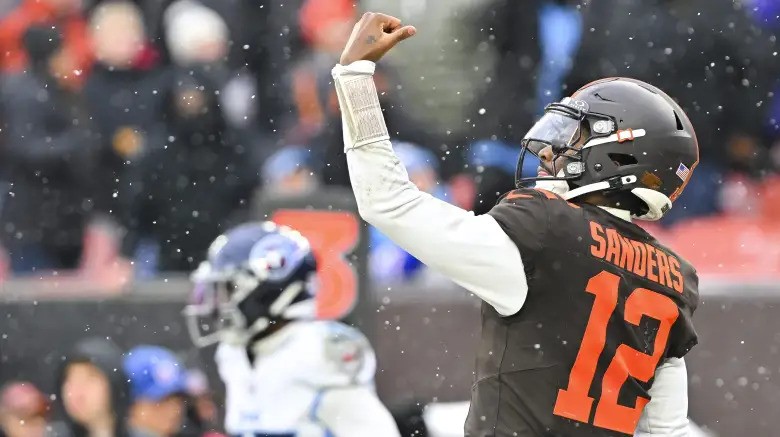
PHILADELPHIA, PA – To watch Shedeur Sanders play quarterback—with his pre-snap poise, his audacious no-look passes, his celebrated, unflappable “Shedeur Face”—is to witness more than a talented athlete. It is to observe a cultural reclamation project. His overwhelming support within the Black community, often chalked up simplistically to his confidence and swagger, is rooted in something far deeper than style. It is a profound, collective recognition. It is the applause of a community that sees in his assured success not just one man’s triumph, but a symbolic redress of a brutal, systemic history—a history whose scars are woven into the very DNA of Black American experience.

The Foundation: American Apartheid on the Playing Field
That history is an American Apartheid, a regime of exclusion not confined to the Deep South but sanctioned at the highest levels of national life, including the playing fields. From its inception in 1906 through the early 1970s, the NCAA operated as a gentlemen’s agreement for segregation, formally barring Black athletes from member institutions, particularly in the powerhouse conferences of the South. For seven decades, the Paul Robesons, Jackie Robinsons, and Jesse Owenses were brilliant, solitary exceptions proving a cruel rule. The Civil Rights Movement forced the gates open, leading to the rapid “tanning” of revenue sports by the 1980s. But the institutional response was not embrace, but a strategic recalibration of exclusion.

The Bureaucratic Barrier: When “Eligibility” Became the New Gate
When blatant segregation became illegal and immoral, the mechanisms of denial became bureaucratic. The NCAA’s evolving “initial eligibility” rules—Proposition 48, the Core Course requirements, sliding GPA scales tied to standardized tests—were weaponized as a more nuanced gate.
Legends like Georgetown’s John Thompson II and Temple’s John Chaney, towering figures who used their platforms without apology, called this what it was: racism. “The NCAA is a racist organization of the highest order,” Chaney declared in 1989, framing the rules as a new punishment for Black kids already punished by poverty. Thompson saw the cynical cycle: athletes were used as integration’s pawns under the guise of benevolence, then discarded with the same paternalistic logic when their numbers grew too great.

The Instinctual Knowledge: A Community Remembers What Was Lost
This is the buried trauma in the collective memory of Black sports fandom. It is the instinctual knowledge that for every Shedeur Sanders lighting up a Power 5 stadium today, there were countless Willie “Satchel” Pages, “Bullet” Bob Hayeses, and Doug Williamses of yesteryear who were denied the stage, their stats relegated to the glory of HBCU lore, their professional careers delayed or diminished. It is the understanding that the path was not cleared, but grudgingly conceded, inch by contested inch.

This brings us back to Shedeur. His journey is a direct rebuke to that entire historical project of exclusion.

Shedeur as Historical Agency, Not Just Athletic Talent
He began not at a traditional blue-blood program, but at Jackson State University, an HBCU, under his father’s tutelage. There, he didn’t just play; he dominated, showcasing a talent so undeniable it forced the mainstream to look to the HBCU, reversing the decades-long drain of talent from them. His subsequent transfer to Colorado and his record-shattering performance—37 touchdowns, 4,134 yards, Big 12 Offensive Player of the Year—wasn’t an assimilation. It was an annexation. He carried the HBCU-developed swagger into Boulder and made it the epicenter of college football.

His confidence, therefore, is read by the Black community as more than personal bravado. It is historical agency. It is the embodiment of a truth: “You could not keep us out forever, and now that we are in, we will not perform with grateful humility. We will excel with the unmistakable flair of those who know the cost of the seat we now occupy.” His much-discussed “swagger” is the posture of liberation from the historical narrative of being the excluded, the regulated, the “problem” to be managed by NCAA legislation.

The Echo in the Draft: A Familiar Story Reinforces the Bond
The fact that his prolific college career culminated in a fifth-round NFL draft pick—seen by many as a slight given his production—only reinforces the narrative. The community, schooled by history, sees the echoes: the subtle devaluation, the search for flaws in the Black quarterback, the institutional reluctance to anoint him the franchise cornerstone his college play warranted. Yet, even in that perceived slight, the support does not waver; it intensifies. Because the story is no longer about what the gatekeepers decide. It’s about what Shedeur, and by extension the community that sees itself in him, has already proven.

An Unfinished Battle, and a Symbol of Its Progress
The contemporary NCAA debate continues, now often couched in the softer language of “unintended consequences” for minority students, as noted by groups like the National Association for Coaching Equity and Development. But the shift from Chaney’s and Thompson’s explicit charges of racism to today’s milder objections itself tells a story of a battle partly won, yet ongoing.

Shedeur Sanders walks onto the field bearing the weight and the defiance of that unfinished battle. The Black community’s embrace is a celebration of his individual talent, yes, but it is also a collective, cathartic affirmation. It is the joy of witnessing a grandson of American Apartheid not just cross the forbidden line, but do so with a dismissive wave, a nod to the crowd, and a perfect spiral into the end zone. His confidence is their vindication. His swagger is their memory, weaponized, and set free.

The Unforgivable Sin of Black Confidence: Angel Reese and Shedeur Sanders are Challenging a Deep-Seated American Taboo

By Delgreco Wilson

CAMDEN, NJ – In the high-stakes arena of American sports, where we claim to celebrate grit and triumph, we are witnessing the rise of a new generation of Black athletes who embody a potent, unyielding confidence. Angel Reese, the WNBA and former LSU basketball star known as “Bayou Barbie,” and Shedeur Sanders, the Cleveland Browns rookie and former star quarterback for his father Deion’s Colorado Buffaloes, are not just exceptional talents; they are cultural phenomena.

Their athletic prowess is undeniable, record-breaking, and thrilling. Yet, for all the celebration, a palpable undercurrent of disdain follows them. The comment sections boil over with vitriol; sports talk radio callers huff about “arrogance”; and a certain segment of the populace seems genuinely unnerved. To understand this visceral response, we need to excavate a term from the ugliest chapters of the American lexicon: the “uppity Negro.” While the phrase itself is now largely relegated to the shadows, the social control it represents is very much alive, and it is the most potent framework for understanding the backlash against these two young Black icons.

The Ghost in the Stadium: A History of “Uppity”

The word “uppity” is an old English adjective for someone putting on airs above their station. But in the American context, particularly in the antebellum South and the Jim Crow era, it was weaponized into a specific and terrifying racial slur. White supremacy required a rigid social hierarchy where Black people were expected to perform subservience—to be grateful, obedient, and to never, ever challenge their “place.”

An “uppity Negro” was anyone who violated this unwritten code. The crime wasn’t just success, but any behavior that suggested equality: a Black man owning a successful farm, a Black person speaking without the obligatory “sir” or “ma’am,” dressing well, or—most fundamentally—looking a white person in the eye with unflinching self-assurance. The accusation of being “uppity” was a tool of enforcement. It was a warning and a justification for punishment, a linguistic precursor to social ostracization, economic retaliation, or far, far worse. It was the mechanism for maintaining a caste system.

In the modern era, the explicit phrase is (mostly) taboo, but its spirit thrives in coded language. When a Black person in the public sphere is called “arrogant,” “cocky,” or “angry,” or when their achievements are dismissed as a product of “affirmative action” or mere nepotism, they are being subjected to the modern “uppity” accusation. The underlying message is unchanged: You are transgressing an unspoken social boundary.

A New Vanguard: The Unapologetic Reign of Reese and Sanders

Enter Angel Reese and Shedeur Sanders. Their rise has been rapid, dramatic, and steeped in a self-belief that refuses to be quiet.

During LSU’s 2023 national championship run, Angel Reese became a national lightning rod. After hitting a game-sealing shot, she famously trailed her opponent, pointing to her ring finger—a gesture signaling where her championship ring would go. The celebration was branded “classless” and “disrespectful” by many, while similar antics from white male athletes are often celebrated as “competitive fire.” Reese, a young Black woman, was not conforming to the passive, grateful archetype often demanded of her. She was, in the historical sense, refusing to perform subservience. She was owning her moment with a theatrical flair that said, “I belong here, and I will celebrate as I see fit.”

Shedeur Sanders’ confidence is of a different, but equally potent, strain. As the quarterback and son of Coach Deion Sanders, he operates with a preternatural calm and an unshakable belief in his own ability. He carries himself with the polish of a CEO, his demeanor often cool and unbothered even under extreme pressure. This is not the “grateful-to-be-here” athlete. This is an athlete who expects to win. When he led a last-second, game-winning drive against Colorado State, his post-game comment was not one of relief, but of expectation: “It’s just a regular operation, you know? We do it in practice all the time.” For critics, this isn’t seen as poise, but as arrogance. He is not waiting for permission to be great; he simply assumes it.

The Root of the Discomfort: A Challenge to the Racial Order

So why does this confidence cause such disconcerting feelings among many white Americans? The reasons are buried deep in the national psyche.

First, it is a direct challenge to white supremacy and entitlement. The ideology of white superiority depends on Black inferiority. An unapologetically confident, successful Black person who does not seek approval or defer to white sensibilities shatters this foundational myth. It challenges an unearned sense of entitlement to social deference.

Second, it creates profound cognitive dissonance. For generations, racist stereotypes have depicted Black people as lazy, ignorant, or simple. Figures like Reese and Sanders—articulate, strategic, and dominant—force a confrontation with these stereotypes. The easiest psychological escape from this dissonance is not to abandon the stereotype, but to pathologize the individual as an exception who is “getting above themselves.”

Finally, it represents the erosion of a controlled identity. The “uppity” Black athlete is the antithesis of the “good Negro”—the humble, non-threatening, and subservient figure who “knows his place.” By defining their own identities—Reese with her “Bayou Barbie” glamour and trash-talk, Sanders with his CEO cool—they refuse to be controlled by white expectations. This act of self-definition is, in itself, a radical and threatening act in a framework built on their subjugation.

A Playbook for the Next Generation

For young Black athletes who will inevitably find themselves navigating these same treacherous waters, the path forged by Reese and Sanders, though rocky, provides a crucial blueprint.

  1. Own Your Narrative. Do not let others define you. Angel Reese leaned into the “Bayou Barbie” persona, turning criticism into a brand of empowerment. Control your story on social media and in interviews.
  2. Let Your Work Ethic Be Your Shield. The most unassailable defense is undeniable excellence. The vitriol aimed at Shedeur Sanders often evaporates in the face of a perfectly thrown fourth-quarter touchdown. Performance can silence critics when logic and reason cannot.
  3. Find Your Community and Mentors. The weight of this scrutiny is immense and unfair. Building a support system of family, trusted coaches, and peers who understand the unique pressures of being a Black athlete in the public eye is non-negotiable for mental and emotional survival.
  4. Understand the History. Knowing that the backlash is not really about you, but about a deep-seated historical anxiety, can be a source of strength. You are not the problem; you are confronting a legacy of control that long predates you.

The visceral response to Angel Reese and Shedeur Sanders is not a simple story of sports rivalry or personal dislike. It is a modern manifestation of an ancient American anxiety. Their confidence is interpreted as a threat because it is one—a threat to a racial hierarchy that has, for centuries, demanded Black submission. They are not just playing games; they are, with every pointed finger and coolly delivered quote, expanding the boundaries of what a Black athlete is allowed to be. And in doing so, they are forcing America to confront the ghost in its stadium.

Sidney Stewart: How a Maryland Freshman Phenom Forged His Own Path to Football Stardom

The Weight of a Legacy

by Delgreco Wilson

COLLEGE PARK, MD – Sidney Stewart was supposed to be a basketball star. It’s in his genes. The Baltimore native is an heir to one of Philadelphia’s great basketball legacies, a family tradition that reads like a history of the game itself. His father, Stephen “Mookie” Stewart, stands ninth in Coppin State history in scoring and rebounding, a MEAC Player of the Year in 1994 and 1995, and now an assistant coach with the Coppin men’s basketball program. Sidney’s uncles, Larry and Lynard Stewart, extended the family’s basketball dominance—Larry became one of only two Coppin State Eagles to play in the NBA, while Lynard starred under John Chaney at Temple before a professional career in Europe.

Yet on Saturday, under the blazing Maryland sun, Sidney Stewart didn’t step onto a hardwood court but rather onto the gridiron of SECU Stadium, where the 6-foot-2, 255-pound freshman defensive lineman delivered a spectacular debut for the University of Maryland Terrapins that announced his arrival as football’s newest sensation.

Sidney Stewart, Maryland Freshman

A Different Path

How does a young man surrounded by basketball royalty find his way to football stardom? For Sidney Stewart, the pull of the gridiron proved irresistible almost as soon as he could walk. While his family legacy pointed toward basketball, Stewart discovered his own passion—one that would eventually lead him to become a preseason freshman All-American selection and one of the most anticipated young talents in Big Ten football.

Stewart’s high school career at Concordia Prep in Towson nearly never was. His time there began in 2020, when COVID-19 forced the cancellation of the season. He reclassified after his freshman year hoping to play four years of football, but ultimately was unable to salvage a season of eligibility for 2024. The disappointment of being allowed to practice but not play during that period forged a resilience that would define his character.

“He was allowed to practice but not play, and that was hard for him to do just because he wanted to be out there so badly with his teammates,” recalled Joe Battaglia, Stewart’s high school coach at Concordia Prep. “I just told him he was going to be so much better for that, and that he was going to have a little different hunger than maybe some other guys that were around him coming in because he understands what it’s like to have football taken from him”.

Character Beyond the Field

If Stewart’s athletic prowess has turned heads, his character has won hearts. In May of this year, after securing Name, Image, and Likeness (NIL) earnings as a college athlete, Stewart made a decision that stunned his former coaches: he donated $4,000 to Concordia Prep’s athletic department—a tangible expression of gratitude to the institution that shaped him.

“What inspired me to do that was the appreciation I have for my school and secondly, I want them to grow because their growth helps my growth,” Stewart explained. “Coming from that school, the better they look the better I look. I just want every area and every aspect of my life that I was a part of to thrive.”

His high school coach remained amazed at the gesture: “Just an incredible thing for a kid who wasn’t supposed to be graduating from high school yet. He enrolled early in Maryland, had made a little bit of money and wanted to give back to the place that kind of built him and give back to his team. I think he appreciates the people along the way.”

This act of generosity wasn’t an isolated moment but part of a pattern of service that defines Stewart’s character. He is “no stranger to acts of service, such as helping out at youth camps or working with young kids any time they are around Concordia Prep,” his old stomping grounds in Towson.

The Family Competitive Fire

Though Stewart chose football over basketball, the competitive fire that burned in his father and uncles clearly ignites his own ambitions. He enters college with a declaration that he wants to be a freshman All-American—a goal directly inspired by his father’s accomplishments on the basketball court.

“My dad played basketball. He’s pretty good. He played basketball overseas and he was an All-American in college,” Stewart said. “One thing he would always tell me growing up whenever [there] was something to do or any specific task he would always boast, ‘It’s only one All-American in this family.’ I can’t be an All-American at 7 years old, but now I have the opportunity to do that.”

Table: The Stewart Family Athletic Legacy

Family MemberSportAccomplishments
Stephen “Mookie” Stewart (Father)BasketballCoppin State Hall of Fame, MEAC Player of the Year (1994, 1995), 9th in Coppin history in scoring/rebounding
Larry Stewart (Uncle)BasketballNBA player (5 seasons), 2x MEAC Player of the Year, Coppin State’s first MEAC Championship
Lynard Stewart (Uncle)BasketballTemple University star, Philadelphia Daily News Player of the Year, professional career in Europe
Sidney StewartFootballMaryland Football freshman, preseason All-American selection, NIL philanthropist

A Debut to Remember

After nearly two years without playing in a real football game, Stewart’s debut for the Terrapins was nothing short of spectacular. Playing multiple positions across the defensive front—right defensive end, left defensive end, occasionally dropping into linebacker coverage—Stewart demonstrated the versatility that makes him such a promising prospect in defensive coordinator Brian Williams’ scheme.

His stat line told the story of a player who had waited patiently for his moment: 5 tackles (4 solo), 1 sack for a safety, and 3 tackles for loss. The sack that resulted in a safety particularly electrified the Maryland crowd, offering a glimpse of the game-changing potential that has coaches and teammates so excited.

Stewart’s physical attributes—documented in his EA SPORTS™ College Football 26 rating as a 64 overall—include impressive acceleration (81), strength (76), and hit power (83) that belie his freshman status. These measurable qualities, combined with his evident motor and football IQ, suggest a player poised for rapid development.

The Maryland Football Future

Stewart represents a crucial piece of Maryland head football coach Michael Locksley’s ambitious plan to “stack back-to-back high-end recruiting classes in 2025 and 2026.” At Big Ten Media Days in July, Locksley boldly declared: “We’ve embarked on recruiting the best two high school classes that we’ve seen in the history of Maryland football. Half of those guys that we signed [for 2025] were able to enroll early and participate in our winter and spring programs, which gives us an opportunity to see those guys as early as possible.”

Stewart’s journey to Maryland was motivated by more than just athletic opportunity—it was driven by a desire to represent his home state. “Growing up here I just kind of felt disrespected,” Stewart explained. “I feel like we had so many guys… I think often they would go to other schools, and they would do well then you would just forget that they’re from Maryland. We never really got the love that I thought we deserved as a football state. Me and a bunch of other guys my age were like, ‘We need to put our foot down and go ball for our home school,’ so I think that’s probably one of the biggest reasons I chose to come here.”

Table: Sidney Stewart’s EA Sports College Football 26 Ratings Highlights

AttributeRatingAttributeRating
Overall64Acceleration81
Speed76Strength76
Tackle79Power Moves77
Pursuit82Hit Power83
Awareness65Agility75

More Than Athletics

What makes Stewart’s story particularly compelling in the NIL era of college athletics is his understanding that his platform extends beyond the football field. His decision to donate a portion of his earnings to his high school reflects a maturity that transcends his 19 years—a recognition that athletic success carries with it the responsibility to uplift others.

This perspective seems deeply ingrained in Stewart’s approach to his sport and his life. “I enjoyed my time there, so the people that helped me [become] who I am I wanted to help in some sort of way,” he said of his Concordia Prep experience.

Stewart’s high school coach believes this character will translate to success at the collegiate level: “I think he brings unbelievable effort. He’s super explosive. Nobody works harder at their craft than Sid does. He’s in a different system in a slightly different position than he’s been in before, but he’s going to work so hard at that and be successful.”

Forging His Own Legacy

As Sidney Stewart continues his freshman season at Maryland, he carries with him both the weight of family expectation and the freedom of having chosen his own path. The basketball legacy that might have defined another man became merely the foundation upon which Stewart is building his football identity—an identity marked by gratitude, resilience, and an unwavering work ethic.

In an era when college athletes face unprecedented scrutiny and opportunity, Stewart represents the best of what the new system can produce—a young man aware of his value but equally conscious of his responsibility to others. His journey from COVID-canceled seasons to college stardom, his decision to give back before he’s truly taken, and his determination to put Maryland football on the map all tell the story of an athlete who understands that legacy is about more than statistics or awards.

The Stewart family tradition of athletic excellence continues, but through Sidney, it has evolved into something new—a football story born from basketball royalty, a Maryland story with Philadelphia roots, and a personal story of gratitude that promises to inspire the next generation of athletes who must choose between following in footsteps or carving their own path.

As the season continues, Sidney Stewart will undoubtedly face challenges—the relentless grind of Big Ten competition, the academic demands of college life, and the pressure of living up to expectations. But if his debut and his journey thus far are any indication, he possesses not just the physical tools but the character necessary to meet those challenges head-on, creating a legacy that honors his family’s past while firmly establishing his own future.

A Tale of Three Coaching Hires: Temple, Norfolk State, and Delaware State

PHILADELPHIA, PA – Temple University’s recent hiring of K.C. Keeler as head football coach has raised eyebrows, especially when juxtaposed with the bold moves by Norfolk State University and Delaware State University. Both HBCUs have decided to roll the dice, following the Jackson State blueprint and hiring high-profile former NFL stars to lead their programs. The contrast is striking, and it raises questions about the strategic decisions underpinning each hire. Is Temple’s choice a calculated move grounded in a traditional approach to developing college football programs, or is it an exercise in playing it safe in the NIL/transfer portal era when bold action is sorely needed? Let’s talk about this shit.

Delaware State Head Coach Candidate, Desean Jackson

Temple Football: A Program in the Abyss

Let’s not mince words: Temple football is ASS! Over the past five seasons, the Owls have compiled a dismal 13-42 record. In an era dominated by NIL deals and the transfer portal, the Owls are woefully unequipped to compete. So much so, that on November 18, 2024, Inquirer Columnist Marcus Hayes argued that the Temple football “program probably needs to go away.” Quarterbacks at other programs are pocketing millions, while Temple’s head coaching position doesn’t even come close to matching that level of compensation. Add to this the widespread perception of an unsafe campus in North Philadelphia—a reality punctuated by frequent reports of murders, armed robberies, and home invasions involving students—and you’ve got a program fighting a gunfight with a butterknife.

The Owls’ attendance woes at Lincoln Financial Field underscore their plight. While the Eagles sell out every game with an average attendance of nearly 70,000, Temple struggles to draw even 14,000 fans on Saturdays. To put it bluntly, they can’t give away tickets. Nobody is paying hard earned money to watch Temple struggle against Coastal Carolina and North Texas.

Recognizing these challenges, on November 26, 2024, Black Cager Sports publicly called for Temple to consider hiring a high-profile former Eagle, like Brian Dawkins or Jason Kelce, to rejuvenate the program. The logic was simple: inject star power, attract media attention, and leverage NFL prestige to appeal to recruits and reignite fan interest. Philadelphia is, after all, a football town, albeit one where the Eagles monopolize the energy. A beloved former Eagle at the helm could have been the spark Temple football desperately needed.

Norfolk State and Delaware State: The Prime Effect

While Temple opted for tradition with Keeler, Norfolk State and Delaware State have embraced the Coach Prime model. On December 2, 2024, Norfolk State introduced Mike Vick as its new head coach in a press conference that felt more like a star-studded gala. With Allen Iverson and Bruce Smith in attendance, the hire radiated cultural significance and media magnetism.

Similarly, Delaware State is finalizing a deal with DeSean Jackson. Like Vick, Jackson brings NFL pedigree, charisma, and name recognition to the table. Both hires reflect a growing trend among HBCUs: leveraging the cultural capital of NFL stardom to transform their football programs. It’s a strategy pioneered by Deion Sanders at Jackson State and now being tested at Norfolk State and Delaware State.

These moves are not without risk. Neither Vick nor Jackson has extensive coaching experience. But as Sanders demonstrated at Jackson State and now at Colorado, NFL stardom is a currency that resonates deeply with recruits. It’s not just about X’s and O’s; it’s about access, visibility, and credibility. Recruits see an opportunity to learn from and be mentored by someone who has reached the pinnacle of football success.

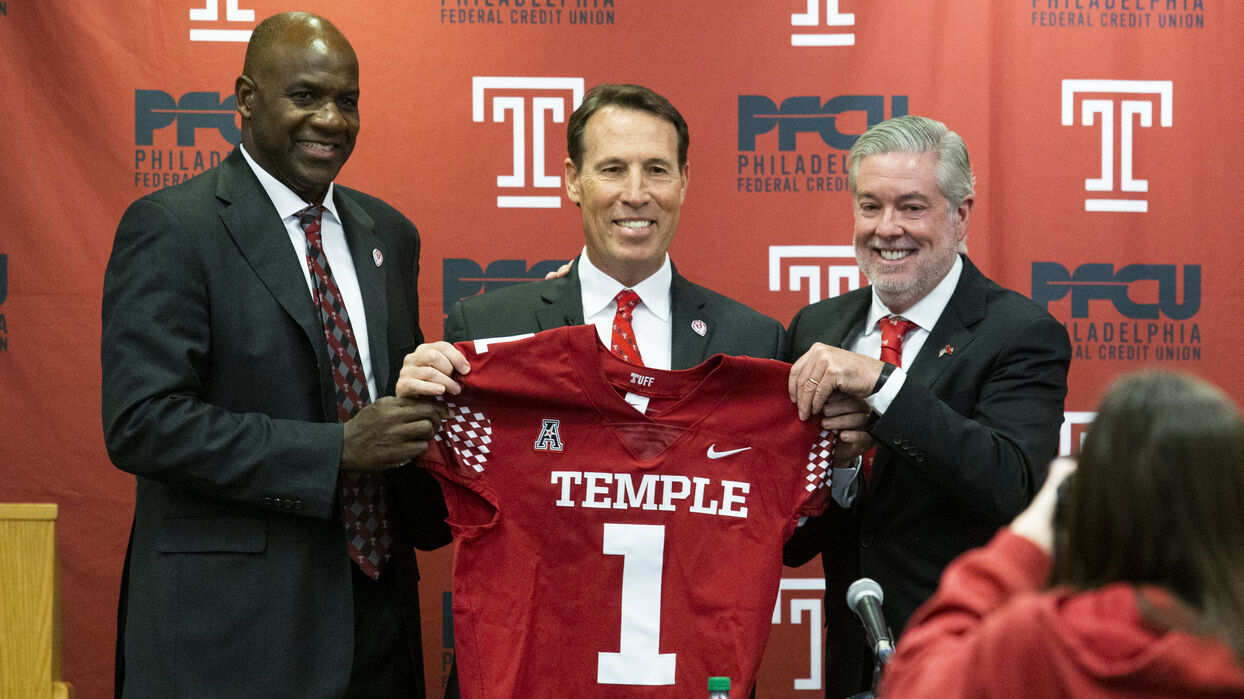
Arthur Johnson, Athletic Director, K.C. Keeler, Head Coach and President John A. Fry

Temple’s Safe Play: K.C. Keeler

On December 1, 2024, Temple announced the hiring of K.C. Keeler, a seasoned coach with a proven track record. Keeler boasts national championships at Delaware and Sam Houston State, along with a history of consistent postseason appearances. His credentials are impeccable, and on paper, he’s an excellent hire.

But here’s the rub: credentials alone won’t solve Temple’s myriad challenges. The Owls don’t just need a competent coach; they need a savior. Someone who can galvanize a fractured fanbase, attract top-tier recruits, and restore relevance to a program that has become an afterthought in its own city.

Can Keeler convince top prospects to live, learn and practice on North Broad Street? Will he be able to lure impact transfers from the portal to Norf Philly? What’s his pitch?

Keeler is a traditional choice, a steady hand on the tiller. But steady doesn’t sell tickets, and it doesn’t land four-star recruits. In the NIL era, Temple needs more than competence; it needs charisma and cachet.

Kelce, Dawkins, Vick and Jackson ooze that shit… Each and every one of them is DAT DUDE…

The Quasi-Experiment

With Temple taking the traditional route and Norfolk State and Delaware State betting on NFL stardom, we have a real-time quasi-experiment unfolding. Which approach will prove more effective in revitalizing struggling football programs? While it’s too early to draw conclusions, the early indicators are telling.

Temple’s choice reflects a belief in stability and experience. Norfolk State and Delaware State, on the other hand, are banking on the transformative power of star power. The latter approach may be riskier, but it’s also far more aligned with the realities of modern college football.

The Case for Bold Action

Temple’s decision to go with Keeler feels like a missed opportunity. In a city that bleeds green for the Eagles, hiring a beloved former player like Brian Dawkins or Jason Kelce could have electrified the program. The media buzz alone would have been invaluable for a university grappling with declining enrollment and waning athletic fortunes.

Dawkins and Kelce are not just football legends; they are cultural icons in Philadelphia. Their presence on the sidelines would have lent instant credibility to the program and created a recruiting pitch unlike any other. Imagine a high school player being recruited by a Hall of Famer or a Super Bowl champion. That’s the kind of edge Temple needs.

Conclusion

As Norfolk State and Delaware State forge ahead with their high-profile hires, Temple’s choice of K.C. Keeler stands as a stark contrast. Time will tell which approach yields better results, but one thing is clear: Temple’s football program is in dire need of a spark. Whether Keeler can provide it remains to be seen. For now, the Owls remain in the abyss, and the question lingers: What could have been if Temple had dared to dream bigger?

Scouting Report: Caiden Kennedy, Gloucester City Mustangs

Scouting Report: Caiden Kennedy
Team: Gloucester City Mustangs (Gloucester City, NJ)
Age: 9
Positions: Linebacker, Running Back

Caiden Kennedy is a tough, physical competitor whose love for contact and relentless effort make him a standout player. Known for his hard-nosed approach to the game, Caiden is the type of athlete who sets the tone on both sides of the ball.

Caiden Kennedy

Defensive Analysis

As a linebacker, Caiden is a punishing presence in the middle of the field. His ability to read plays quickly and attack downhill leads to consistent big stops for his team. Caiden thrives on delivering hard hits, often stopping ball carriers in their tracks and halting any forward progress. His toughness and instinct for the game make him a leader on defense and a critical piece of the Mustangs’ game plan.

Offensive Analysis

On offense, Caiden brings the same physicality to the running back position. He relishes contact, often initiating it rather than avoiding it. His refusal to go down on first contact and determination to fight for extra yards make him a difficult player to tackle. Caiden has a powerful running style complemented by surprising agility, allowing him to break through defenses and create big plays.

Strengths

  • Physicality: Thrives in physical situations, delivering hard hits on defense and running through contact on offense.
  • Toughness: Plays with a relentless attitude, showing grit and determination in every snap.
  • Instincts: Reads plays well, especially on defense, where his ability to anticipate the action leads to timely tackles.
  • Work Ethic: Puts in the effort to improve his skills and elevate his game.

Areas for Growth

  • Speed and Agility: Continued focus on speed and lateral quickness will enhance his ability to make plays in space.
  • Pass Coverage: Developing his skills in coverage will make him a more complete linebacker.
  • Vision as a Runner: Refining his ability to read blocks and find running lanes will add to his offensive effectiveness.
Caiden Kennedy and his Mother, Maureen O’Kane

Outlook

As a proud Gloucester City legacy athlete, Caiden Kennedy has all the tools to continue his family tradition of excellence at Gloucester City High School. His physical style of play, combined with his natural leadership on the field, positions him as a future star at the middle school and high school levels. With his unmatched determination and love for the game, Caiden is on track to become a highly recruited middle school prospect and a key contributor to any team he plays for.

Projection: High-impact middle school player with the potential to be a cornerstone for Gloucester City High School’s football program. A true competitor whose best years of football are still ahead.