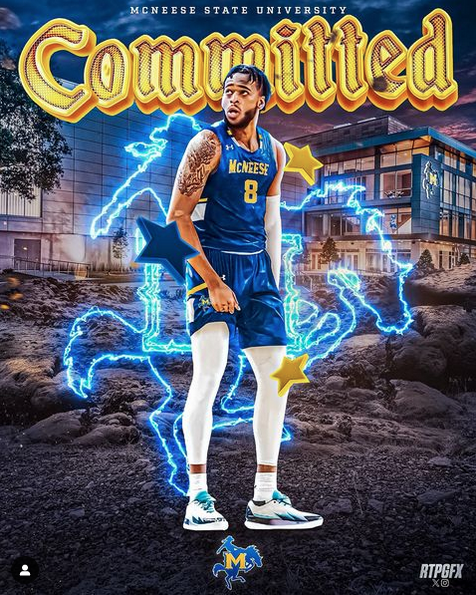
CAMDEN, NJ – In an era when college basketball players often chase the brightest spotlight or the most lucrative NIL deals, Jerome Brewer’s decision to return home stands as a rare act of introspection and social responsibility. The 6’8” forward, who has navigated a winding collegiate journey from Texas A&M Commerce to McNeese State, could have followed his former coach to North Carolina State or sought a bigger stage elsewhere. Instead, he chose La Salle University—not just for basketball, but to fulfill a deeper mission.
Brewer’s choice reflects a maturity beyond his years. At a time when young athletes are frequently pressured to prioritize immediate success, he considered something more enduring: his ability to influence the next generation. His insistence that La Salle facilitate access for Camden City Public School students to games and practices isn’t a mere publicity gesture; it’s an intentional effort to reinforce the values that shaped him.
“Sports act as an agent of socialization,” Brewer said, articulating a perspective more common among seasoned coaches than 22-year-old players. “They teach values, behaviors, and skills—teamwork, communication, resilience.” His words underscore an awareness of basketball’s broader role, one that extends far beyond the box score.
This understanding didn’t emerge in a vacuum. Brewer’s formative years were spent in Camden’s gyms, where the game was both an escape and an education. After a brief stint in the Philadelphia Catholic League, he returned to Camden High, helping restore its basketball prominence alongside future Division I standouts. When college offers didn’t meet his expectations, he bet on himself—first at prep school, then in the Southland Conference, where he blossomed into an All-League performer before injury intervened.
His resilience was tested again last year when he redshirted at McNeese State, biding his time for the right opportunity. When it arrived, he weighed his options with the discernment of someone who recognizes that a career is more than stats or conference prestige. He thought of his younger brother, Domani, a budding seventh-grade phenom who now has a front-row seat to his brother’s final collegiate chapters. He thought of Camden’s kids, who will see in him a path forward.
Camden Mayor Vic Carstarphen, a former Temple standout under John Chaney, praised Brewer’s character, calling him “one of the finest student-athletes to come through Camden in recent years.” City Councilman Arthur Barclay, who played for John Calipari at Memphis, highlighted Brewer’s potential as a role model: “He was one of them not long ago. Now, he’s showing them what’s possible.”
La Salle, under new coach Darris Nichols, gains not just a versatile forward who can stretch defenses and guard multiple positions, but a leader who grasps the weight of his platform. In return, Brewer gets a chance to cement his legacy where it matters most—at home.
In an age of fleeting allegiances and transactional relationships, Brewer’s decision is a reminder that some choices are about more than basketball. They’re about purpose. And in that regard, his homecoming is already a victory.
PHILADELPHIA, PA – Temple University’s recent hiring of K.C. Keeler as head football coach has raised eyebrows, especially when juxtaposed with the bold moves by Norfolk State University and Delaware State University. Both HBCUs have decided to roll the dice, following the Jackson State blueprint and hiring high-profile former NFL stars to lead their programs. The contrast is striking, and it raises questions about the strategic decisions underpinning each hire. Is Temple’s choice a calculated move grounded in a traditional approach to developing college football programs, or is it an exercise in playing it safe in the NIL/transfer portal era when bold action is sorely needed? Let’s talk about this shit.
Delaware State Head Coach Candidate, Desean Jackson
Temple Football: A Program in the Abyss
Let’s not mince words: Temple football is ASS! Over the past five seasons, the Owls have compiled a dismal 13-42 record. In an era dominated by NIL deals and the transfer portal, the Owls are woefully unequipped to compete. So much so, that on November 18, 2024, Inquirer Columnist Marcus Hayes argued that the Temple football “program probably needs to go away.” Quarterbacks at other programs are pocketing millions, while Temple’s head coaching position doesn’t even come close to matching that level of compensation. Add to this the widespread perception of an unsafe campus in North Philadelphia—a reality punctuated by frequent reports of murders, armed robberies, and home invasions involving students—and you’ve got a program fighting a gunfight with a butterknife.
The Owls’ attendance woes at Lincoln Financial Field underscore their plight. While the Eagles sell out every game with an average attendance of nearly 70,000, Temple struggles to draw even 14,000 fans on Saturdays. To put it bluntly, they can’t give away tickets. Nobody is paying hard earned money to watch Temple struggle against Coastal Carolina and North Texas.
Recognizing these challenges, on November 26, 2024, Black Cager Sports publicly called for Temple to consider hiring a high-profile former Eagle, like Brian Dawkins or Jason Kelce, to rejuvenate the program. The logic was simple: inject star power, attract media attention, and leverage NFL prestige to appeal to recruits and reignite fan interest. Philadelphia is, after all, a football town, albeit one where the Eagles monopolize the energy. A beloved former Eagle at the helm could have been the spark Temple football desperately needed.
Norfolk State and Delaware State: The Prime Effect
While Temple opted for tradition with Keeler, Norfolk State and Delaware State have embraced the Coach Prime model. On December 2, 2024, Norfolk State introduced Mike Vick as its new head coach in a press conference that felt more like a star-studded gala. With Allen Iverson and Bruce Smith in attendance, the hire radiated cultural significance and media magnetism.
Similarly, Delaware State is finalizing a deal with DeSean Jackson. Like Vick, Jackson brings NFL pedigree, charisma, and name recognition to the table. Both hires reflect a growing trend among HBCUs: leveraging the cultural capital of NFL stardom to transform their football programs. It’s a strategy pioneered by Deion Sanders at Jackson State and now being tested at Norfolk State and Delaware State.
These moves are not without risk. Neither Vick nor Jackson has extensive coaching experience. But as Sanders demonstrated at Jackson State and now at Colorado, NFL stardom is a currency that resonates deeply with recruits. It’s not just about X’s and O’s; it’s about access, visibility, and credibility. Recruits see an opportunity to learn from and be mentored by someone who has reached the pinnacle of football success.
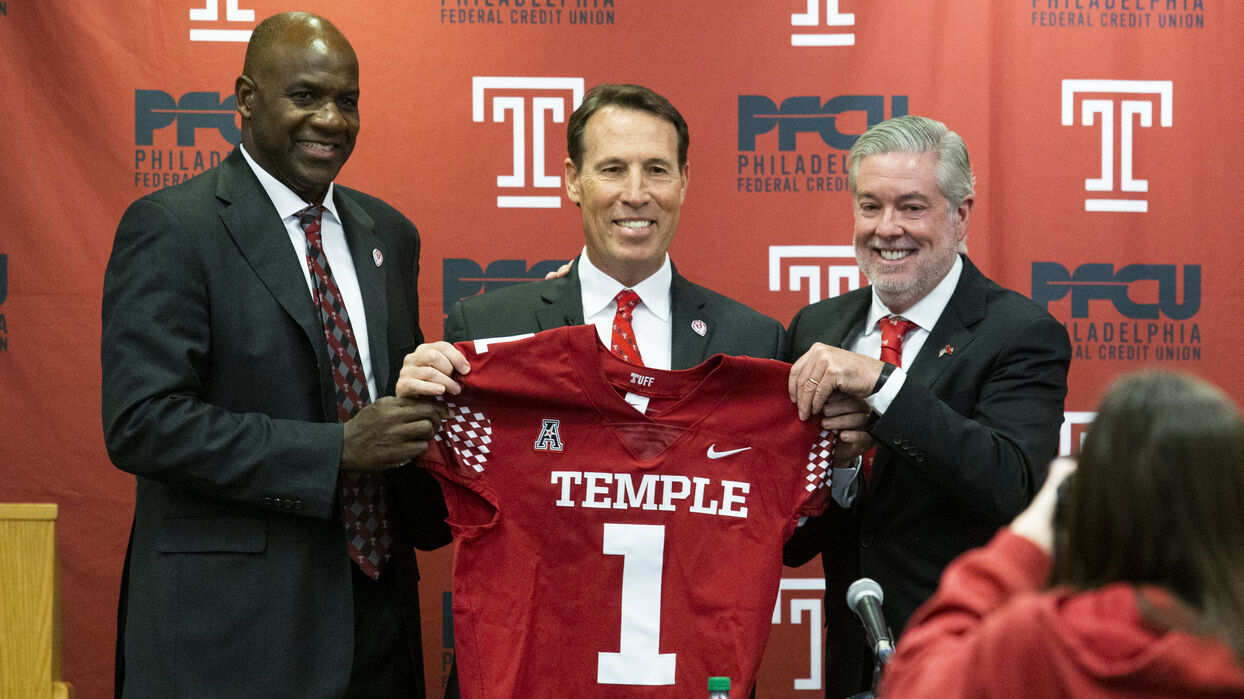
Arthur Johnson, Athletic Director, K.C. Keeler, Head Coach and President John A. Fry
Temple’s Safe Play: K.C. Keeler
On December 1, 2024, Temple announced the hiring of K.C. Keeler, a seasoned coach with a proven track record. Keeler boasts national championships at Delaware and Sam Houston State, along with a history of consistent postseason appearances. His credentials are impeccable, and on paper, he’s an excellent hire.
But here’s the rub: credentials alone won’t solve Temple’s myriad challenges. The Owls don’t just need a competent coach; they need a savior. Someone who can galvanize a fractured fanbase, attract top-tier recruits, and restore relevance to a program that has become an afterthought in its own city.
Can Keeler convince top prospects to live, learn and practice on North Broad Street? Will he be able to lure impact transfers from the portal to Norf Philly? What’s his pitch?
Keeler is a traditional choice, a steady hand on the tiller. But steady doesn’t sell tickets, and it doesn’t land four-star recruits. In the NIL era, Temple needs more than competence; it needs charisma and cachet.
Kelce, Dawkins, Vick and Jackson ooze that shit… Each and every one of them is DAT DUDE…
The Quasi-Experiment
With Temple taking the traditional route and Norfolk State and Delaware State betting on NFL stardom, we have a real-time quasi-experiment unfolding. Which approach will prove more effective in revitalizing struggling football programs? While it’s too early to draw conclusions, the early indicators are telling.
Temple’s choice reflects a belief in stability and experience. Norfolk State and Delaware State, on the other hand, are banking on the transformative power of star power. The latter approach may be riskier, but it’s also far more aligned with the realities of modern college football.
The Case for Bold Action
Temple’s decision to go with Keeler feels like a missed opportunity. In a city that bleeds green for the Eagles, hiring a beloved former player like Brian Dawkins or Jason Kelce could have electrified the program. The media buzz alone would have been invaluable for a university grappling with declining enrollment and waning athletic fortunes.
Dawkins and Kelce are not just football legends; they are cultural icons in Philadelphia. Their presence on the sidelines would have lent instant credibility to the program and created a recruiting pitch unlike any other. Imagine a high school player being recruited by a Hall of Famer or a Super Bowl champion. That’s the kind of edge Temple needs.
Conclusion
As Norfolk State and Delaware State forge ahead with their high-profile hires, Temple’s choice of K.C. Keeler stands as a stark contrast. Time will tell which approach yields better results, but one thing is clear: Temple’s football program is in dire need of a spark. Whether Keeler can provide it remains to be seen. For now, the Owls remain in the abyss, and the question lingers: What could have been if Temple had dared to dream bigger?
CAMDEN, NJ – Basketball royalty has long reigned in the Greater Philadelphia Region. Legends like Tom Gola, Wilt Chamberlain, Kobe Bryant, Earl Monroe, Lionel Simmons, DaJuan Wagner, Jameer Nelson and Dawn Staley have defined the sport across eras, blending artistry, power, and grace on the hardwood. Each generation claims its king or queen—a player so gifted that their dominance transcends debates. Today, Philadelphia basketball hoops has a new, unquestioned ruler: Hannah Hidalgo.
Notre Dame after defeating #3 USC in Los Angeles
A native of Haddonfield, New Jersey, Hidalgo has staked her claim not only as the finest amateur player from the Greater Philadelphia area but as one of the best collegiate basketball players—male or female—in the country. The All-American Notre Dame star has redefined what it means to be an elite two-way player, combining offensive brilliance with defensive ferocity in a way few can match. Her recent 24-point, 8-assist, 6-rebound, 5-steal masterpiece against No. 10 USC is merely the latest testament to her all-around greatness.
Relentless Offensive Brilliance
What separates Hidalgo offensively is her rare combination of skill, intelligence, and relentless competitiveness. Just a sophomore, she commands the floor with a poise that belies her youth, dissecting defenses with surgical precision. Her scoring repertoire is comprehensive: a lethal first step allows her to blow by defenders, a feathery touch finishes plays at the rim, and a reliable jump shot keeps opponents honest. Her stat line against USC—24 points on 9-of-21 shooting—is emblematic of her relentless drive to lead her team, finding ways to score against one of the nation’s best defenses.
Hidalgo’s passing is equally transcendent. Against USC, she orchestrated Notre Dame’s offense with eight assists, threading passes through tight windows and consistently setting up teammates like Olivia Miles for high-percentage looks. It is no wonder Notre Dame led wire to wire and silenced a hostile crowd of nearly 8,000 at Galen Center. USC’s JuJu Watkins is one of the transcendent stars in college basketball. Hidalgo went into Watkin’s crib and dominated the contest. Hidalgo’s ability to elevate her teammates makes her not just a scorer but a truly elite offensive engine.
She’s a DAWG! Defensive Dominance
Hidalgo’s impact on the defensive end is, perhaps, even more remarkable than her offensive prowess. At 5’6″, she defies expectations, leveraging her quickness, instincts, and sheer willpower to straight up terrorize opponents. One the game begins, the angelic Hidalgo becomes a gangsta! Her five steals against USC underscored her knack for disrupting passing lanes and applying relentless ball pressure. She routinely forces the very best ball handlers in the nation to “pick that shit up” before she takes it.
Defense is often an afterthought for star players, but for Hidalgo, it is a source of pride. She does not merely guard; she disrupts, dismantles, and demoralizes. She’s a beautiful basketball bully of the highest order. Her ability to turn defense into offense—whether by igniting fast breaks or snatching rebounds against taller opponents—makes her one of the most complete players in college basketball.
The Relentless Competitor
Beyond the numbers, Hidalgo’s competitive fire sets her apart. She does not merely play the game; she attacks it with an intensity that inspires teammates and overwhelms opponents. When Notre Dame needed a spark in the fourth quarter against USC, it was Hidalgo who delivered, leading a decisive 16-2 run that sealed the game. Watkins and the Trojans, undefeated until that moment, had no answer for Hidalgo’s relentless energy and leadership.
A Legacy in the Making
Philadelphia basketball has long celebrated its legends, but few players have fused offense and defense with the level of mastery displayed by Hannah Hidalgo. Her achievements at Notre Dame are a continuation of her brilliance at Paul VI High School, where she was a McDonald’s All-American and one of the nation’s top recruits. Now, she is taking her place on college basketball’s biggest stage and dominating with the same flair and tenacity that made her a household name in high school.
Hidalgo’s ascent represents more than individual greatness; it is a reminder of the region’s proud basketball tradition. She follows in the footsteps of icons like Dawn Staley and Kobe Bryant while carving her own unique legacy. With every steal, every assist, every clutch basket, she affirms her place as not just Philadelphia’s finest but one of the best players in the history of collegiate basketball.
Hannah Hidalgo is not just a star; she is a phenomenon, a player whose brilliance reminds us why basketball matters so deeply in Philadelphia. She has earned her crown, and her reign has only just begun.
CAMDEN, NJ: Watching the Bryant Bulldogs edge out the home court Delaware Blue Hens, 85-84, in a fiercely competitive basketball game last night, I couldn’t help but reflect on the ever-widening chasm in college athletics, particularly in the era of NIL (Name, Image, and Likeness) deals, transfer portals, and immediate eligibility. As I admired the work of coaches like Phil Martelli Jr. and Martin Ingelsby, their relentless hustle, and their ability to construct cohesive rosters from unlikely sources, my mind drifted to Colorado’s Football Coach Deion Sanders and his now-infamous declaration when he met his inherited football team: “I’m bringing my luggage with me, and it’s Louis.”
Coach Prime
That statement, dripping with urban swagger and intent, encapsulated the reality of the high-major recruiting ecosystem in today’s college sports. Coach Prime wasn’t merely warning his players that change was coming—he was announcing that he, with his cultural cachet, financial resources, and unmatched name recognition, could shop at the most exclusive recruiting boutiques. For Sanders, recruiting isn’t about finding diamonds in the rough; it’s about walking into Louis Vuitton or Gucci and selecting the finest clothing and accessories crafted from the most exclusive materials with zero regard for the price. Plainly stated, Coach Prime was “talking’ dat shit”…
Coach Prime’s Cultural and Financial Advantage
Deion Sanders embodies a unique blend of celebrity, charisma, and cultural influence. As a Hall of Fame athlete who transcends football, Sanders commands attention in a way few coaches can. His name alone draws recruits, and his bold personality ensures that Colorado is always in the conversation. Add to that the deep NIL coffers available at high-major programs like Colorado—backed by boosters, local businesses, and national sponsorships—and you have a recruiting juggernaut.
At Colorado, Sanders can promise recruits not just the opportunity to play but to profit. The NIL deals available to his players mean that they don’t just join a team—they join a brand. This access to financial opportunity is a game-changer in recruiting, especially for families who see NIL as a way to escape economic hardship. Combined with Sanders’ ability to curate a team narrative that feels larger than life, it’s little wonder he attracts top talent.
When Coach Prime references “Louis,” he’s not just talking about talent—he’s talking about perception. High-major recruits are not only better athletes but often come with the polish of elite training programs, social media followings, and marketable personas. At Colorado, these players become the centerpiece of a well-funded, highly visible machine. Sanders doesn’t just coach players—he amplifies their brands.
Martin Ingelsby
The Mid-Major Reality: The Hunt for Prospects at Marshalls and TJ Maxx
Contrast this with the world of mid-major coaches like Martelli and Ingelsby, whose programs don’t have the luxury of shopping for recruits at Louis Vuitton. Instead, they scour the aisles of Marshalls, TJ Maxx, and even scratch-and-dent outlets, searching for overlooked talent and undervalued gems.
The players on mid-major rosters are often transfers, walk-ons, or athletes who have endured significant challenges—whether injuries, academic struggles, or simply being overlooked by high-majors. These coaches spend countless hours scouring the “racks” identifying potential in players who, for various reasons, slipped through the cracks. They’re not offering $300,000 NIL deals; they’re selling opportunity, development, and the chance to shine on a smaller stage.
This makes mid-major recruiting a different kind of art. Coaches at programs like Delaware and Bryant must be relentless scouts, combing through tape, traveling to obscure high school gyms, and building relationships with junior college programs. They have to spot talent that others miss and then cultivate it, often transforming “scratch-and-dent” players into stars.
The Transfer Portal: A Shared Marketplace
The transfer portal has complicated this dynamic further. For high-majors, it’s another Louis Vuitton boutique—a place to restock quickly and efficiently. For mid-majors, it’s a double-edged sword. While they can snag players who didn’t thrive in high-major environments, they also risk losing their own developed talent to the bigger programs.
This constant churn forces mid-major coaches to be even more resourceful. They must balance the need to recruit high-potential transfers with the understanding that a breakout season might mean losing their best player to a higher bidder. This reality is perhaps the most glaring difference between the two levels: high-majors can afford to poach, while mid-majors must perpetually rebuild.
Phil Martelli, Jr.
The Luxury of Louis vs. the Grind of Marshalls
In this era of NIL and transfer portal frenzy, programs like Colorado operate in an entirely different ecosystem than Delaware or Bryant. For Coach Prime, the combination of recognition, cultural influence, and financial resources means he can approach recruiting like a luxury shopping spree. For mid-major coaches, it’s a relentless grind, searching for hidden gems and hoping to polish them before they’re poached.
And yet, there’s beauty in the hunt. Watching Martelli and Ingelsby’s teams battle last night, I saw a different kind of success—one born of resourcefulness, resilience, and the ability to make the most of what’s available. Their players, whether transfers or “scratch-and-dent” pickups, play with a chip on their shoulder and a drive to prove their worth.
Coach Prime’s Louis Vuitton luggage may draw the headlines, but there’s something to be said for the mid-major hustle. In the world of college sports, not every success story starts in luxury boutiques. Some begin in the clearance aisles, and those stories, too, are worth celebrating.
Scouting Report: Caiden Kennedy Team: Gloucester City Mustangs (Gloucester City, NJ) Age: 9 Positions: Linebacker, Running Back
Caiden Kennedy is a tough, physical competitor whose love for contact and relentless effort make him a standout player. Known for his hard-nosed approach to the game, Caiden is the type of athlete who sets the tone on both sides of the ball.
Caiden Kennedy
Defensive Analysis
As a linebacker, Caiden is a punishing presence in the middle of the field. His ability to read plays quickly and attack downhill leads to consistent big stops for his team. Caiden thrives on delivering hard hits, often stopping ball carriers in their tracks and halting any forward progress. His toughness and instinct for the game make him a leader on defense and a critical piece of the Mustangs’ game plan.
Offensive Analysis
On offense, Caiden brings the same physicality to the running back position. He relishes contact, often initiating it rather than avoiding it. His refusal to go down on first contact and determination to fight for extra yards make him a difficult player to tackle. Caiden has a powerful running style complemented by surprising agility, allowing him to break through defenses and create big plays.
Strengths
Physicality: Thrives in physical situations, delivering hard hits on defense and running through contact on offense.
Toughness: Plays with a relentless attitude, showing grit and determination in every snap.
Instincts: Reads plays well, especially on defense, where his ability to anticipate the action leads to timely tackles.
Work Ethic: Puts in the effort to improve his skills and elevate his game.
Areas for Growth
Speed and Agility: Continued focus on speed and lateral quickness will enhance his ability to make plays in space.
Pass Coverage: Developing his skills in coverage will make him a more complete linebacker.
Vision as a Runner: Refining his ability to read blocks and find running lanes will add to his offensive effectiveness.
Caiden Kennedy and his Mother, Maureen O’Kane
Outlook
As a proud Gloucester City legacy athlete, Caiden Kennedy has all the tools to continue his family tradition of excellence at Gloucester City High School. His physical style of play, combined with his natural leadership on the field, positions him as a future star at the middle school and high school levels. With his unmatched determination and love for the game, Caiden is on track to become a highly recruited middle school prospect and a key contributor to any team he plays for.
Projection: High-impact middle school player with the potential to be a cornerstone for Gloucester City High School’s football program. A true competitor whose best years of football are still ahead.
Scouting Report: Kashon Page Team: Whitman Park Tigers (Camden, NJ) Age: 9 Positions: Defensive End, Tight End, Running Back
Kashon Page, Whitman Park
Kashon Page is a dynamic, versatile athlete who excels on both sides of the ball. His ability to impact the game from multiple positions sets him apart as a standout performer on the youth football circuit.
Defensive Analysis
At defensive end, Kashon consistently wreaks havoc in the backfield. His explosive first step, coupled with excellent lateral agility, allows him to beat offensive linemen off the edge with ease. He has a natural instinct for tracking down ball carriers and frequently records tackles for loss. Kashon’s high motor and relentless pursuit make him a nightmare for opposing quarterbacks, as evidenced by his impressive sack totals.
Kashon Page with BIG hit!
Offensive Analysis
On offense, Kashon’s versatility shines through. As a tight end, he demonstrates strong hands and an ability to create mismatches against smaller defenders. He excels in both blocking and route running, making him a reliable target for his quarterback. When lined up at running back, Kashon’s sprinter-level speed becomes a major asset. He has a rare blend of power and elusiveness, capable of breaking long runs and turning broken plays into game-changing moments.
Strengths
Athleticism: Combines speed, strength, and agility to dominate in multiple roles.
Football IQ: Shows an advanced understanding of the game for his age.
Versatility: Can play and excel in multiple positions on both sides of the ball.
Work Ethic: Demonstrates a relentless drive to improve, both during games and in practice.
Areas for Growth
Technical Development: As he matures, refining his technique, particularly in hand usage on defense and route running on offense, will elevate his game.
Physical Development: Continued growth and strength training will help him reach his full potential.
Outlook
As a proud Camden native, Kashon Page has his sights set on suiting up for Camden High in the future, a goal that seems well within reach given his current trajectory. With his natural talent, relentless work ethic, and love for the game, Kashon is poised to become one of the most highly recruited middle school prospects in the region. His playmaking ability and leadership on the field already make him a cornerstone of the Whitman Park Tigers, and his best football is still ahead of him.
Projection: High-impact middle school player and future star at Camden High. Keep an eye on Kashon as he continues to develop his game and establish himself as a premier talent in New Jersey youth football.
Philadelphia, PA – On Hawk Hill, where the legacy of Saint Joseph’s University basketball has endured for 116 years, hope springs eternal. Embracing the team’s motto, “The Hawk Will Never Die,” the Hawks enter the 2024-25 season with a roster that boasts both depth and talent, putting them in position to compete at the top of the Atlantic 10 Conference. With head coach Billy Lange improving his team’s winning percentage in each of his five seasons, optimism among fans and alumni is high.
Head Coach, Billy Lange
Under Lange’s guidance, St. Joseph’s has navigated a transformed collegiate landscape, one where NIL and the transfer portal have reshaped the stakes and players are freer than ever to shape their paths. Lange’s ability to build a cohesive, talented squad in this modern climate has kept the Hawks competitive, highlighted by their 21-14 record last season. This year’s lineup continues that trajectory, with a guard trio among the finest in the nation and an athletic, promising frontcourt.
The Backcourt: An Elite Trio
Leading the charge is senior guard Erik Reynolds, who sits just 478 points shy of Jameer Nelson’s all-time scoring record. Known for his fluid shot creation, Reynolds can score from all three levels, whether it’s scoops and floaters inside or deft pull-ups in the midrange. His balance of patience and quickness out of ball screens makes him a persistent offensive threat. With sophomore guard Xzayvier Brown handling point duties, Reynolds has grown more versatile, showing strong instincts as an off-ball scorer and becoming one of the most consistent offensive forces in the Atlantic 10.
Erik Reynolds, Senior Guard
Brown, a Philadelphia native and son of Associate Head Coach Justin Scott, has quickly established himself as one of the top point guards in the conference. He brings a steady hand, exceptional footwork, and a knack for breaking down defenses with smooth crossovers and hesitation moves. Tough and fearless, Brown’s body control enables him to score in traffic or kick the ball to open teammates on the perimeter. Perhaps, his most impressive attribute is the fact that he has big balls… Brown is not afraid of the big moment and will put the team on his shoulders when the offense stagnates. This season, he’ll look to cement his role as a leader capable of taking over when the game is on the line.
Xzayvier Brown, Sophomore Guard
Rounding out this talented backcourt is junior transfer Derek Simpson from Rutgers. A a prototypical mid-high major combo guard in that he does a bit of everything despite having the size of a point guard. He is a supremely confident bucket-getter with three-level scoring capabilities. Although he is most effective getting all the way to the basket and pulling up for mid-range jumpers. He can make an occasional three, but is much more efficient attacking he basket and in transition. Simpson is agile and crafty with the ball in his hands and brings two years of experience playing in the highly physical Big 10 Conference. Simpson thrives in both isolation and pick-and-roll situations. He is highly intelligent, and selfless high-energy player on offense and defense. He makes winning plays. This was a tremendous free agent acquisition for Lange and his staff.
Derek Simpson, Junior Guard
The Frontcourt: Emerging Talent and Physicality
While the guards may steal the spotlight, the front court play will largely determine how deep this version of Hawks can go in March. The time has come for Rasheer Fleming to become a household name. The junior power forward from Camden High, is solidly built and strong. He just has to put it all together in game situations. Fleming is long and has excellent instincts on the offensive end. He is very young (just turned 20) for a college junior playing D1 college basketball. Fleming has natural strength and the type of body that could withstand the physicality of NBA level play. He has already attracted the attention NBA scouts. He has broad shoulders and a wide base yet still has good agility and is fluid on his feet. On the offensive end, Fleming can do a bit of everything. He can score in the post, using his strength to bully opponents. He is particularly adept at getting to his jump hook over his left shoulder, which he makes at a very high rate. He is also an excellent leaper, allowing him to make plays above the rim. He has steadily improved his mid-range game. He shot a decent 32.4% from 3-point range in his sophomore season.
Justice Ajogbor, Graduate Student Center and Rasheer Fleming, Junior Forward
Sophomore Anthony Finkley, another key forward, is set to play the ultimate “glue guy” role this season. Finkley’s versatility and strong basketball IQ make him a valuable presence on the court, especially in passing and rebounding. Known for his unselfish play, Finkley is a key piece in making those around him better, and his intensity adds a gritty edge to the frontcourt.
Sophomore Shawn Simmons brings outstanding athleticism and size to the wing. Known for his quickness and explosiveness, Simmons’ speed makes him a reliable transition player and a potential defensive stalwart. With time and experience, Simmons could become a premier perimeter defender, contesting shots and creating havoc in passing lanes.
Justin Scott, Associate Head Coach and Steven Solano, Freshman Center
Redshirt freshman Dasear Haskins is a promising shot-maker with prototypical size and a smooth three-point shot. At 6’8”, Haskins has the physical tools to stretch defenses and create mismatches. The addition of Harvard graduate Justice Ajogbor in the center role adds experience and defense to the lineup, complemented by seven-footer Steve Solano, a former four-star recruit known for his low-post game and international experience.
Dasear Haskins, Redshirt Freshman Wing
Newcomers and Outlook
New faces like guard Khaafiq Myers and forwards Kevin Kearney and Mekai Johnson round out the roster. Myers is, yet another, quintessential Philly guard, to arrive on Hawk Hill. Prior to a leg injury that cut his senior season short, Myers was dominating the Philadelphia Catholic League and appeared to be a strong contender for MVP. An exceedingly quick player, he regularly forces opposing guards to pick up their dribble in the middle of the court. Myers takes tremendous pride in guarding the best opposing guard.
Khaafiq Myers, Freshman Guard
This roster is built to compete with any team in the A10 and the mid-Atlantic region. On paper, the Hawks may be better than regional high majors like Villanova (Big East), Seton Hall (Big East), Georgetown (Big East), Rutgers (Big 10), Penn State (Big 10) and Temple (American).
Coach Lange and his assistants Justin Scott, Dwayne Jones, Thomas Boyle and the rest of the staff have proven they can build a highly competitive roster.
The question becomes: Can the staff coach these guys to wins on the road in the A10, in the A10 tournament and in the NCAA tournament?
We still do not know the answer… But we ’bout to find out!
PHILADELPHIA, PA – In just his second season as head coach, Brandon Williams has transformed the basketball program at Penn Charter into a national destination for high major college coaches. The once overlooked campus in East Falls is now at the center of the basketball map, luring recruiters and scouts to witness a remarkable assembly of talent. Williams’s efforts have vaulted the Quakers into the ranks of the elite in Philadelphia high school basketball, making it impossible to ignore their rise.
Earlier tonight, Penn Charter’s senior point guard Jake West made headlines with his commitment to Northwestern University, securing a spot in the Big Ten under coach Chris Collins. West’s decision marks a significant moment for the program, but it’s just one in a series of high-profile commitments. His backcourt partner, Kai Shinholster, is also Big Ten-bound, set to play for the University of Minnesota. Meanwhile, the team’s versatile big man, Matt Gilhool, will head south to join the LSU Tigers in the powerhouse SEC, turning down a slew of high major offers.
These achievements on the recruiting front are not isolated incidents but rather part of a growing trend that began with Williams’s arrival. The new coach has reinvigorated a program that was long overshadowed by traditional Philadelphia juggernauts like Roman Catholic, Imhotep Charter, Neumann-Goretti, and Westtown. Now, the roads leading from private airports to the scenic Penn Charter campus are being traveled by top scouts from every corner of the nation, all in pursuit of the school’s newfound talent.
At the heart of Penn Charter’s surge is Williams’s ability to attract and develop top-tier players, a skill that has already paid dividends. The team’s future is exceptionally bright, with freshman guard Carter Smith being widely considered one of the top 25 prospects in the country. The buzz surrounding Smith alone is enough to keep college coaches flocking to the East Falls campus for years to come. His talent, combined with the recent commitments of West, Shinholster, and Gilhool, has cemented the Quakers’ status as a must-see program for high major recruiters.
Williams has instilled a new culture at Penn Charter—one marked by intense preparation, disciplined play, and a sense of ambition that extends beyond the boundaries of the school gym. The players have embraced this culture, with top prospects now seeking out Penn Charter rather than being sought after. The shift is indicative of a broader transformation: the Quakers are no longer content with being competitive; they aim to dominate. The talent level and coaching acumen now in place suggest that the team’s ambitions are more than realistic.
It’s time to include Penn Charter in conversations about the premier programs in the Greater Philadelphia area. For too long, the narrative has been dominated by names like Roman Catholic, Imhotep Charter, Neumann-Goretti, Camden, and Academy of the New Church. With Williams at the helm, the Quakers have earned their place in that elite group. In fact, the arrival of high-profile recruits and the presence of top college coaches at open gyms and games indicates that Penn Charter is no longer just striving to compete against these programs—it may be poised to surpass them.
The school’s transformation is a testament to Williams’s vision and the remarkable pace at which he has executed it. In less than two years, he has established Penn Charter not only as a contender for league and state titles but as a burgeoning national powerhouse. For a program that has long been in the shadow of local rivals, the view from the top is exhilarating, and it’s a view that Penn Charter’s players and fans can get used to.
Brandon Williams’s appointment as head coach has not only changed the trajectory of Penn Charter basketball but may have also rewritten the landscape of high school basketball in Philadelphia. As the season unfolds, and as more top-tier talents commit to the Quakers, the roads to East Falls will become even more well-worn. In Williams’s hands, Penn Charter has become a place where high school players can achieve their loftiest dreams, and college coaches can find the game-changing recruits they covet. The future is bright, and for the Quakers, the journey to the top has only just begun.
PHILADELPHIA, PA – May 14, 2024 – The world of college basketball scholarships has undergone a seismic shift in recent years, and the epicenter of this transformation lies in the transfer portal. Once a mere footnote in the recruiting process, the transfer portal has now become a game-changer, reshaping the landscape for both high school prospects and college coaches.
The Transfer Portal: A New Frontier
Imagine a bustling marketplace where athletes can freely explore their options, unshackled by the traditional constraints of commitment. That’s the transfer portal—a digital agora where players can test the waters, seek greener pastures, and redefine their collegiate destinies. No longer bound by the rigid boundaries of their initial commitment, student-athletes can now move with unprecedented fluidity.
The Recruiting Dance: A New Choreography
For college coaches, the transfer portal has rewritten the recruiting playbook. Gone are the days when coaches could meticulously court high school phenoms, nurturing them from raw talent to polished stars. Instead, they find themselves wading through a sea of experienced players who have already tasted the college game. These transfer prospects arrive battle-tested, their skills honed in the crucible of actual competition.
The Second (and Third) Act
In this new era, players transferring for the second or even third time are no longer outliers—they’re the norm. The transfer portal grants immediate eligibility, allowing these seasoned athletes to step onto the court without missing a beat. Their maturity, physicality, and court awareness make them coveted assets for college programs hungry for instant impact.
The High School Dilemma
But what of the high school prospects—the fresh-faced dreamers who once held the keys to college basketball scholarships? Their path has grown rockier. With more than 2,000 transfer prospects flooding the market, coaches now have a buffet of options. Why invest in an untested high schooler when a battle-tested transfer is readily available?
The Numbers Don’t Lie
Let’s crunch the numbers. In the Big Ten alone, 79 scholarship players entered the transfer portal during the recent window. These weren’t just fringe players; some were major contributors. The transfer frenzy has left high school recruits jostling for attention, their star potential overshadowed by the allure of experience.
The Way Forward
As we navigate this brave new world, we must strike a balance. Yes, the transfer portal offers exciting opportunities for athletes seeking fresh starts. But let’s not forget the magic of discovering raw talent—the high school kid with fire in their eyes, dreaming of cutting down nets. College coaches, take heed: The next superstar might still be shooting hoops in a high school gym.
In the end, the transfer portal isn’t the villain—it’s the catalyst for change. As we recalibrate our expectations, let’s remember that every journey begins somewhere. Perhaps, just perhaps, the next college basketball legend is dribbling a ball on a high school court, waiting for their chance to shine.
High School Live Periods
In the world of college basketball recruiting, there remain High School Live Periods when coaches focus their attention on high school prospects. These critical junctures allow coaches to assess both academic qualifications and playing ability. Among these periods, two specific windows stand out: June 21-23 and June 28-30. During these six days, Division 1 college coaches engage in off-campus activities to evaluate prospective student-athletes. Importantly, no in-person, off-campus recruiting contacts occur during these evaluation periods.
Black Cager Pre-Live Summer Classic
The Philadelphia/Camden region boasts one of the nation’s premier live events for high school prospects: “Philly Live.” Hundreds of Division I college coaches converge on Philadelphia annually to scout local talent. For high school coaches, participation in Philly Live has become essential—a strategic move to position their players for basketball scholarships. But there’s more: the Black Cager Pre-Live Summer Classic, taking place on June 15th and 16th, offers an additional opportunity. This event allows coaches to “warm up” their teams with two highly competitive games, closely mirroring the actual live period. Coaches can analyze game footage from these matchups to prepare for the high school live period.
While Division I coaches cannot attend the Black Cager Summer Classic, hundreds of small college coaches do. NAIA, Division II, and Division III coaches actively recruit players at Black Cager events. For high school coaches aiming to help their players secure college scholarships, participating in Black Cager tournaments is a strategic move that pays huge dividends. It’s an opportunity to showcase talent, build connections, and open doors for aspiring student-athletes. So, as the calendar turns to those crucial June days, the basketball world watches, and high school coaches seize their limited opportunities to shape the future of the game for the young men in their respective programs.









 The Black Cager