Take Control of YOUR NCAA Eligibility Process: kwalifī app

Happy Holidays!! Here’s my gift to the basketball community… It’s a tool that will allow you to track the progress of young people you care about. It could be your son, daughter, niece, nephew, grandson, granddaughter, neighbor, cousin or just a youngin’ you know with potential.  For a limited time in December, we are making the kwalifī app available for FREE to those that read The Black Cager.
kwalifi Poster - Bruiser Flint-page-0

The kwalifī smartphone app allows high school student-athletes, parents and other concerned adults to track progress toward meeting NCAA DI, DII and NAIA eligibility standards.

kwalifi - screen shots -page-0

The app is available in both the IPhone App store and Google Play store for Android. Use a keyword search for “Black Cager” to access the FREE download. You can also download kwalifi by clicking on the logo below and following the links on the website…

Kwalifi logo

If you care about a young student-athlete, download the app… Tell the student-athlete to download the app… Tell his parents to download the app… Take control of the NCAA eligibility process…

It costs you nothing!! This is my gift to the basketball community… Merry Christmas!!

If you do NOT download the app… If you do NOT take control of the NCAA eligibility, the consequences could be severe!!
kwalifi poster - basketball black & white-page-0

For nearly 30 years… The NCAA has been closing the window of opportunity for students…

“A survey by the Associated Press showed the overwhelming majority of players sidelined by NCAA eligibility standards are Black…. Blacks accounted for 81 percent of football ineligibles in 1986 and 90 percent in 1987.”

Reading Eagle, September 9, 1988

eddie_jones_1991_01_01

Temple Great Eddie Jones was ineligible as a freshman

“Two members of Temple’s 1990 basketball recruiting class who figured prominently in the Owls’ plans will be ineligible next season because they failed to meet the academic requirements of NCAA Proposition 48, sources said. Sources close to the program said yesterday that Eddie Jones, a highly touted 6-foot-6 swingman from Pompano Beach, Fla., and Aaron McKie, a 6-4 shooting guard from Philadelphia Public League champion Simon Gratz, had scored less than the required 700 of a possible 1,600 on the Scholastic Aptitude Test or 15 of a possible 36 on the American College Test.

Philadelphia Inquirer, July 18, 1990

Garnett

Sun-Times player of the year Kevin Garnett of Farragut H.S. (photo by Phil Velasquez 2/28/95 Sun-Times) Sun-Times Library files

Kevin Garnett had the high-school grades to qualify to play college basketball, but the standardized test scores were a different story. He easily gained the necessary number in practice tests, and his teachers considered him plenty smart, but try as he might, he kept coming up short when the ACT was given for real. The best he could do was a 16, one point short of the minimum required by the NCAA for freshman eligibility at the time.”

ESPN, February 28, 1995

jennings.600

Brandon Jennings could not meet NCAA eligibility requirements

Brandon Jennings signed a letter of intent to attend Arizona and planned to stay there only one season. But he struggled to reach a standardized test score to meet the N.C.A.A. minimum for a scholarship. (He and his mother, Alice Knox, said that his last SAT score was questioned by the testing service and that they still had not received it.)”

New York Times, October 4, 2008

jonahbolden

Jonah Bolden (right) in street clothes during UCLA game

“The NCAA has ruled that UCLA freshman Jonah Bolden is a partial qualifier, and as such, will not be able to compete for the men’s basketball team this season,” UCLA said. “The ruling allows for Bolden to continue on athletic scholarship.”

ESPN, September 12, 2014

lamonteturner

Lamonte Turner was not cleared by NCAA

“Tennessee athletic department spokesman Tom Satkowiak confirmed that Lamonte Turner is unable to compete or travel with the Volunteers this season because he “was not cleared by the NCAA eligibility center.” Satkowiak said Turner will be able to practice with the team. Turner enrolled at Tennessee in August but was awaiting clearance from the NCAA in an attempt to play this season.”

ESPN, September 28, 2015

kobie-eubanks

Kobie Eubanks lost a scholarship to University of Alabama

“Kobie Eubanks, Alabams’s top recruit in the 2015 class, won’t play for the Crimson Tide after he was not cleared by the NCAA. Eubanks will not enroll at Alabama, Tide head coach Avery Johnson said in a statement on Wednesday.“We are disappointed for Kobie and his family,” Johnson said. “Unfortunately, Kobie wasn’t cleared by the NCAA and we couldn’t get him admitted to the University of Alabama. He has a bright future and we wish him well.”

Sports Illustrated, August 19, 2015

andyvanvliet

Andy Van Vliet ruled ineligible by NCAA

“Wisconsin forward Andy Van Vliet will not play in the 2015-16 season after being ruled ineligible by the NCAA, UW announced Tuesday night. According to the press release from UW, “NCAA rules state that prospective student-athletes have one year to enroll in a collegiate institution following their high school graduation or expected graduation date. Van Vliet played basketball as an amateur outside of that one-year window, which has resulted in him sitting this season and losing a year of eligibility.”

SB Nation, November 17, 2015

James Proche

James Proche ruled ineligible by NCAA

“SMU receiver James Proche, a DeSoto alum, has been ruled academically ineligible for the 2015 season by the NCAA. But don’t get the wrong impression about Proche, who was one of the state’s top-100 recruits in the Class of 2015.”

DallasNews.com, August 25, 2015

Marcuslovett

Marcus Lovett cannot play this year

Red Storm freshman guard Marcus LoVett has been deemed a partial qualifier for the 2015-16 season, which basically means that he can practice with the team but cannot play in games. The ruling stems from an investigation into LoVett’s academic credits in high school, as the six-foot point guard attended three different schools.

CBSSports.com, November 11, 2015

2014 Nike EYBL. Session #2. Dallas.

Mickey Mitchell rule ineligible by NCAA

“Ohio State freshman forward Mickey Mitchell has been ruled ineligble, according to a release from the university athletic department. “Freshman forward Mickey Mitchell has not been cleared to compete for the Ohio State men’s basketball team by the NCAA Eligibility Center,” Ohio State director of athletics Gene Smith said in the release. “He is eligible to practice but not compete until the issue is resolved.”

Scout.com, November 3, 2015

Mayimba

Therence Mayimba lost scholarship to George Mason

“We got some sad news yesterday via redshirt freshman Therence Mayimba’s instagram account. It appears that once again he has been ruled ineligible by the NCAA and likely keeping him off the college basketball hardwood for good. Recently he’s been playing in the FIBA Afrobasket 2015 tournament for his home nation of Gabon and doing well.”

GMUHoops.com, August 29, 2015

Jovon Robinson

Jovon Robinson ruled ineligible

“Auburn’s biggest running back on the roster will not be playing for the Tigers this year after the NCAA ruled Jovon Robinson ineligible. The action came after one of his high school guidance counselors at Memphis’ Wooddale High admitted to changing a grade on his transcript.”

Trackemtigers.com, August 18, 2012

GIOVANNI-MCLEAN-3

Giovanni McLean lost a scholarship

“The NCAA has issued a temporary waiver allowing Giovanni McLean to continue his studies at the university for the remainder of the fall semester,” said Lynn Bushnell, vice president for public affairs. “He is, however, prohibited from playing and practicing with the basketball team until the NCAA issues a final decision.”

Q30television.com, November 3, 2014

kwalifi Poster - Kevin Baggett-page-0

Download the kwalifi app NOW!!! Click the link below…

www.kwalifi.com

Do Y’all Even Give A Fuck? Notes of a Madd Ol’Head

With the start of the High School Basketball season upon us, the Black Cager has few things he wants to get off his chest… This information is presented “WITH LOVE” and nothing I write is directed at any particular individual… However…

MorganMeme

Yo… HS Coach, why you tryin’ to get that boy to transfer to your school?

You know the average SAT score at your school is 650… You know the kid is at a good school right now… The average SAT score at his current school is 1280… His science labs have modern, functioning, state of the art equipment… Your school has 15 year old text books and the students have to share those…

Last year, there was one suspension at his school. There was a heated argument and one girl slipped and called another girl an “ugly bitch.” She fucked up and said it in front of that nosey meddlesome group of parents that volunteer at the school 3-4 days a week. Of course, they reported her to the Head Master and his hands were tied… He had to suspend her for one (1) day… That’s as bad as it gets at his current school…

Last year, at your school there were 4-5 fights per day. Everyday, weapons and potential weapons are confiscated as students arrive for their daily trek through the metal detector gauntlet. There are 3 armed police officers assigned to your school. One of the rooms adjacent to the main office has been converted to a “holding cell.” The police make trips to take “offenders” to the station for processing.

schoolfight-page-0

The counselors told you that there were 23 pregnancies at your school. You took three of your players to the clinic when you realized they were “burning.”

C’mon man… How…..

How do you even broach the subject of the kid transferring from such a well regarded, high achieving learning environment to your abysmally under-performing school? One hundred percent of the students at his school are admitted to college and many end up in Ivy League institutions. Conversely, only about 26% of the Black males in your school will actually receive a diploma.

Does high school basketball mean that much to you?

Are you really willing to place your desire to win a league, city and/or state championship above the clear cut “best interests” of this young man?

You’re fucked up!

Yo… AAU coach, why you trying to get that boy to change AAU programs?

He’s been with those guys for six (6) years. When they first got him, he couldn’t make two consecutive layups. He was garbage… No one wanted him.

Marquise_Walker_001.jpg

That range from anywhere on the floor all the way out to NBA three… It didn’t just appear. Those guys put in hundreds of hours in the gym working on that jumper. That soft touch around the rim, where he uses both hands to finish with a variety of moves, is the result of intensive drills day in day out. You know how he gets in the triple threat position and uses jabs and shot fake? Well, they work so well because those guys spent countless hours improving his first step.

When they got the kid, he was soft as cotton candy. Now, he fights hard to get good position on the block, and even harder when crashing the offensive glass. That’s the result of reinforcing the mental aspects of the game day in and day out for years. They have developed a kid with a strong personality with great confidence who never gets down on himself. There are few doubts about him becoming a big time impact talent at the collegiate level.

Now… You want him to abandon those guys and come play with you?

He already has 23 scholarship offers… How does changing programs benefit him?

Are you really gonna place your desire to win AAU tournaments and secure a shoe company endorsement over what’s best for the kid?

You’re fucked up!

Yo Mom… Why you not playing the parental role?

That boy is only 12… I know he can be a handful. He’s going through that stage. He’s trying to figure out who he is.

He wants to be a baller!

But… Pay attention… I mean… seriously…

Pay attention

You need him to be a student-athlete. Or, should I say STUDENT-athlete! In order to accomplish that goal, he needs his parents to play a parental role.

blackboystudying

Black student-athlete at his desk

I know it seems innocuous… The “mentor” seems nice… He looks out for your son. He picks him up almost every day to go to the gym. He feeds him before he brings him back. He’s given him 6 or 7 pairs of sneakers. I know it feels like a real burden’s been lifted off your back. Those sneaks cost $125-$200 a pair.

maxresdefault

Your son seems happy… He’s traveled to New York, the Jersey Shore, Washington, D.C, Virgina Beach and Orlando to play ball. There’s no way you could have afforded to take him all those places.

I understand… But… Nothing is free…

Here is where you need to be careful. The “mentor” is gonna come and tell you that your son should change schools. He’s gonna tell you that his current school cannot “develop” your son to his full potential. He’s gonna tell you that your son should go to “Big Catholic/Private HS.” He’s gonna tell you it’s a much better school and he may be right in that regard…

What he isn’t telling you is that he has a relationship with the coach at “Big Catholic/Private HS”… He isn’t gonna tell you that the transfer is designed to ensure that he strengthens his “control” over your son’s scholastic basketball career…

private-school-4

Knowing full well that you can’t afford to pay $9,000, $22,000 or even $30,000 per year, he’s gonna tell you that your son will receive a “scholarship.”

Beware… If your son does not develop as player the “scholarship” funds will disappear. If your family decides to move, you may find out you have accumulated a balance that will have to be paid in full before your school records are released to his new school. If you son has disciplinary issues, you may discover that same balance is due the day they ask you to leave.

I can safely predict that they will tell you that you son need to repeat a grade (reclassify) when he enters “Big Catholic/Private HS.” The stated reason will be that he is inadequately prepared for the more rigorous curriculum. The extra year will allow him to become acclimated to more challenging academic setting. The more pressing, and often unstated, reason is that 19 year old seniors are more effective high school players than 17 or 18 old seniors.

Collage Poster-page-0

You may agree with all of the above, but it should ALWAYS be your decision. Do NOT relinquish your parental control.

When the college coaches start to call, text and direct message your son, make sure you are in the loop. It may seem convenient to let the mentor “handle” his recruitment. College coaches are worse than the most persistent bill collector you have ever encountered. They are relentless and the amount of communication can seem overwhelming. But, it’s part of the process.

Always remember that the interests of the mentor and those of your family might be aligned and they also might NOT be aligned. There may be outstanding academic colleges offering your son a scholarship but unwilling to make donations to the mentor’s “program.” If a less prestigious, less competitive college is willing to make a donation to the mentor’s “program” he will steer you toward that program. More importantly, you may never even know the other school offered a scholarship.

Are you really gonna place your convenience above the best interests of your son?

If so, you’re fucked up!

Which begs the question: Do y’all even give a fuck?


Aaron McKie, Tyrone Pitts: From Evictions to Big 5 Success

What do you see in this picture?

Pitts and McKie

Aaron McKie, Temple ’94 and Tyrone Pitts, Penn ’88

Most people probably see two American success stories… Aaron McKie (left) earned over $50 million dollars over the course of a solid 13-year NBA career. Drafted in the 1st round of the 1994 NBA Draft by the Portland Trailblazers, McKie was a key player for Portland, Detroit and Philadelphia. He finished his playing career with the Los Angeles Lakers.

Philly hoop heads will see a Simon Gratz High School graduate. They will recall his prolific three-year career at Temple (1991-92 thru 1993-94). A Big 5 legend, McKie started for all 92 games of his career, averaging 17.9 points per game while leading the Owls to 60 wins, three NCAA Tournaments and a trip to the 1993 Elite Eight.

mckie and chaney

Hall of Fame Coach, John Chaney and Aaron McKie

McKie was an honorable mention All-American (1993). He was named first-team All-Atlantic 10 (1993, 1994) and a member A-10 All-Championship team (1993). He balled out in the local rivalry games and was named first team all-Big 5 every year of his college career (1992, 1993, 1994). In addition, McKie was named Atlantic 10 Conference and Philadelphia Big 5 Player of the Year for his performance in the 1992-93 season, when he averaged a team-best 20.6 points per game.

Tyrone Pitts (top right), born and raised in Camden, New Jersey, is the largest minority general contractor in Southern New Jersey. This year, his firm KL Pitts Construction will generate in excess of $20 million in revenue. Like McKie, Pitts made his mark playing in Philadelphia’s Big 5.

tyronepitts

Tyrone Pitts with a picture depicting the balance between books and basketball

A high flying Palestra favorite and an All-Ivy League player, Pitts finished his career at the University of Pennsylvania with 1301 points. After trying out for the Philadelphia 76ers, Pitts embarked upon a highly successful 7 year professional career in several overseas leagues. Once his playing days were over, he returned to the Ivy league an assistant coach with Cornell University.

Longing to return to the Camden/Philadelphia region, Pitts joined Speedy Morris’ staff at LaSalle University. However, his training in Wharton business school allowed him to see business opportunities where others could not. For a while, he tried to maintain his responsibilities as a basketball coach and manage his investments in Camden real estate.

It soon became obvious that he would have to devote his full attention to managing over 100 full-time construction workers on multiple commercial, public and residential projects. Over the past year or so, his firm has totally renovated 175 low-income housing units in Camden and built a 110 unit senior housing complex in Lindenwold, New Jersey.

What you don’t see in the picture…

You don’t see the scared and insecure boys that came home from school to find padlocks on their front doors and their family’s precious few belonging strewn across the sidewalk. “I was in seventh grade when we got evicted from our house,” Pitts said. ”You can imagine the feeling I had. You come out of your house and see your things lying on the sidewalk. That feeling that hit me that day was something that I’d never like to come back to me again. From then on, I was kind of determined to succeed.”

eviction pic

Belongings on sidewalk following eviction

Addressing a group of children and community organizers at a Philadelphia Youth Basketball Foundation event, McKie conveyed the same feeling. “I came home one day and we were evicted. All I can remember is that there was a big padlock on our door and we no longer lived there. I’ll never forget that feeling.”

Pitts and McKie came of age in the 1980‘s. Cities like Philadelphia and Camden were in the throes of the crack epidemic. North Philadelphia and Camden had long been poor, highly segregated neighborhoods in which a majority of individual adults were either unemployed, had dropped out or never been a part of the labor force. Most of their peers were dropping out of school and many were entry level “lookouts” or “hand to hand” participants in the booming illegal street drug game.

But not these guys…

Pitts and McKie embraced sport as a way to help them develop and become productive citizens by learning life lessons. Despite growing up in the midst of despair and chaos, they were able to develop positive social sphere through sports. Basketball participation offered countless opportunities for socialization activities such as team work, fair play, respect for others and personal discipline.

Forced to deal with evictions and all that goes with that process, Pitts and McKie used basketball to develop coping mechanisms for anxiety, stress, and other factors that make up a low income urban Black male adolescent’s life.

Camden

A street in Camden, New Jersey

They leveraged basketball for access to education…

For McKie and his Temple running mate, Eddie Jones, it was a close call. Both were declared ineligible as freshmen by the NCAA. As reported by the Philadelphia Inquirer in July 1990, “Sources close to the program said that Eddie Jones, a highly touted 6-foot-6 swingman from Pompano Beach, Fla., and Aaron McKie, a 6-4 shooting guard from Philadelphia Public League champion Simon Gratz, had scored less than the required 700 of a possible 1,600 on the Scholastic Aptitude Test or 15 of a possible 36 on the American College Test.”

Time out…

Think about this for a minute… In 2013, the average SAT score at Simon Gratz High School was 682. Keep in mind that in 1994, four years after McKie and Jones sat for the test, the nation’s SAT scores were “recentered.” In other words means that every child in America got something like 100 free points added to his score. So… the current Gratz HS average of 682 is equivalent to 582 when McKie actually sat for the exam. That’s an indicator of how poorly the academic program at Gratz prepares students for college entrance exams.

Gratz kids ain’t supposed to make it… Shit… only 26% of Black males graduate in four years from Philadelphia’s woefully under-performing public schools.

Collage Poster-page-0

The NCAA has spent thirty years closing the window of opportunity for guys like McKie and Jones. They were fortunate to have John Chaney in a position to give them an opportunity to play collegiate basketball. For that, McKie is eternally grateful…

“This is the university that gave me an opportunity at life when no one else wanted to,” McKie said. “I was a Prop 48 coming in … I’m forever grateful to Temple … I was able to get my degree in 4 years.”

Pitts made the transition from the hardscrabble streets of Camden to one of the most competitive and highly regarded business schools in the nation. He has been able to apply his business education and improve the lives of Camden residents. His firm has been responsible for the construction and/or renovation of thousands of units of low-income and market rate housing. He employs hundreds of Camden residents in high paying construction jobs.

kwalifi - Dion Waiters Poster-page-0

Recognizing the importance of education, Pitts also co-founded the Arline Institute which provided small-group tutoring to over 6,000 low-income students attending under-performing public schools.

According to Pitts, “Attending Wharton allowed me to develop the skills necessary to apply the theories needed to overcome challenges in places like Camden. It helped me be in a position to make a positive impact.”

Basketball was the gateway for these success stories. When they had nowhere to live, they had their teams. They had their youth coaches. They had the structure that basketball provided. It helped them avoid the fate that befell so many of their contemporaries.

Kwalifi Poster - Rens-page-0


A Real NCAA Rule Change Casualty

Today, I received a text message from a good friend of mine. He’s highly regarded high school basketball coach. Over the years, he has sent numerous players to some of the best college basketball programs in the nation. He’s known as a stern taskmaster that does things the right way. He’s asked the Black Cager to address his parents and players in the past. We’ve always been happy to oblige.

kwalifi Poster - Bruiser Flint-page-0

Today, he needed help. He needed me to talk to a parent. He asked if I could spell it out for Mom.

Her son, “Javonte” (not his real name) is a “Dead Man Ballin”!!

At 6’8″ 240 lbs, he is a beautiful physical specimen.  He is a high level athlete with a smoothness to his game.  On the court, Javonte has a chance to be very special.  He just turned 17 and is already playing at a very high level for high school. Possessing text book form with feathery touch and excellent release, Javonte grew up around the game. His older brothers were All-State players. As a result, he shows a feel for the game that cannot be learned on the fly. With a strong handle, he is adept at creating shots for himself and can spot up or pull up off the dribble. He is very good at creating offense for his teammates.  Javonte has a tremendous basketball body with a big frame, wide shoulders, enormous hands and long arms.

Big East, Big 10, ACC, Atlantic 10 and SEC coaches have been drooling at the thought of Javonte joining their program. They have been constantly hitting him up on twitter, instagram and snapchat.

None of them have seen his transcript…

Bad Transcripts-page-0

Mom refused to take the coach’s advice. When he transferred in prior to the start of his 11th grade year, the coach told Mom, “Your son has dug a big hole for himself… it’s gonna be tough.”

He had spent his freshman and sophomore years at a Catholic High School. During that period he had taken and completed 12 core courses. His grades were 6 D’s and 6 C’s. He had a 1.5 core GPA.

Coach, very much aware of the 2016 rule changes, stressed the importance of getting straight A’s going forward. Coach hoped the kid would at least get mostly A’s with a few B’s. Kid proceeded to fail English and get a D in Algebra as a Junior.

Coach pleaded with Mom and the kid to go to summer school before 11th and again before 12th grade. Coach explained over and over again that he needed to get those D’s off his report card.

“D’s are GPA killers!”

He would say over and over, to no avail. Mom and her boyfriend wanted the boy to play on the Nike EYBL circuit and summer school would get in the way…

On the first day of school in September, when the homeroom bell rang, the NCAA had him in their sights….

Sniper lens pic-page-0

When the teacher, taking attendance for the first time, called his name…

“Javonte, Javonte?”

The finger was on the trigger… Once he raised his hand and responded…

“Here….”

He was done… Dead Man Ballin’…

His senior year had officially commenced. With that, the poor grades on the transcript depicted above were “locked in”.

He cannot retake or replace any of those grades in an attempt to raise his core GPA to the new 2.3 minimum.

His refusal t0 follow the directions of his coach cost the family anywhere from $200,000 to $300,000 in scholarship funds.

Scholarship Values-page-0

Like a cop after an accident in the middle of the night… Like a military chaplain after a young man steps on a land mine…

It was my responsibility to let his mother know that her son is a Dead Man Ballin’…

Before he plays a single game in his senior year, he is ineligible for a Division 1 athletic scholarship…

This fucked up situation is playing out in High Schools and homes in Black communities across the country… Unnecessarily so!!

Kwalifi logo

The Re-Emergence of Black Consciousness Within the Sports Community

Kwalifi - Black Boys Prison Poster-page-0

The term ‘Black Consciousness’ stems from the great Black sociologist W.E.B. Dubois’ development of the concept of the ‘double consciousness.’ Seeking to make sense of the Black American experience a century ago, DuBois coined the term in an Atlantic Monthly article titled “Strivings of the Negro People.” It was later republished and slightly edited under the title “Of Our Spiritual Strivings” in his famous book, The Souls of Black Folk. Du Bois describes double consciousness as follows:

It is a peculiar sensation, this double-consciousness, this sense of always looking at one’s self through the eyes of others, of measuring one’s soul by the tape of a world that looks on in amused contempt and pity. One ever feels his two-ness,—an American, a Negro; two souls, two thoughts, two unreconciled strivings; two warring ideals in one dark body, whose dogged strength alone keeps it from being torn asunder.

The history of the American Negro is the history of this strife — this longing to attain self-conscious manhood, to merge his double self into a better and truer self. In this merging he wishes neither of the older selves to be lost. He does not wish to Africanize America, for America has too much to teach the world and Africa. He wouldn’t bleach his Negro blood in a flood of white Americanism, for he knows that Negro blood has a message for the world. He simply wishes to make it possible for a man to be both a Negro and an American without being cursed and spit upon by his fellows, without having the doors of opportunity closed roughly in his face.”

Black consciousness among athletes reached it’s zenith in the 1960s.  Perhaps, the most glaring example of Black social consciousness during that era took place on June 4, 1967 at 105-15 Euclid Avenue in Cleveland, Ohio. On this glorious day, Jim Brown (Cleveland Browns), Bill Russell (Boston Celtics), Kareem Abdul-Jabbar (UCLA), John Wooten (Cleveland Browns), Jim Shorter (Washington Redskins), Willie Davis (Green Bay Packers), Curtis McClinton (Kansas City Chiefs), Sid Williams (Cleveland Browns) and Bobby Mitchell (Washington Redskins) met with Muhammad Ali and then held a news conference in support of his refusal to be drafted into the U.S. Army in 1967.

african-american-athletes-at-news-conference-af400c2cb31b07a9

Prominent Black Athletes Supporting Muhammad Ali, June 4, 1967

Twenty years later, John Chaney and John Thompson boldly and brazenly exhibited their Black consciousness by condemning the NCAA’s naked attempt to “close the doors of opportunity to poor Black student-athletes.

“The NCAA is a racist organization of the highest order,” said John Chaney on January 12, 1989. “On this day, it instituted a new punishment on black kids who have already been punished because they are poor. Any time the NCAA, which is 90 percent white, considers the youngsters in Division I basketball and football, it discriminates, because 89 percent of the kids are black. I wonder what message they are sending. It’s another hardship for black kids made by white folk.”

CHANEY ALLEN ROBINSON

Hall of Fame Coach, John Chaney

A couple of days after John Chaney excoriated the NCAA, John Thompson, then coach at Georgetown, walked off the court before a Big East Game against Boston College. Thompson said that he would not coach in an N.C.A.A. sanctioned game ”until I am satisfied that something has been done to provide these student-athletes with appropriate opportunity and hope for access to college.”

There can be no doubt that Chaney and Thompson were conscious. They obviously felt their two-ness. They are both American  and Black. In their public pronouncements one can almost literally see their “two souls, two thoughts, two unreconciled strivings; two warring ideals in one dark body, whose dogged strength alone keeps it from being torn asunder.”

These days we are bombarded with stories of urban Black student-athletes and student-athletes from Africa being declared ineligible by the NCAA. They window is closing… Just as Chaney and Thompson noted nearly 30 years ago, the NCAA has “instituted a new punishment on black kids who have already been punished because they are poor.”

Fortunately, there has emerged a level of consciousness among some prominent Black members of the basketball community. Accompanying this increased consciousness, has been some innovative and exciting efforts to lift up young Black students and student-athletes. Athletes are helping younger Blacks understand what they have to accomplish and they are working to provide the necessary tools.

The greatest example of contemporary Black consciousness among athletes has to be LeBron James giving kids from Akron — ones with challenging backgrounds like his — the chance to go to college for free. Jame has partnered with the University of Akron to provide a guaranteed four-year scholarship to the school for students in James’ I Promise program who qualify. The scholarship will cover tuition and the university’s general service fee — currently $9,500 per year.

The developers of the kwalifī smartphone app are trying to empower and increase the level of consciousness among high school student-athletes and their families. They want to put famileis in position to take advantage of scholarship opportunities. The kwalifī smartphone app makes it easy to track individual progress toward meeting NCAA and NAIA eligibility requirements.

kwalifi - Dion Waiters Poster-page-0

The kwalifi app has been embraced by some of the most prominent and influential members of the Black basketball community. In cities like Newark, NJ, Philadelphia, PA, Baltimore, MD, Washington, DC and Houston, TX socially conscious Black men are working to increase awareness of NCAA rule changes. Conscious Blacks in the basketball community are working to increase the level of awareness among those coming after them.

Seton Hall great Marcus Toney-El (NJ Playaz), Vincent Robinson (Robinson School) and Roland Whitley (NC State) are leading the charge in Northern New Jersey. Kamal Yard (Philly Pride), Rodney Veney (Philly Pride), Amauro Austin (Philly Pride), Eric Worley (Philly Triple Threat), Charles Monroe (All-City Classic) Paul Gripper (Team Phenom), Steve Pina (ASM Sports) Lonnie Lowry (Team Philly), Terrell Myers (WeRone Hoops) and Aaron Burt (Team Final) are educating Philadelphia area student-athletes and parents about the new rules. In Baltimore, Nick Myles (St. Frances) and Rod Harrison (Mount Zion Prep) are trying hep Black kids access college scholarship opportunities.

kwalifi - Klutch Sports Group pics-page-0

Rich Paul, Klutch Sports Group – LeBron James’ Agent

Curtis Symonds has embraced the kwalifi movement after a spectacular career as a Senior Executive with ESPN and BET. He is working to increase awareness of the rule changes in Northern Virginia, Washington, DC and Prince George’s County, MD. Former McDonald’s All-American Jawann McClellan is working with Houston families.

There is widespread consensus that the recent rule changes will have disparate negative impact on poor Black and African student-athletes. The is also widespread commitment to helping families take control of their eligibility process. The kwalifi app is a tool that empowers individual student-athletes.

kwalifi - Frazier Management pics-page-1

Josh Selby and Bay Frazier, Frazier Sports Management – Carmelo Anthony’s Business Manager

Social consciousness is re-emerging amongst Black athletes. The kwalifī app is THE tool for conscious student-athletes and their families.

Kwalifi logo

www,kwalifi.com

kwalifī Smartphone App: Take Control of NCAA Eligibility Process

‘kwalifī EligibilityTracker’ available on the Apple App Store and the Android Market

An app that allows high school student-athletes to track progress toward meeting NCAA and NAIA eligibility requirements, now available for IOS and Android devices

PHILADELPHIA – November 16, 2015 – Available today, the app kwalifī allows college-bound high school student-athletes to instantly understand where they stand regarding NCAA and NAIA scholarship eligibility requirements. Increasingly stringent NCAA academic requirements have resulted in hundreds of elite student-athletes being deemed ‘ineligible’ across the country. Low-income minority student-athletes and African student-athletes have been disproportionately impacted by changes in eligibility standards. Our goal is to help parents and student-athletes take control of the scholarship eligibility process.

kwalifi - screen shots -page-0

Utilizing a simple and intuitive interface, parents, coaches and/or student-athletes enter identifyng information, core course grades and SAT/ACT scores. kwalifī instantly computes the student-athletes progress toward meeting NCAA and NAIA eligibility requirements. Interpretation of the NCAA sliding scale and accurate core course GPA calculations are crucial for ensuring eligibility. No more depending on overwhelmed guidance counselors. Simple, easy to understand and very useful! Specific steps are outlined to help student-athletes meet NCAA and NAIA requirements.

kwalifī Eligibility Tracker is now available for $9.99 in the US and is priced accordingly in other regions. The app is available world-wide, in several languages on the Apple AppStore and the Android Market. Perfect timing for the app, as the NCAA applies a new set of eligibility requirements for 2016 high school graduating class.

Please visit http://www.kwalifi.com for more information including a demo and screenshots of the app.

The kwalifī EligibilityTracker was developed by Black Cager Web Development, LLC a Black-owned web and mobile development company based in Camden, New Jersey.

###

If you would like further information on kwalifī EligibilityTracker, or you would like to schedule an interview, please contact:

Delgreco Wilson, Managing Partner, Black Cager Web Development, LLC
Phone: (267) 251-1355
EMail: delgrecowilson@kwalifi.com
Twitter: @DelgrecoWilson

Learning Disabilities and NCAA Eligibility: Open Letter to Parents

Say your son or daughter has a learning disability. They are bright and inquisitive, but they learn differently.

If your child receives special education services, he must have an Individualized Education Program (IEP). That’s the law. An IEP is an important legal document. It spells out your child’s learning needs, the services the school will provide and how progress will be measured.

einstein_quote

Several people, including parents, are involved in creating the document. The entire process can be a great way to sort out your child’s strengths and weaknesses. Working on the IEP can help you figure out ways to help him succeed in school.

Creating an effective IEP often takes time, effort and patience.

If your child is also an elite scholastic athlete, there are some other very important factors that must be taken into account.

Your child’s AAU/Grassroots coaches and High School coaches should help walk you through the legal language and procedures so it’ll be easier for you to participate. The more they know about the process, the better they can advocate for your child.

Even with an IEP your child will be required to complete 16 NCAA approved core courses.

The AAU/Grassroots coaches should help you identify a high school with a strong special education component. They should help you find a school with NCAA-approved core courses for special education students.

Imhotep - 48H-page-0

Imhotep - 48H-page-1

IMHOTEP High School in Philadelphia is one such school. As you can see, IMHOTEP has 18 special education classes listed on their NCAA APPROVED Core Course list. If your son or daughter has exhibited elite-level athletic abilities and you are NOT in a position to pay $40,000 to $65,000 to cover the cost of the first year of college, ask questions…

Ask to see the list of NCAA APPROVED Core Courses… If they don’t have a strong special education program, consider another placement. If they do NOT have NCAA APPROVED special education Core Courses, find a high school that does.

Because of your son’s or daughter’s athletic abilities, many people will have opinions. They will criticize your school selection. They will question your motives. Ignore them.

They will NOT help you pay for college if your son or daughter is not eligible. Put your child in the best possible situation to excel athletically and meet increasingly stringent NCAA eligibility guidelines.

Andre

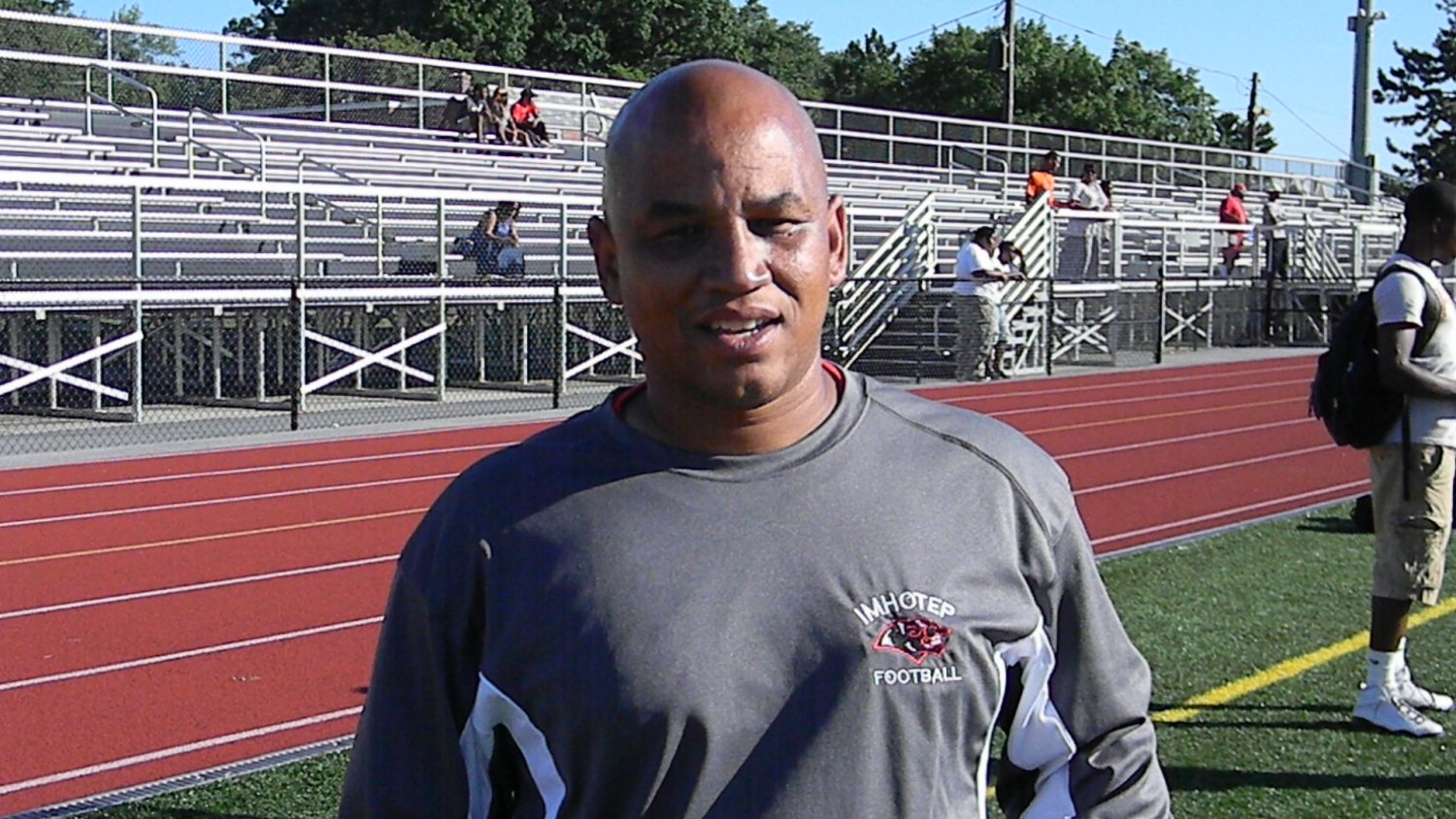
Andre Noble, Imhotep Boys Basketball Coach

Find a school that has taken the time, like IMHOTEP, to make sure that their special education classes were reviewed and approved by the NCAA.

albie-crosby-imhotepAlbie Crosby, Imhotep Football Coach

Give your child the best possible chance to earn a college scholarship… Everything else is bullshit… I’m just sayin’….

Dealing with Barriers to NCAA Eligibility: The kwalifī Strategy?

I’m NOT sayin’ it’s a racist organization, but….

Historically speaking, from 1906 through the early 1970‘s the National Collegiate Athletic Association (NCAA) sanctioned and supported Apartheid-like Jim Crow segregation among it’s member institutions. For the better part of seven decades, the NCAA perpetuated a system which, more or less, formally excluded people of color from widespread participation. A few exceptional Black athletes like, Paul Robeson (Rutgers), Jackie Robinson (UCLA) and Jesse Owens (Ohio State) slipped through the segregationist cracks in the northern and western parts of the country. In the South, however, big-time college athletics was the exclusive purview of white people.
kwalifi poster - basketball black & white-page-0

Following a massive and sustained struggle for respect, dignity and basic Human Rights during the 1950’s and 1960’s, overt and blatant segregation waned considerably. By 1971, Blacks, heretofore excluded from collegiate athletics at Kentucky, North Carolina, Alabama, Florida, Texas, Mississippi, South Carolina, Clemson, North Carolina State, Louisiana State and other powerhouse football and basketball programs, became all the rage. Between 1970 and the early 1980’s Black student-athletes became a dominant force in mainstream collegiate athletics. Simultaneously, Historically Black Colleges and Universities (HBCUs) suffered as they steadily lost the most talented Black athletes to wealthier predominantly white institutions.

What was the response of the NCAA to this rapid “tanning” of the high profile revenue generating sports? For some white University Presidents, Athletic Directors and University Donors it must have seemed like an invasion…

Something had to be done… But what?

They couldn’t just contract with Donald Trump to build a “HUGE” wall around football and basketball locker rooms… Nonetheless, they needed a means of stemming the rising tide of Black bodies flooding Basketball and Football programs across the nation…

The problem was that formal segregation was no longer acceptable in America circa 1982-83. It was no longer politically viable to resurrect and reinstall “White Only” signs that had been removed 15 years earlier… A more nuanced and subtle means of denying access was needed. They devised on strategy centered on the development and implementation of “initial freshman eligibility rules.”

I’m NOT sayin’ it’s a racist organization, but….

These eligibility rules were, and remain to this day, discriminatory against Blacks. John Chaney and John Thompson, II throughout much of the 1980’s and early 1990’s, passionately campaigned against what they referred to as  intentionally “racist” eligibility rules. Following eligibility reforms in 1989, Chaney, Temple University’s Hall of Fame Head Coach, unequivocally stated, “The NCAA is a racist organization of the highest order… On this day, it instituted a new punishment on black kids who have already been punished because they are poor. Any time the NCAA, which is 90 percent white, considers the youngsters in Division I basketball and football, it discriminates, because 89 percent of the kids are black. I wonder what message they are sending. It’s another hardship for black kids made by white folk.”

John Chaney

In response to the same reforms, Georgetown University’s John Thompson, II noted, ”I think it’s sort of ironic when they began to integrate the South athletes were the ones used to pave the way, and they were used under the pious assertion that ‘we’re helping these poor kids… Now, apparently someone has said, ‘Enough,’ so they don’t need the kids anymore. They’re using the same rationale they used to get them in to begin to keep them out. I guess it’s a situation where we’re like shoes and clothes. We’re not in style anymore.”

John Thompson

John Thompson, II

These legendary Black coaches used their positions of prominence to consistently and fervently denounce the NCAA’s racist actions. Since then, every four or five years, the NCAA has implemented increasingly stringent initial eligibility standards. Each set of reforms disproportionately impacting Black student-athletes in a negative manner. The most recent 2016 reforms have, once again, led contemporary prominent Black coaches to openly question the disparate racial impact.

I’m NOT sayin’ it’s a racist organization, but….

The National Association for Coaching Equity and Development (NACED), a group led by Texas Tech coach Tubby Smith, Georgetown coach John Thompson III (son of John Thompson, II) and former Georgia Tech coach Paul Hewitt, recently issued a statement to The Associated Press observing that the standards disproportionately target minority and less affluent students in “an unintended consequence beyond acceptability.”

Whereas Chaney and Thompson, II contended that the NCAA acted with malice and fully intended to harm Blacks, the contemporary Black coaches recognize the same harmful impact but chose to consider it “an unintended consequence.” The raw, unfettered and direct accusations of racist behavior on the part of the NCAA put forth by Chaney and Thompson, II stand in stark relief to mild objections of “unintended consequences” emanating from Tubbs, Hewitt and Thompson, III.

John Thompson, III

Nonetheless, today’s coaches are voicing objection… “That dream could be taken away after six semesters in high school,” John Thompson III said. “So for someone that’s a late bloomer, someone that the light bulb doesn’t go on until later, now it’s too late. And just the disproportionate number of minorities that’s going to affect, the number of people in general that’s going to affect, is not good.”

The 2016 rule changes, coupled with a 2007 rule that allows for only one course from prep school to be applied to an athlete’s transcript, will have a major impact on the number of Black athletes that will be eligible to compete as freshman, especially in the NCAA’s two biggest moneymakers: football and men’s basketball.

A recent NCAA report found that 43 percent of men’s college basketball players, 35 percent of football players and 15 percent of Division I athletes overall who were competing as freshmen in 2009-10 would not have qualified under the new standards. Whether it’s intentional as argued by Chaney and Thompson 25 years ago or “unintentional” as posited by Tubby, Thompson, III and Hewitt, the end result is clear.

A disproportionate number of Black males are going to be excluded from collegiate competition.

I’m NOT sayin’ it’s a racist organization, but….

If I wanted to identify a scheme that would disproportionately harm Black student-athletes I would set the minimum SAT score, with a minimum GPA, at 900. As you can see on the above chart, there is a persistent “performance gap” between racial/ethnic groups on the SAT exam. Asians excel, whites do well and ONLY Blacks have average SAT scores below the 900 cutoff point.

In the “real world,” the “average” white student with a 2.3 GPA will be eligible and the “average” Black student with a 2.3 GPA will be ineligible.

This a perfect scheme… if the aim is to limit opportunities for Blacks while appearing race-neutral.

I’m NOT sayin’ it’s a racist organization, but….

How can Blacks counter this scheme that will, undoubtedly, have racist and discriminatory impact?

While it is certainly interesting to note the evolution of the responses from Black coaches, it really does not matter if the NCAA is intentionally or unintentionally trying to decrease opportunities for Blacks? We must deal with the simple fact that they are decreasing opportunities for Blacks.

The inevitable outcome will be fewer eligible Black student-athletes.

So… What are our strategic options? What should Blacks do about it?

The Black Cager has been discussing this very question with prominent and influential members of the Black youth basketball, AAU/Grassroots and educational communities. Although a lot of different ideas emerged during these conversations, there was a recurring theme in all the discussion.

“We have to EDUCATE the young student-athletes.” Over and over, it was concluded that the best thing we could do was to provide student-athletes and their parents with easy to understand and accessible information regarding the rule changes.

Kamal Yard, Philly Pride/Triple Threat

The Black Cager has had strategic discussions with Kamal Yard, Eric Worley, Rodney Veney and Amauro Austin (Philly Pride/Triple Threat AAU/grassroots organization). They immediately embraced and acted upon the strategy. Rob Brown and Aaron Burt (Team Final) agree that educating families and student-athletes is the most useful tactic at this point. Lonnie Lowry (Team Philly) continues to be a staunch supporter of educational efforts by the Black Cager. Terrell Myers (WeRone Hoops) has also embraced the educational outreach strategy.

Terrell Myers and Sedee Keita

Others have embraced and incorporated the educational outreach strategy as well. Littel Vaughn Charles Monroe consistently make sure they incorporate NCAA eligibility education in every event/league they organize. Philly’s High School Coaches have been very proactive with regard to getting information out to the families. John Mosco (Archbishop Wood), Paul Ramczuk (Archbishop Carroll), Rob Moore (Constitution), Andre Noble (Imhotep), Jazz Williams (West Catholic), Kenyatta Bey (Audenreid), Larry Yarbray (Chester), Pervis Ellison (Life Center Academy), Carl Arrigale (Neumann-Goretti), Chris Clahar (Parkway, CC) and Clyde Jones (Penn Wood) have demonstrated a strong commitment to working with families to increase opportunities for their players to access high learning institutions.

The Black Cager has consulted with Paul Gripper (Team Phenom), Vincent Robinson (The Robinson School) and Sam Rines (Rise Academy) on numerous individual cases. These guys fight the fight and walk the walk with their players. They win some, they lose some… But they always try to arm the players/families with accurate information as early as possible. Lou Daniels, Betty Givens, Mo Howard and Claude Gross are always available to provide counsel and guidance. They treat every kid as if he/she were their own.

But…

Even with all of these efforts we are just scratching the surface of an enormous problem affecting tens of thousands student-athletes of color. This is a national, perhaps even international, issue.  Many African, Latin American and European student-athletes have also been experiencing great difficulty meeting eligibility requirements.

kwalifi - screen shots -page-0

All agree that we need interventions capable reaching tens of thousands of families. Hence, after consulting with all of the above members of the youth basketball community, we have developed the kwalifi smartphone app. kwalifī is a simple and powerful app for tracking progress toward meeting NCAA Division I, Division II and NAIA scholarship eligibility requirements. It allows parents, students and coaches to take ownership of the eligibility process. Core course grades, sliding scales, core course GPA calculations are made easy to understand. No more depending on counselors. It is simple, easy to understand and very useful! Specific steps are outlined to help student-athletes meet NCAA and NAIA requirements.

Bay and Josh

Josh Selby and Bay Frazier

Moreover, with the assistance of people like Rodney Veney, we have discussed ways to ensure that every Black kid has access to the kwaifi app with Bay Frazier (Carmelo Anthony’s Manager), Rich Paul (LeBron James’ agent), Curtis Symonds (retired BET Executive) and Kevin Chiles (Publisher, Don Diva Magazine). As we develop marketing distribution strategies, The Black Cager welcomes input from all concerned parents. players, coaches and others committed to improving the educational opportunities for Black student-athletes. This is merely one step in a struggle to ensure our young people continue to have access to educational opportunities commensurate with their academic and athletic abilities.

Rich Paul

Rich Paul, Klutch Sports Group

We have to EDUCATE the young student-athletes… If you have any thoughts, ideas or suggestions as to how we can do a better job of pursuing this strategy please shoot us an email at blackcager@gmail.com. If you know of youth organizations or schools that will benefit from the kwalifi app, let me know!

Delgreco K. Wilson
The Black Cager

Kwalifi logo


Philadelphia Youth Basketball: Social, Educational and Emotional Development

On October 8, 2015, Philadelphia Youth Basketball, Inc. started a new dialogue…

A wide range of basketball stakeholders were present. Claude Gross represented the Sonny Hill League. Don DiJulia, Saint Joseph’s University’s Athletic Director was reunited with his Sweet 16 backcourt of Rashid Bey and Terrell Myers. Fran Dunphy and Steve Donahue, respectively, represented their Temple University and Pennsylvania University basketball programs. Kamal Yard (Philly Pride), Myers (WeROne), Eric Worley (Philly Triple Threat) and Bey (Team Final) represented three of the more prominent and influential AAU/Grassroots programs in the region. Justin Scott, Arcadia University and Rudy Wise II, Rosemont, held it down for the small colleges. Camden was represented by Tyrone Pitts and Larry Yarbray was flying the Chester High flag.

Pitts, Bey, Dunph, Claude, Scott

Tryone Pitts (Penn), Rashid Bey (SJU), Fran Dunphy (Temple), Claude Gross (Sonny Hill League), Dr. Scott Brooks (Missouri)

What was most interesting about this gathering was the fact that the game of basketball was never mentioned over the course of more than 2 hours. The discussion focused squarely on how the Philly basketball community can develop, harness and leverage social capital that can be utilized to further the social, educational and emotional development of young people or “our guys” as Dr. Scott Brooks described them.

Held in the Graduate School of Education at the University of Pennsylvania, the “Roundtable Discussion” was led by Dr. Brooks, Professor of Sociology at the University of Missouri. Dr. Howard C. Stevenson, Constance Clayton Professor of Urban Education at the University of Pennsylvania and Stephanie A. Tryce, J.D., Assistant Professor of Sports Marketing were also in attendance.

Kenny Holdsman and Eric Worley outlined their vision and plans to build a state of the art, basketball-based youth development center in the heart of North Philadelphia. Holdsman passionately posited that when you create opportunities for young people to develop their potential as students, athletes, and responsible engaged citizens, the individual and the community will thrive. Basketball, for Holdsman and Worley, is more than a game. Their efforts are undergirded by extensive research demonstrating that sports foster growth and development physically, academically, and socially.

Kwalifi Poster - Rens-page-0

Towards that end, Holdsman noted that they have begun building a professional organization and initiated fundraising efforts to construct a $25 million state-of-the-art, basketball-based youth development center in the heart of North Philadelphia. This 120,000 square foot facility will have 8 indoor and 8 outdoor courts including a 2,000 seat indoor competition court. It will also feature an education wing with a library, classrooms, computer lab, and a community engagement center.

Take the PYB Tour!

Worley explained that they simply could not wait for construction to be concluded to begin serving Philadelphia’s young people. As a result, in a couple of weeks they are initiating the PYB School Partnership Pilot Program. Through this pilot program, PYB will provide programming in eight-week intervals (fall, winter & spring) for middle-school aged students at four school partners located in the North, Northwest, and Southwest regions of the city. Programming will be held at the location of the four school partners twice a week during after-school hours and every Saturday at Temple University and/or another Philadelphia area college or university. The program will focus on academic support, homework help, study skills, time management, tutoring, high school selection, leadership, character development, health and nutrition, family engagement, and basketball skill-building and competition. All participants will receive basketball uniforms.

Dunph and Claude

Fran Dunphy & Claude Gross

Claude Gross shared stories from his experiences over the past 55 years with the Charles Baker and Sonny Hill Leagues. Gross explained that the Hill league was never about producing NBA basketball players. Rather it was always about producing middle class young men that could provide for themselves and their families and become positive contributing members of society.

Finally, there was a magisterial presentation by Dr. Brooks, a protege of Philly Schoolboy legend Claude Gross. While pursuing a Ph.D. in sociology at the University, Brooks spent four years coaching under Gross in the Sonny Hill League basketball. The result of his research was an extremely insightful and nuanced book, Black Men Can’t Shoot (University of Chicago Press). For those interested in gaining a better understanding of the multi-layered intersections of urban education and scholastic sports, it is a must read.

Black Men Can't Shoot

In his presentation, Dr. Brooks deftly described what he saw, heard, and felt working with the young black men in the Hill league. His discussion of the manner in which the Claude Gross, Fred Douglass, Vince Miller, John Hardnett, Tee Shields and others utilized their social networks and expended their social capital was both informative and captivating.

Stephen Pina, a sports attorney with ASM Sports exclaimed, “that was the best talk I’ve heard… Dr. Scott is able to convey his academic work in a very ‘REAL’ manner.” Kamal Yard said, “He articulated everything I have been saying and thinking for the past 10 years.” Rashid Bey reported, “I thought about that presentation all night.”

Perry, Terrell, Rashid

Perry Clark, South Carolina Assistant Coach, Terrell Myers and Rashid Bey

There will be subsequent “Roundtable Discussions” sponsored by Philadelphia Youth Basketball, Inc. and Black Cager Urban Sports Media. Updates will will be available on this website.