CAMDEN, NJ – The transfer portal giveth, and the transfer portal taketh away. But sometimes—rarely—the portal gives a player the chance to reconsider, recalibrate, and return.
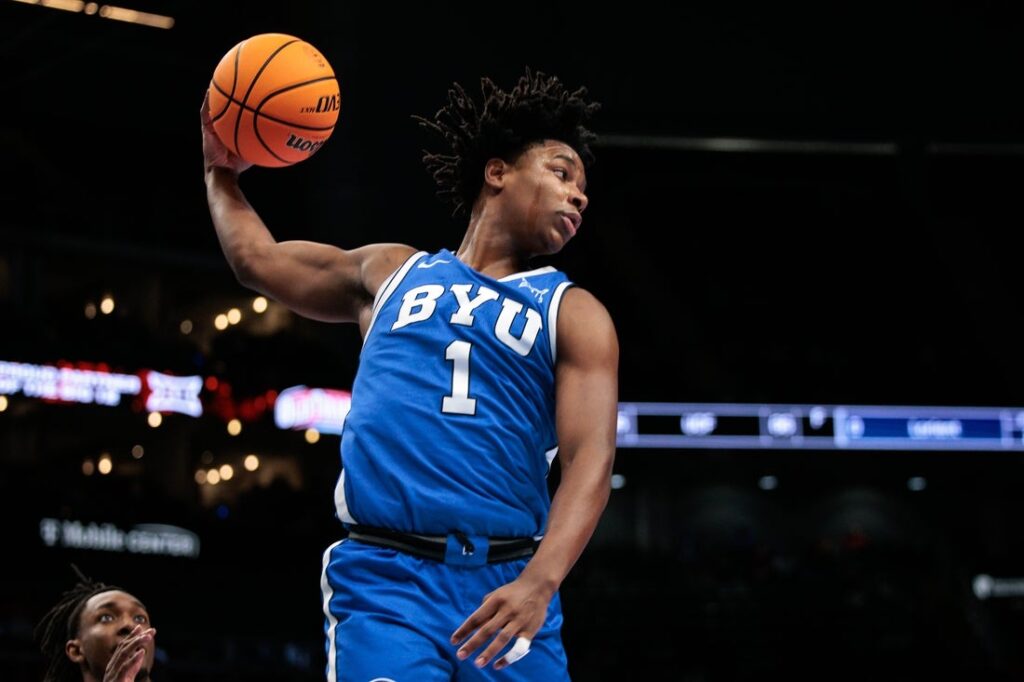
That is precisely what happened when Robert Wright III, arguably the top point guard in the transfer portal this spring, made the stunning decision to withdraw his name and remain at BYU. The 6’1″ floor general had been pursued relentlessly by Kentucky, Ohio State, and a host of other blue-blood programs eager to add a proven winner to their backcourts. For a moment, it seemed Wright was gone—another star plucked from the Wasatch Front by the gravitational pull of the SEC or Big Ten.
Instead, Wright did something increasingly rare in this era of perpetual roster churn. He stayed.
And by staying, he may have made the smartest decision of his career.
The Portfolio Problem: What Wright Was Weighing
To understand Wright’s decision, you have to understand the calculus that elite players now face. This is no longer simply a choice between schools. It is a portfolio allocation problem—a balancing of immediate returns against long-term speculative assets.
When Wright entered the portal, he was confronted with a classic dilemma:
Immediate Returns (Kentucky/Ohio State): Substantial NIL guarantees, the prestige of the SEC or Big Ten, and the promise of a national stage. On paper, the offers were overwhelming.
Speculative Growth Assets (BYU): A system where he was already the unquestioned leader. A coaching staff that had built the offense around him. A developmental infrastructure that had just produced an All-Big Ten Third Team season, a 39-point outburst against Colorado, and a game-winning dagger at Madison Square Garden.
The high major offers promised money and exposure. But they also promised uncertainty. A new coach. A new system. New teammates who had not yet learned to trust him. The risk of becoming a role player rather than the man.
Wright weighed those risks carefully. And he chose BYU.
What He Leaves on the Table (And What He Gains)
Let’s be clear: Wright is leaving real money on the table. Kentucky and Ohio State’s collectives were prepared to offer NIL packages that BYU—despite its resources—could not match. In the short term, this decision costs him.
But the long-term calculus is different.
Wright is not a player who needs to prove he can score against high-major competition. He has already done that. This past season, he averaged 18.1 points, 4.6 assists, and 3.5 rebounds per game while shooting 41 percent from three and 82 percent from the line. He scored a career-high 39 points in an overtime victory over Colorado on Valentine’s Day. He hit a game-winning three-pointer against Clemson in the Jimmy V Classic at Madison Square Garden. He was named All-Big 12 Third Team, NABC Second Team All-District, and was a finalist for the Bob Cousy Award.
He has nothing left to prove at the individual level.
What he needs is what BYU already provides: certainty. He knows he will play 35 minutes per game. He knows the offense runs through him. He knows Coach Kevin Young—a former NBA assistant with the Phoenix Suns—is preparing him for the professional game. He knows the Big 12 is the toughest conference in college basketball, and he has already conquered it.
At Kentucky or Ohio State, none of that would be guaranteed. He would have to earn trust. He would have to compete for minutes against other elite guards. He would have to learn a new system, build new chemistry, and hope that the promises made during recruitment translated to playing time.
That is a risk Wright did not need to take.

The Asymmetric Information Problem
One of the most underappreciated dynamics of the transfer portal is the information asymmetry between players and programs. Programs have complete information about their own rosters, their own systems, and their own depth charts. Players do not.
When Wright entered the portal, Kentucky and Ohio State could promise him anything. But promises are not playing time. Depth charts shift. Coaches get fired. Recruiting classes arrive. The player who is promised 30 minutes in April may find himself playing 15 in November.
Wright has already experienced this dynamic once. He transferred from Baylor to BYU after his freshman season precisely because he wanted a guaranteed role. He got it. He started all 35 games, averaged nearly 35 minutes, and became the face of the program.
Why would he risk that again?
The BYU Infrastructure: More Than Just Minutes
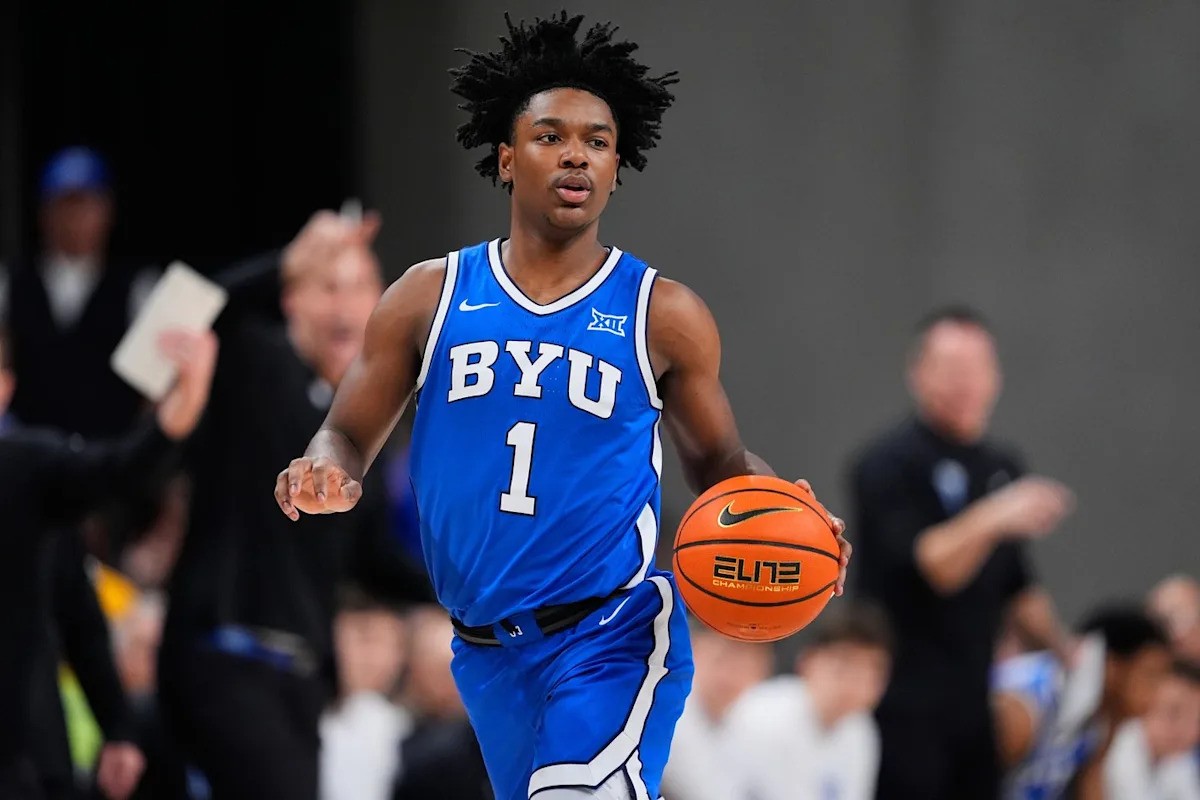
It is also worth noting what BYU offers beyond playing time. Kevin Young is not a typical college coach. He spent years on Monty Williams’ staff with the Phoenix Suns, developing NBA talent and learning modern offensive principles. His system—pace, space, player empowerment—is a direct pipeline to the professional game.
Wright flourished in that system. He was 6th in program history in field goal attempts in a debut, 8th in games started in a season, 10th in assists in a single season, 14th in points in a game, and 20th in points in a single season. He is not just a player at BYU. He is a program cornerstone.
And BYU’s schedule—with games against Kansas, Houston, Baylor, Iowa State, and Texas—provides as much high-level competition as any conference in America. Wright does not need the SEC to be seen. He is already seen.
The Final Verdict: A Mature Decision in an Immature Market
In the chaotic, transactional world of the transfer portal, Wright’s decision to stay stands out as remarkably mature. He was pursued by the biggest brands in the sport. He was offered life-changing money. He had every excuse to leave.
He chose to stay because he understood that the goal is not maximizing NIL compensation in a single season. The goal is maximizing career value over a lifetime. And BYU—with its system, its coach, its certainty—offers him the best path to the NBA.
Wright has a legitimate opportunity to be a first-round pick in the 2027 NBA Draft. He could make more money in his rookie contract than any NIL deal could provide. And he will look back on this decision—to stay, to trust, to finish what he started—as the moment his career trajectory changed for good.
The portal giveth. But sometimes, wisdom taketh away.
 The Black Cager