CAMDEN, NJ – Athletes are frequently criticized for chasing immediate NIL paydays rather than prioritizing programs that offer superior coaching, development, and professional pathways. You are well acquainted with the narrative: players sign with schools offering the largest guarantees, struggle to adapt, lose confidence, and watch their draft stock crater.
Rare are the stories of rational and intelligent decisions based on strategy. Where the player does not chase the highest NIL offer. Where the player chases the right fit, the right level, the right platform, and the right coach.
The transfer portal is often portrayed as a realm of chaos. But for every cautionary tale, there is a player like Ernest Shelton, who has used the portal not as an escape, but as a ladder.

Shelton’s journey from Division II Gannon to Merrimack to Boston College is not a story of impatience or disloyalty. It is a story of a player who has improved every single year, who has consistently bet on himself, and who has made well-informed strategic decisions to maximize his development, his exposure, and his professional future.
This season, after beginning his collegiate career in the PSAC, Shelton will likely start for Boston College in the ACC under first-year head coach Luke Murray—the architect of UConn’s back-to-back national championship offenses. That sentence would have seemed impossible three years ago. But Shelton has proven that the portal, used wisely, can be a tool for ascending—not just transferring.

The Portfolio Problem: Two Decisions, One Trajectory
To understand Shelton’s journey, you have to understand his decision-making as a series of portfolio allocations—each one balancing immediate returns against long-term growth.
Decision #1: Gannon to Merrimack (2024-25)
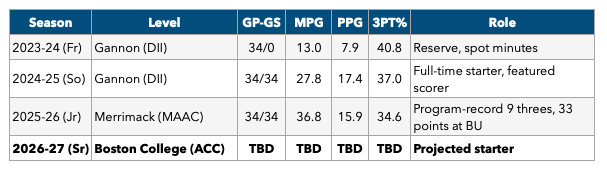
As a freshman at Gannon, Shelton was a reserve, averaging just under 13 minutes per game. But he showed flashes—a 24-point explosion in his collegiate debut (8-of-12 from three), a 40.8% three-point percentage that ranked fifth in the PSAC.
During his sophomore season at Gannon University in 2024-25, Ernest Shelton emerged as a full-time starter and one of the most prolific scorers in the PSAC, appearing in and starting all 34 games while averaging 27.8 minutes per contest. He led the team with 17.4 points per game, knocked down 150 three-pointers at a 37.0 percent clip, and shot an impressive 85.5 percent from the free-throw line. Shelton recorded seven 20-point games and one 30-point outburst, highlighted by a season-high 32 points against Virginia State (March 16) and a season-best seven three-pointers against Davis & Elkins (November 13). His breakout sophomore campaign proved he could carry a featured scoring load and set the stage for his subsequent transfer to Merrimack and eventual ascent to Boston College.
He needed a platform where he could play.
Merrimack offered that platform. The Warriors were a rising program in the MAAC. They needed shooting. They needed a guard who could stretch the floor. They promised him a featured role.
The Calculus: Shelton traded the comfort of a known system for the uncertainty of a new one. But he also traded D2 starter’s minutes for a D1 starting job. He traded PSAC obscurity for MAAC visibility. The speculative assets—development, exposure, professional pathway—outweighed the risk.
Decision #2: Merrimack to Boston College (2025-26)
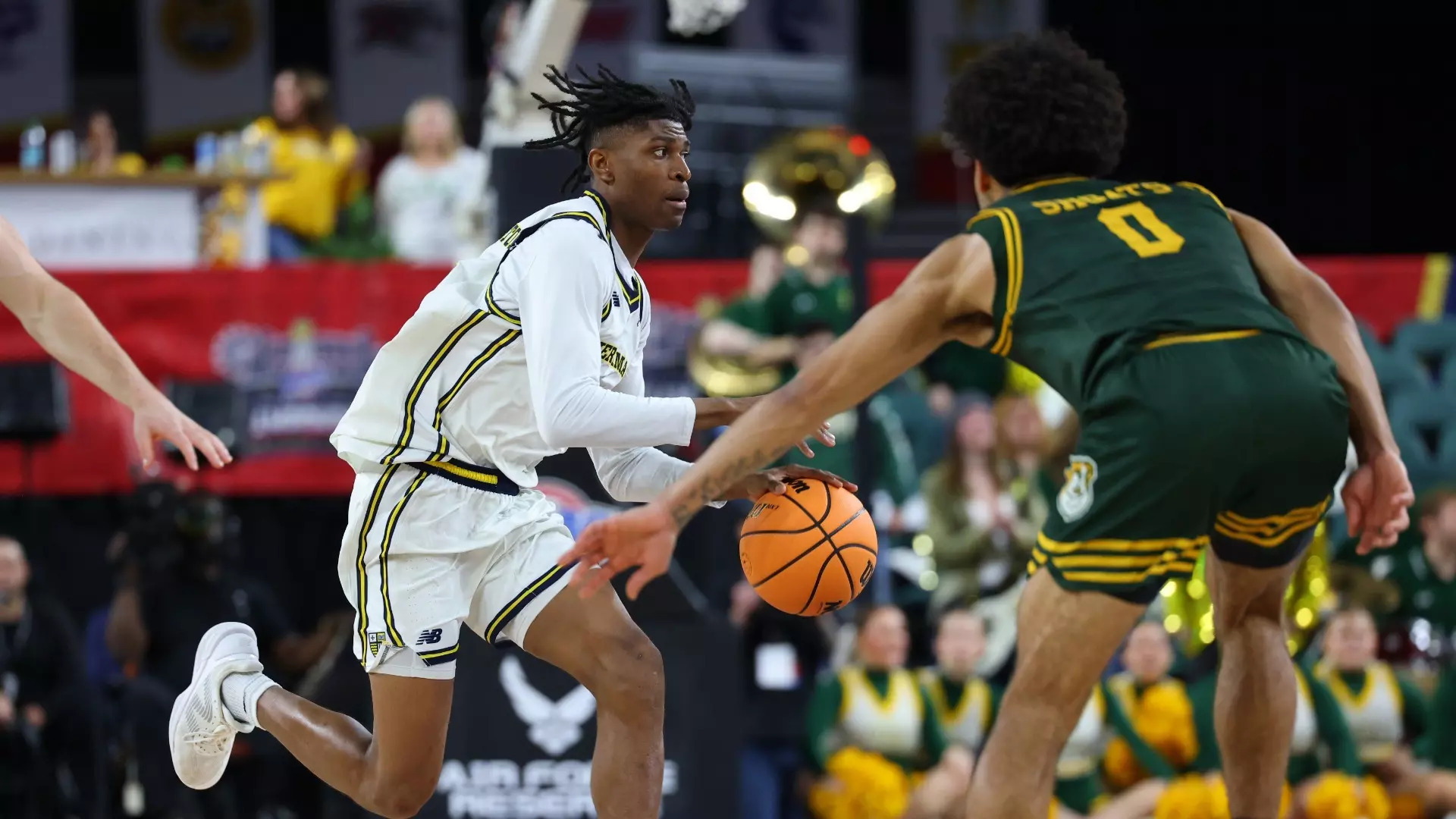
Shelton’s single season at Merrimack was a resounding success. He tied the program’s single-game record with nine three-pointers (9-of-12) on his way to 33 points in a win at Boston University. He had the rare feat of two four-point plays in back-to-back games. He scored 23 points, making five threes, at No. 20 Auburn. He led the Warriors with 16 points in a win at Princeton. He made five threes on his way to 17 points in a win over La Salle at the Palestra.
He had proven he could produce at the Division I level. But the MAAC, while respectable, is not the ACC. And Shelton had one season of eligibility remaining.
And then Luke Murray was hired.
Boston College offered the next rung on the ladder: a starting job in the ACC, a platform with NBA scouts in attendance every night, and a chance to prove he could produce against high-major competition.
The Calculus: Shelton traded the comfort of a known role (featured scorer at Merrimack) for the uncertainty of a higher level. But he also traded MAAC visibility for ACC exposure. He traded a mid-major platform for a power conference stage. And he gained something invaluable: a head coach who had just coordinated the most dominant two-year stretch in modern NCAA history.
The Luke Murray Factor: A Championship Pedigree
If Shelton’s decision to transfer to Boston College was strategic, the arrival of Luke Murray made it inspired. Murray joined Dan Hurley’s UConn staff prior to the 2021-22 season. In four seasons in Storrs, the Huskies posted a 115-32 (.782) record—the winningest four-year span in program history.
They won back-to-back national championships in 2023 and 2024.
They produced eight NBA players and three lottery picks, including Donovan Clingan, a lottery pick whom Murray led recruiting efforts for.
Murray’s Offensive Pedigree:
UConn’s offense ranked No. 22 in his first season (Kenpom)
Soared to No. 3 in his second season
Peaked as the nation’s No. 1 offense in 2023-24
The ’24-25 unit finished 15th in adjusted offensive efficiency and was the BIG EAST’s most efficient attack
Murray’s Player Development Track Record:
Final Four MOP and All-American Adama Sanogo
Lottery pick Donovan Clingan (lead recruiter)
Alex Karaban (All-BIG EAST)
Liam McNeeley (McDonald’s All-American)
Cam Spencer (First Team All-Conference, NBA draft pick)
For Shelton, a shooter who has improved every year, playing for the architect of the nation’s most efficient offense is a dream scenario. Murray’s system prioritizes spacing, ball movement, and three-point shooting—all of which play directly to Shelton’s strengths.
The Consistency: A Player Who Improves Every Year
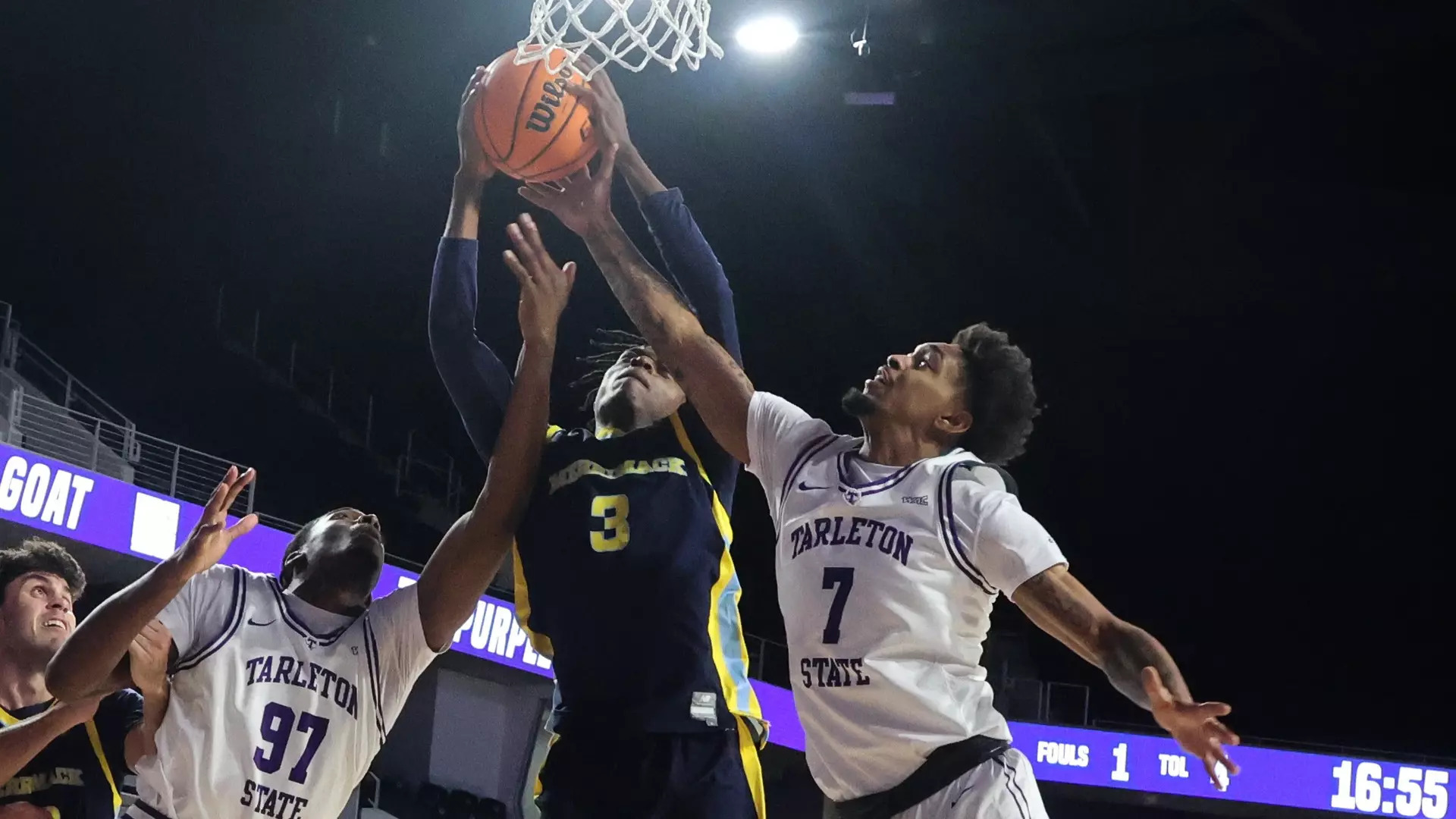
What makes Shelton’s journey remarkable is not just the transfers themselves, but the consistent improvement that has accompanied each move.
Shelton has improved every single season. He went from a reserve to a full-time starter. From 7.9 points per game to 17.4. From the PSAC to the MAAC to the ACC. And now, he will play for a coach who has coordinated the most efficient offense in college basketball.
The Information Asymmetry Problem
One of the most underappreciated dynamics of the transfer portal is the information asymmetry between players and programs. Programs have complete information about their own rosters, their own systems, and their own depth charts. Players do not.
Shelton mitigated this risk by making moves that were logical, incremental, and evidence-based. He did not jump from Division II to the ACC in one move. He took an intermediate step—Merrimack—to prove he could produce at the Division I level.
He chose programs where he had a clear path to playing time. He chose coaches who had demonstrated they could develop guards.
And now, he has chosen to play for a coach who has demonstrated he can develop NBA talent and coordinate championship-level offenses.
That patience—that strategic sequencing—is the exception, not the rule, in the portal era.
What Shelton Gains at Boston College
A Championship Offensive System: Murray’s UConn offenses were historically efficient. The 2023-24 squad set a program-record with 37 wins and was the dual BIG EAST champion before concluding the most dominant two-year stretch in modern NCAA history. Shelton, a career 40% three-point shooter, will thrive in a system that prioritizes spacing and perimeter shooting.
NBA Development Infrastructure: UConn produced eight NBA players and three lottery picks during Murray’s four seasons. Shelton will be coached by someone who has prepared players for the professional level.
ACC Exposure: Boston College will face Duke, North Carolina, Virginia, Miami, and Florida State. NBA scouts attend every ACC game. Shelton will be seen nightly.
A Clear Role: Boston College needs shooting. Shelton provides shooting. He will likely start from day one.
The Final Verdict: A Blueprint for the Strategic Transfer
Ernest Shelton’s journey is a blueprint for how the transfer portal should work. He did not transfer out of desperation. He transferred out of strategy. He did not chase the highest NIL offer. He chased the right fit, the right level, the right platform, and the right coach.
He began his career as a reserve at a Division II program. He will end it as a starter in the ACC, playing for a coach who has won back-to-back national championships and developed lottery picks. That is not luck. That is a player who understood his own portfolio, who made calculated decisions under conditions of incomplete information, and who consistently bet on himself.
The portal is full of cautionary tales. Ernest Shelton is a success story—one that should be studied by every player considering a transfer.
 The Black Cager