From North Philly to Strong Island: The Emergence of Ameen Tanksley

On the low?
Yeah, the only way to blow
You let your shit bubble quietly
And then you blow

Jay-Z, Coming of Age

Ameen1Ameen Tanksley, Hofstra University

Sometimes everything just comes together… Sometimes the situation is just right… Your teammates believe in you… Your coach has confidence in you… The school community embraces you… Your stroke is tight… Sometimes… Sometimes, the timing is just right… When it happens, it can seem magical…

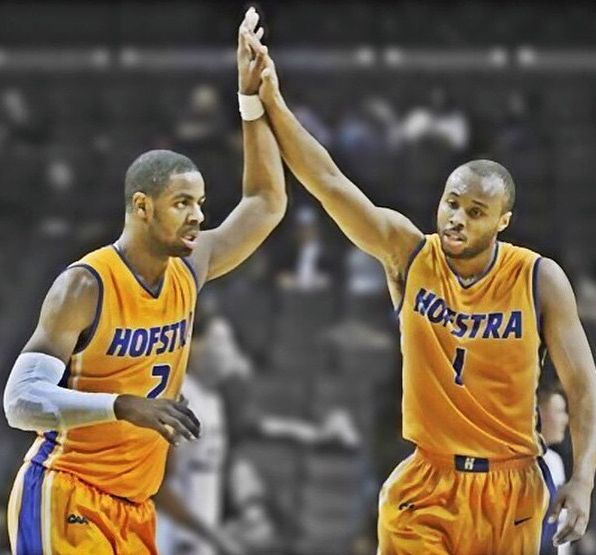
Welcome to Hempstead, Long Island. Here, about 25 miles east of NYC two of Philly finest are putting together a phenomenal season in the 5,023-seat David S. Mack Sports and Exhibition Complex. Juan’ya Green and Ameen Tanksley have emerged as, perhaps, the most lethal tandem at the mid-major level. In their first season at Hofstra, they have taken the Island by storm.

Green’s production comes as no surprise. He is the known.  He’s been killin ’em… We all know what to expect from Juan’ya.  Three years ago, he exploded on the collegiate hoops scene averaging 17.7 ppg and 4.5 apg as highly decorated frosh for the Niagra Purple Eagles. Green followed up with a strong sophomore campaign in which he averaged 16.5 and 4.9. In just two seasons, Juan’Ya dropped an astounding 1131 points on Niagara opponents.

Juanya1

Juan’ya Green, Hofstra

He was well on his way to the finest career in Niagra’s illustrious history since the legendary Calvin Murphy was named a three-time All-American in the late 1960s.

Tanksley, on the other hand, was a solid but not spectacular player. As a freshman he contributed 8.7 ppg and snared 5.9 rpg. As a sophomore he improved his output and scored 11.3 ppg while still grabbing 6.0 rpg. He was a good player. But he was overshadowed by Green and Antoine Mason who averaged 18.7 ppg that year as the Purple Eagles went 19-14 and won the MAAC Regular season championship.

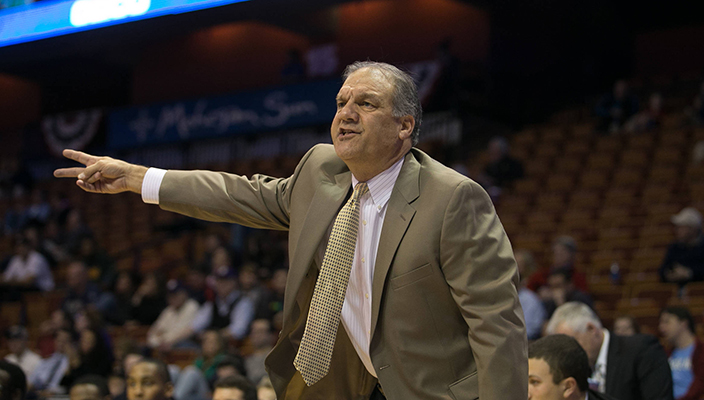
In April of their sophomore year, Tanksley and Green learned that their coach, Joe Mihalich was taking the job at Hofstra University. Coming off a season where they had experienced a great deal of success, Niagra was expected to be even better going forward. Niagara’s top five scorers were all underclassmen expected to return next season. Green and Tanksley would be leaders of an established group.

mihalichJoe Mihalich, Head Coach, Hofstra University Basketball

But, Coach Mihalich was out… The questions were obvious…  The answers were not… What should the Philly boys do? Should they stay with the reigning regular season champs? Should they stay with a program loaded with experienced and highly productive players?

Or… Should they roll the dice?  Should they take a take a chance? Do they leave the security and comfort they established in the Niagara program for the uncertainty surrounding Hofstra?

Hofstra was flailing and floundering… They had just finished in 10th place out of 11 teams and hadn’t appeared in the NCAA tournament since 2001. While Niagra was winning the regular season championship, Hofstra was going a dismal 7-25 during a season in which four players were arrested on charges related to several on-campus burglaries. When Mihalich arrived, there were only seven players on the roster, and none averaged more than 6.8 points per game.

The Philly boys, perhaps predictably, decided to roll out with their Philly coach. Just as Mihalich demonstrated his loyalty while serving as an assistant at LaSalle University for 17 years (1981-1998), his Philly recruit displayed a tremendous amount of loyalty and followed him Long Island. They haven’t looked back.


tanksley and greenTanksley and Green

After sitting out a year following their transfer, the Philly boys are having a huge impact at Hofstra. Green has wasted no time establishing himself as a premier CAA guard. That is no small accomplishment. He is averaging 17.6 ppg, 6.8 apg and 5.1 rpg. While these numbers are outstanding, they are not surprising. He’s not new to this… Green came in the collegiate door blazing straight from his prom. For those that have followed his development, nothing less than 17, 5 and 5 every night is acceptable from Mr. Green.  He is well on his way to continuing the recent lineage of outstanding guard play in the CAA.  He appears to he heir to Eric Maynor (VCU), Charles Jenkins (Hofstra), Devon Saddler (Delaware) and Franz Massanet (Drexel).

However, the biggest surprise in the CAA this season has been the emergence of Tanksley as a viable POY candidate. Through his first 12 games with Hofstra Tanksley has averaged a league leading 19.8 ppg. After two solid seasons at Niagra, he has become a go to guy in Hempstead. Reaching double figure is every game, Tanksley exploded for 32 against LIU-Brooklyn and 30 in a contest with Norfolk State. He had been over 20 on four other occasions. Even more impressive than his production has been his efficiency.

Tanskley is shooting 56.6% from the field and an amazing 53.7% from the 3-point line. After shooting only 33.3% on 3-pointers at Niagra, he has transformed himself into a deadly long-range specialist. Tanksley attributes his improvement to good old fashioned hard work.

“One of my coaches, Mike Farelly stayed on me… he constantly worked with me in the gym. We shot thousands of shot every day. He really helped me understand the mechanics of being a good shooter. We focused on eliminating wasted motion and developing a reliable and repeatable stroke. My confidence is really high as a result.”

Things really couldn’t be better for Tanksley. He’s very comfortable with the choices he has made. “A lot of Philly kids fall for the hype of playing high-major college ball. The most important thing for me was playing right away and getting better. My high school coach, Andre Noble, really helped me understand the importance of trust. I trust coach Mihalich and Coach Farelly.”

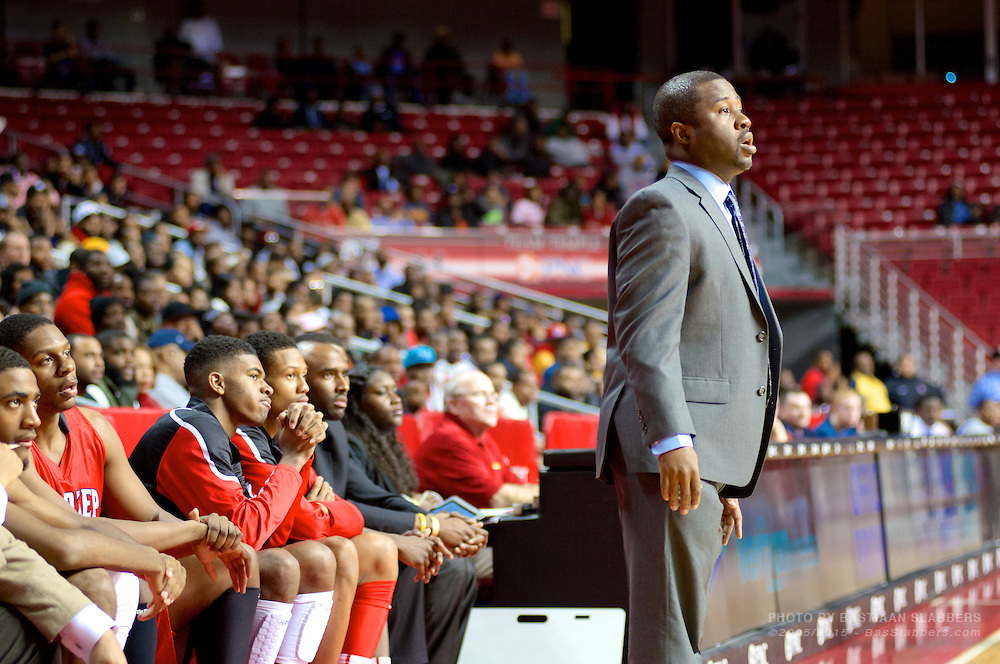
Imhotep wins fourth Public League title with thrilling 67-66 victory over VauxAndre Noble, Head Coach, Imhotep Charter High School

He credits Noble for helping him discern what’s really important. “After talking to Brother Andre, I was able to look in the mirror and be honest with myself. I was able to ask myself do you want to play high-major because everybody around me wants me to go high major. Once, I realized which questions were the most important, Coach Mihalich gave me all the best answers.”

A strong B student, majoring in Linguistics and Business, Tanksley is enjoying every minute of his stay on Long Island. “As a linguistics major, I really enjoy the fact that there are more media outlets in New York City. I have met all kinds of people since I’ve been here. I even spent some time in the Hamptons this past summer. I love Hofstra!”

On the court, Tanksley credits his success this season to Green. “The chemistry was always there. But at Niagara we also had Mason and I had to find my opportunities. This year, Juan’Ya looks for me… He finds me and he gets me the ball in spots where I can finish. He’s an incredible player… he makes me better.”

More Philly kids should take Tanksley’s advise and look in the mirror and be honest with themselves…

← Back

Thank you for your response. ✨

If not Us? Who?

“So when they continued asking him, he lifted up himself, and said unto them, He that is without sin among you, let him first cast a stone at her.”
John, Chapter 8, Verse 7

A major comeback up from my minor setback
They still don’t know we living just thinking about the get back
The get back
I crack a smile knowing God has a day for me
Until that day comes I slay these niggas faithfully
The get back

Fabolous, “The Get Back”

I am a sinner.

I am a certified, bonafide and confirmed sinner. At 15, I was an adjudicated delinquent. At 16, I was the father of a baby born out of wedlock. In college, I smoked marijuana daily. Indeed, one day the Dean came to my room to confront us about playing our music too loudly. Upon entering, he almost choked on the billows of fine smoke wafting through the air.  I’m sure he got a contact…

A few months later, the same Dean uncovered our “fundraising” efforts which included selling all you could drink “get blast” passes to our fellow students for the low price of $10.00. He became aware of our activities after a few of our “pass holders” threw one of our classmates through a plate glass window in the lobby of our dorm.

The Dean didn’t throw us away… He didn’t call the police… He dealt with us personally… We had to deal with him and he held us accountable to him… I thank God for Dean Burroughs…

I never forget that I along with every one of my college friends exercised incredibly poor judgement during that 18 to 22 year old period.

I’ll never forget entering the communal bathroom to brush my teeth and discovering three of my homies from Darby Township washing their genitals in the sink. C’mon man!! What the fuck? Why y’all doing that shit?

“Yo Grec… we running a train on this white girl down the hall… she lettin erry body hit it…”

I looked down the hall and there were at least 10-12 guys waiting patiently in line for their opportunity to knock off this drug addled, drunk, confused and lost young woman… Unbeknownst to them, my friends were all a police statement away from felony rape charges and maybe 7-14 upstate…

This is the perspective from which I view young men that experience public “falls” today.

“There but for the grace of God go I”

If not us? Who? Who will be there to encourage our young men? Who will stand up and applaud there efforts to do better?

Fall from Grace-page-0Savon Goodman, Arizona State

On December 20, 2014, Savon Goodman posted 24 points and grabbed 12 rebounds against Lehigh. He shot 9-11 from the field and even left 5 points on the floor by shooting only 6-11 from the free throw line. Three days later against Detroit, Savon shot 8-12 from the field and improved his foul shooting by going 6-8 from the charity stripe while securing 11 rebounds on his way to 22 points.

Trayvon ReedTrayvon Reed, Auburn

On December 17, 2014 Trayvon Reed grabbed 8 rebounds and blocked 2 shots in 12 minutes as Auburn defeated Winthrop. Three days later he grabbed 5 rebounds and blocked 5 shots as Auburn defeated East power Xavier.

BrandonBrandon Austin, Northwest Florida State

Brandon Austin has averaged 16.1 ppg, 4.3 rpg and 3.2 apg for Northwest Florida State College. Please note that while he has started every one of the the 14 contested for the undefeated Raiders, he is averaging ONLY 19.8 minutes per contest. He is playing less than half a game because his squad has been decimating opponents by an average score of 92 – 59.

These young men are on their last opportunities… They have felt the pain and embarrassment associated with publicly disappointing your mother, father and grandparents… They have watched as the sports media and the general public condemned them as “thugs” and declared them unworthy of future opportunities…

Still…

They got up and moved forward…

Still…

They searched for someone to give them another chance, another shot to prove that they could be contributing members of learning communities and integral parts of basketball programs…

These young men are my little brothers… I was there when it was “ALL GOOD”… I was there when they were declared top 50 players…. I was there when scores of coaches called, texted, tweeted and direct messaged all day, every day, day after day after day…

I was also there when the police came… I was there when they were pariahs… I listened when they wondered if it was all over…

I provided references, honest references for coaches afraid to take a chance on them…

I truly respect Herb Sendek (ASU), Bruce Pearl (Auburn) and Steve DeMeo (NWFS) for looking past the headlines and reaching out to the young men when they needed a strong hand to lift them up.

I love these guys… Like me, they fucked up “BIG TIME” while in college…

I applaud their efforts to revitalize their academic and athletic careers.

Those of you who are without sin, feel free to cast stones.

The rest of you, I ask that you support and encourage the efforts of OUR young men to stay on the straight and narrow path to success on and off the court.

← Back

Thank you for your response. ✨


spengine.com Mid-Season Philly College Hoops Awards

DJ NewbillDJ Newbill, Penn State University

DJ Newbill, Mid-Season MVP
In the Spring of 2010, DJ Newbill committed to play for Buzz Williams at Marquette. While he flew under the radar as far as national recruit rankings were concerned, those who followed Philly hoops knew exactly how good he was. The “King of North Philly” while leading Strawberry Mansion HS to state prominence, Newbill couldn’t have been happier. Marquette was his dream school and he eagerly anticipated competing in the Big East. The confident young man knew he would make a big impact at the high major level.

Then, at the last minute, like Lucy pulling the football away from Charlie Brown, Buzz shitted on Newbill and gave his scholarship to Jamal Wilson who was transferring home from Oregon. Left scrambling, Newbill settled down at Southern Mississippi where he was an All-Freshman performer for the Golden Eagles. However, after one season he yearned to test his mettle at the highest level and reduce the distance between himself and his family in North Philly.

Newbill transferred to Penn State and suited up for the Nitanny Lions in the Big 10 Conference. After two very solid All-Big 10 level seasons, he the leading scorer in the Big 10 at 21.8 ppg, while grabbing 5 rebounds and dishing 3.1 apg. Penn State is at the top of the standings (11-1) in the Big 10 as Conference play is about to begin.

“This is better than I could have ever imagined,” said Newbill. “I am Penn State… I love everything this university represents. I just want to lead the team to a strong season in the Big 10 and a return to the NCAA tournament. Penn State has given me an opportunity to become a leader on and off the court. I am extremely proud to know that I can live the rest of my life as a Penn State alum. Hopefully, we can continue winning and make some noise in the NCAA Tournament.”


Rondae-Hollis-JeffersonRondae Hollis-Jefferson, Arizona University

Rondae Hollis-Jefferson
One of the best players in America does not start for his team. Rondae Hollis-Jefferson leads the 3rd ranked Arizona Wildcats in rebounds (6.5) and blocks (1.0), while ranking second in scoring (11.9), in an average of 25.9 minutes per game off the bench.

In an era of selfish guys that try to “get numbers” every time out, Rondae is a throwback. Hollis-Jefferson does so many things that help his team win basketball games. This tendency was highly regarded in high school and has continued at the high major level. Arizona has continuously resided in the top5 since Rondae’s arrival.

Rondae consistently provides tremendous levels of energy on both ends of the floor, hustling non-stop for loose balls and shutting down the opponents best player in position 1-4.


North Carolina State v SyracuseRakeem Christmas, Syracuse University

Rakeem Christmas
The expectations were huge. Rakeem Christmas was a Mcdonald’s All-American four years ago. Many thought he had the potential to go to the NBA after one or two college seasons. His career at Syracuse hasn’t played out the way many prognosticators predicted. Christmas barely played as a freshman. While others may have contemplated transferring, Christmas decided to stay and find a niche within the Syracuse program. His sophomore and junior seasons were Ok but nothing like the superstar projections many made prior to his Carrier Dome arrival.

This year, the 6’ 9” senior is Syracuse’s leading scorer (16.4). “I knew it was my time. We lost a lot of players last year, and coach needed me to step up,” said Christmas. He has stepped in other areas as well. He leads the Orange in rebounding (8.9) and blocked shots (2.44). “I figured this would be a big year for me, so I put in the work this summer to become a better all-around player.” Always a high percentage shooter, Christmas, shooting 60.4 percent from the field,

012112stjohns16nmJayvaugn Pinkston, Villanova University

Jayvaugn Pinkston
A key performer on the best program in the region, Jayvaughn Pinkston is a very strong athlete with well rounded post skills that allow him to prosper on the interior. A former McDonald’s All-American, Pinkston just makes winning plays for the Wildcats time after time.

His scoring is down (10.5 ppg) compared to last year, when he averaged 14.1 ppg. But he remains the go to guy when Villanova need a bucket in crunch time. More often that not he delivers. Pinkston gets it done with b guts, determination and extra-helpings of heart. He has a keen ability to sense when he teammates need him to deliver difference making plays. When he is overmatched by his opponents size and athleticism, he simply goes right through them.

Photographer: Zack Lane, Hofstra University PhotographerAmeen Tanksley, Hofstra University

Ameen Tanksley
Quietly, Ameen Tanksley has emerged as one of the better college players from the Greater Philadelphia Region. He is leading Hofstra is scoring (18.3 ppg) while also snaring 6.0 rpg. After sitting out a year Against a North Carolina State team that had 14,264 in attendance at PNC Arena, Tanksley notched 13 points and 10 rebounds in just 24 minutes.

Tanksley has been in double figures every game this season. He has exceeded 20 points in 4 of the last six outings, including 30 points in a win against Norfolk State. He is shooting 55% from the field and an incredible 56% from the 3 point line. At 7-3, Hofstra is at the top of the Colonial Athletic Association standings.

aaron-walton-moss
Aaron Walton-Moss, 6th Man
Those who understand and appreciate basketball in the region know that Aaron Walton-Moss is a really, really good player. Last season’s national Division III Player of the Year, Walton-Moss is off to another great start. He is averaging 20.7 ppg, 10.8 rpg and 7.9 apg.

He creates his own shots, and shots for others and rebounds the ball. He is one of the best college basketball players in the region at any level.

Spenginelogo

The Best of the Rest rysheedjordanRysheed Jordan, St. John’s University, 14.5 ppg, 4.1 rpg and 3.1 apg


JabrilTrawickJabril Trawick, Georgetown University, 7.3 ppg, 4.4 rpg, 2.8 apg

BembryDeAndre Bembery, St. Joseph’s University, 14.9 ppg, 6.7 rpg and 3.0 apg

DamianLee

Damion Lee, Drexel University, 19.9 ppg, 5.6 rpg, 2.3 apg

Ky Howard

Ky Howard, NJIT, 13.2 ppg, 6.4 rpg and 3.8 apg

spengine ad


← Back

Thank you for your response. ✨

Last Vestige of Explicit Racism in Collegiate Sports: Message Board Bigots

Villanova Fan: These idiots would loot and burn sh!t up every day of the week if they could get away with it.  Acting out of revenge for the shooting lets them do it for now…. 
11/25/2014

Villanova Fan: they have no pride in their neighborhoods.  that is why inner cities look like they do.  if they cared about Ferguson they would have protested peacefully and tried to honor the life of the dead.   NAH lets burn our own city to the ground, that will solve everything.
11/25/2014

Villanova Fan: [Officer Darren] Wilson should get a medal. Who knows how many future murders he prevented.
11/27/2014

Temple Fan: North Philly should drop down on their knees and thank God every day for temple. without temple, North Philly would look like it does now west of 18th to 30th and east of 10th to the EL.”
10/27/2014

Temple Fan: [Temple University] should have moved out of the city years ago. Can’t educate a bunch of dumbasses.
10/27/2014

Temple Fan: I am originally from South Philly. Over the last 15 years the blacks forced me out. Guess we are even.
10/27/2014

Alabama Fan: I notice they name Pittsburgh as a prospective team” he wrote. “Pittsburgh has FOUR fine negro players. Other eastern teams have negro players. SO if anything did come-in the way of an invitation we want to be sure to insist that no negroes be allowed in the game. 11/17/1952

From the moment Europeans landed on the the North American continent in the early 1600’s, a majority of them expressed profound and deep-seated hatred of Black people.  Over the next 350 years, it was socially acceptable, politically expedient and financially beneficial to express, and act upon, white supremacist and racist sentiments in virtually every area of American life.  However, since the late 1960s and early 1970s overt racism has been steadily displaced by more subtly racialized narratives. This process is clearly observable in realm of collegiate and professional sports. In Philadelphia, college sports message boards have emerged as the last refuge for openly racist scoundrels.

Things have gotten better over the past 6o years or so… That fact is undeniable… White supremacist racists used to stand on front porches, in center square, on the steps of City Hall and courtyards of State Houses with megaphones in hand and, from the top of their lungs, call for the exclusion and repression of Black student-athletes.

Marvin_Griffin_Photo

Georgia Governor Marvin Griffin

On December 1, 1955 Georgia Governor Marvin Griffin threw down the gauntlet when he declared,  “The South stands at Armageddon. The battle is joined. We cannot make the slightest concession to the enemy in this dark and lamentable hour of struggle. … One break in the dike and the relentless seas will rush in and destroy us.”  Georgia’s governor, a self-avowed white supremacist, proposed to “forbid the athletic teams of the university system of Georgia from participating in games against any teams with Negro players or even playing in any stadium where unsegregated audiences breathe the same air.”   Overt, explicitly racist sentiments and formal exclusion of Blacks from competition were rooted in prevailing notions of white supremacy and commonplace within collegiate sports from the turn of the century through the 1960s.

Of course, the north did not escape the scourge of race-based segregation on the courts and fields across college campuses.  Philadelphia is a college hoops town. You are literally born into it. Just as the sons of the Confederacy are born into lifelong SEC football allegiances. In the City of Brotherly Love, college football, despite the valiant and long-standing efforts of Temple, Villanova and Penn, just doesn’t resonate. We just don’t care if these programs qualify for the Pat’s Cheesesteak or the Dwight’s Southern Barbecue Bowl games. Those with a passion for college football tend to adopt Penn State, Notre Dame or some other BCS proxy.  For the most part, Philly prefers it’s football on Sundays, after several rounds of libations and we’d much rather watch guys that are paid millions collide headfirst into one another on the gridiron.

Philadelphia_Big_5_logoBig 5 Hoops, on the other hand, is always a major focal point for Philly sports fans. Indeed, many local hoop heads have begrudgingly accepted Drexel, led by Southwest Philly’s Bruiser Flint, as a member of what is now referred to the City 6.  Over the past 60 years, Philadelphia’s Big 5, featuring LaSalle, Penn, Temple, Villanova and St. Joseph’s, has evolved into a highly competitive tradition unique to Philadelphia. Every year, for the past sixty years these schools have laced ‘em up and went toe to toe in hotly contested battles for pride and local bragging rights.

Officially introduced to the world on November 23, 1954, the Big 5 was, from the outset, deeply immersed in prevailing notions of white supremacy and the resulting racial discrimination was a prominent stain on Philadelphia’s college basketball culture. Nonetheless, it could have been much, much worse.  It wasn’t like Alabama, Mississippi or Johannesburg.

At the dawn of the Big 5, Apartheid-like Jim Crow segregation reigned supreme across the American South. However, in the Northern and Western parts of the country there were a few limited opportunities for Blacks at some major predominantly white colleges and universities. At the professional level, African-American athletes were just beginning to gain access in the major sports. Overall, 167 years after the Founding Fathers set out “to form a more perfect union” White supremacy based racial discrimination was very real.

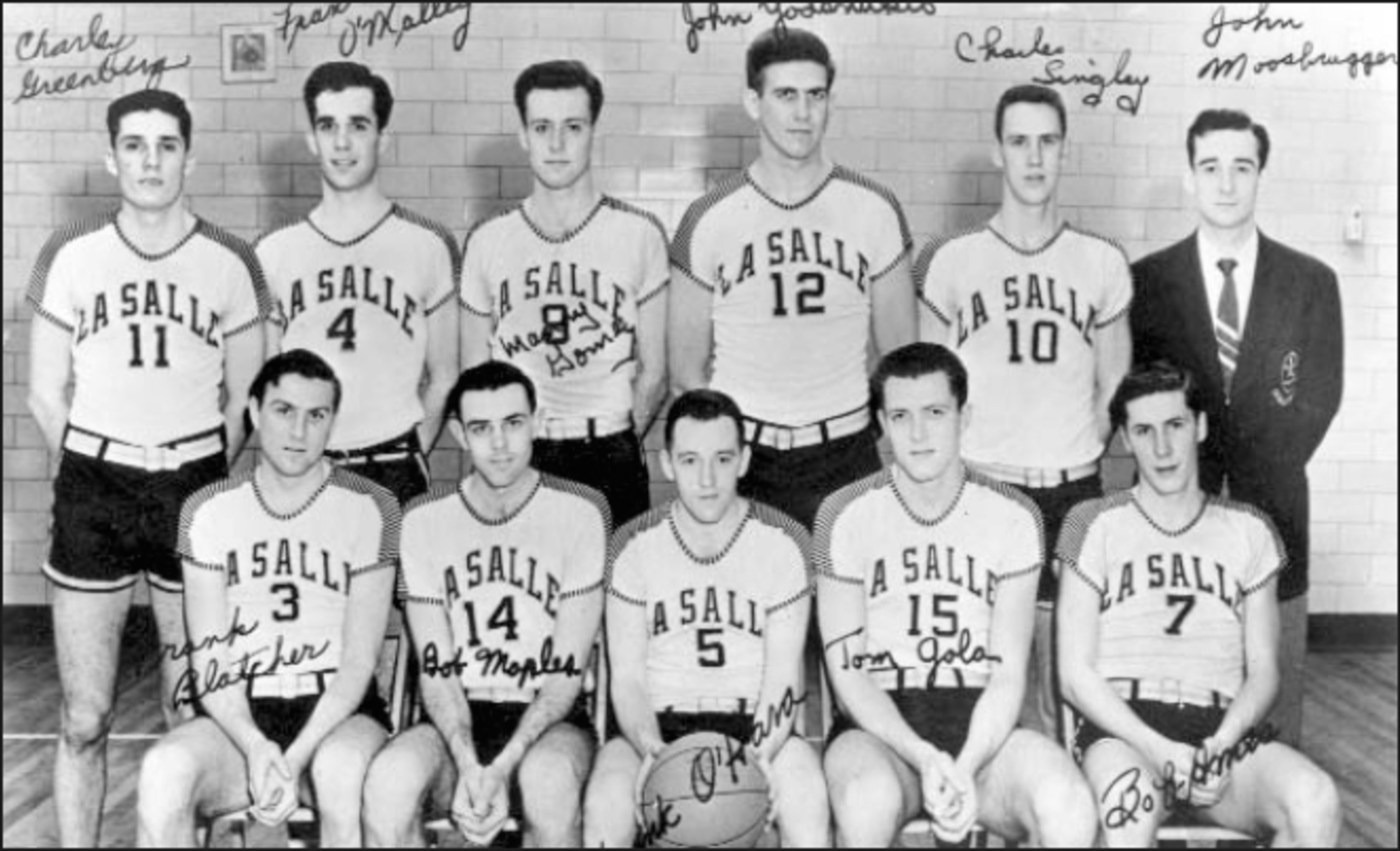
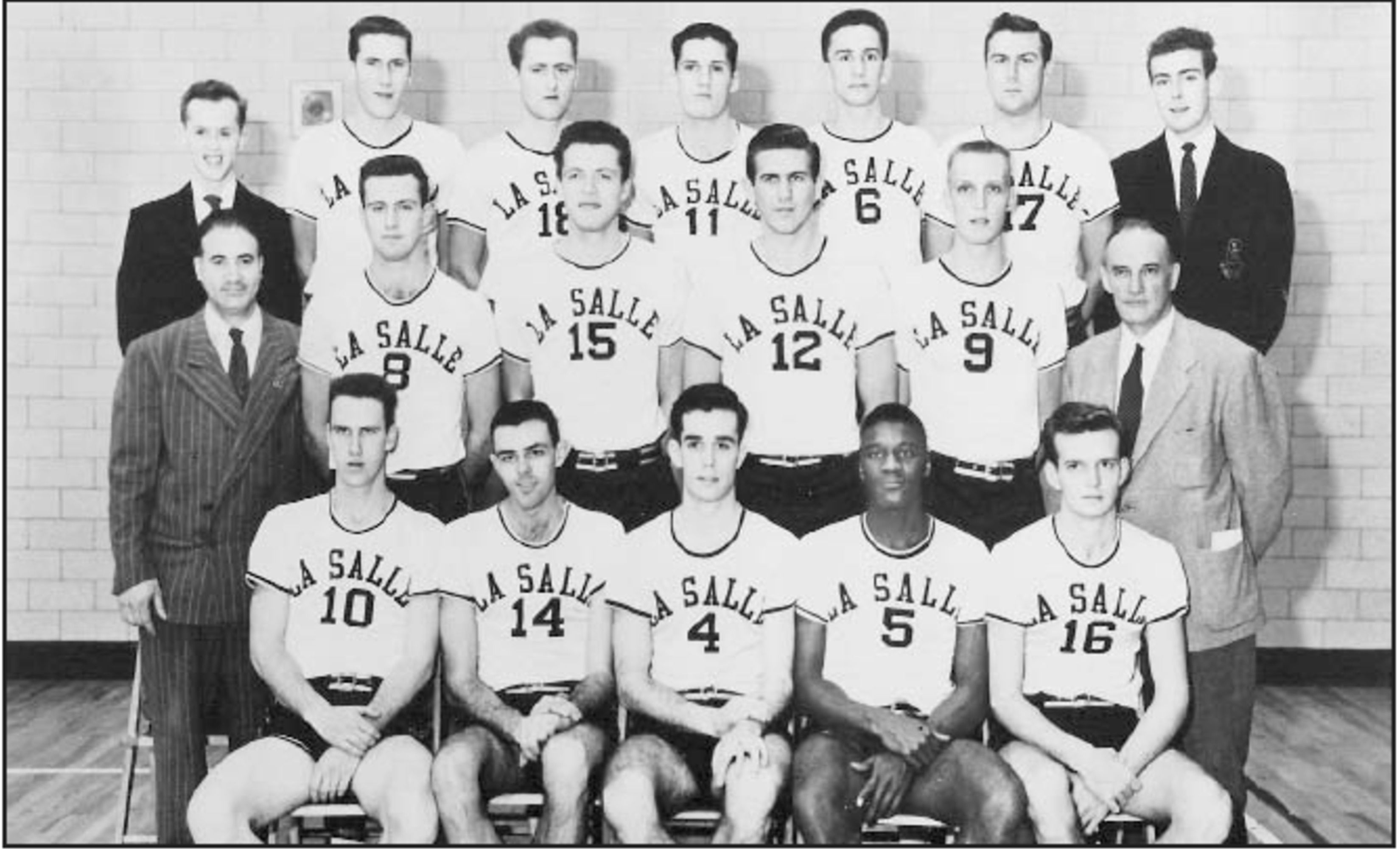
LaSalle 1954 Champs-page-0LaSalle University, 1954 NCAA Champions

The Philadelphia Big 5, like most U.S. institutions and organizations privileged white people over African-Americans, peoples from the Americas, Asia and the Arab world. Under the prevailing white supremacist system, white privilege and racial oppression were two sides of the same coin. This, unfortunately, was the American way.

For some, college basketball resides in realm of recreational activities and is generally considered to be far removed from real world issues and their often ugly consequences.  Nonetheless, Big 5 basketball programs grew in popularity across racial and ethic boundaries in last half of the twentieth century and into the twenty-first century. In some important ways, racial developments within Big 5 programs mirrored the altered rhythms of everyday life as Philadelphia grappled with vexing issues of racial inclusion and pronounced demographic shifts.

LaSalle 1955 NCAA Finalists-page-0LaSalle University, 1955 National Finalist, 1st year of the Big 5

As Philadelphia’s social, racial and political order shifted and changed over time, explicit racism within Big 5 basketball waned.  I have been privileged to gain insight into the racial dynamics of the Philadelphia basketball community from those who stood on the front line.  Every November through March from 1979 til 1983, I spent at least 2-2.5 hours, six days a week, in the gym with Big 5 Hall of Fame member Alonzo Lewis.  Pictured above, Alonzo was the only Black man on some of great LaSalle teams of the mid to late 1950s.  He was one of the first Blacks to play in the Big 5.  Mr. Lewis was my teacher, my coach and, became after graduation, my friend.

Unlike Philadelphia schoolboy legends, John Chaney and Claude Gross, who came along 3 and 4 years prior to him, Lewis was given an opportunity attend and play at one of the local white colleges.  Chaney and Gross, despite the fact that both were named MVP of the Public league in 1951 and 1952, respectively, didn’t get a sniff from the Philly schools.  They were victims of Affirmative Action and rigidly enforced racial quotas.  Philadelphia college programs were either all-white or had maybe one Black player.  Talented players like Chaney and Gross were routinely passed over in favor of lesser white players.  Like the old American Express tagline, “Membership has its privileges.”   Gross, along with the legendary Wilt Chamberlain, was an important part of the first all-Black YMCA national championship team in 1953 (pictured below).

Wilt Claude  The 1953 National YMCA Championship Team from Philadelphia

Years of listening, listening, listening and a little discussion with Lewis and Gross, has helped shape my understanding of the role of sport in Philadelphia’s racial relations.  They provided two distinct perspectives, one “made it” to college and the other a victim of staunchly enforced racial quotas (90-100% white males).  Form them, I learned that athletic achievement has very real social consequences.  For a Black man, status as a star athlete provides a certain level of respect to which most Blacks, and other suppressed minority groups, aspired.  Black athletes are considered, more or less, full citizens.  This understanding of citizenship helps explain why so many Black parents continue to have faith in the transformative possibilities of athletics, despite numerous setbacks over the years.  Through basketball, Black boys can become somebody.

For the past three or four decades watching increasingly integrated Philadelphia college basketball… in reading the accounts of Dick Weiss, Bill Lyon, Dick Jerardi and the under-appreciated Donald Hunt about the games… and in discussing the performances of Gola, Rodgers, Kennedy, Anderson, Goukas, Durrett, Brooks, Simmons, Macon, Nelson, Lowry, Galloway and Wyatt afterward, Philly sports fan drew tremendous entertainment value from Big 5 competition.

Of even more significance is the fact that Philly sports fans of all races and ethnic backgrounds have also used local college basketball as a shared cultural language to help them understand their world.

This was not always the case.

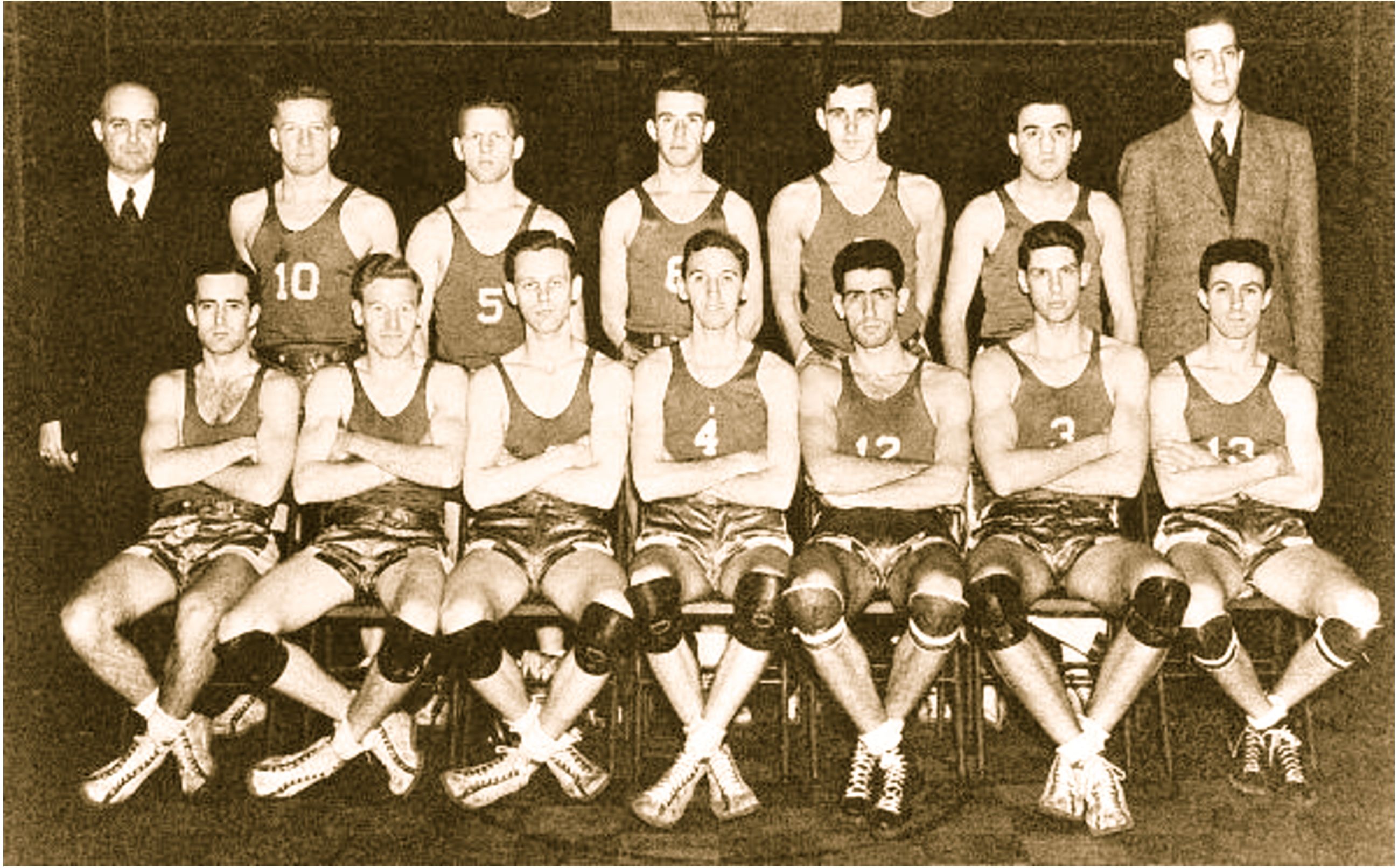
Temple 1938 NIT Champs-page-0Temple University, 1938 NIT Champions

Over time, Philadelphia’s Big 5 has been an agent for positive social change.  Over time,  playing field has become fairer. . . the Big 5 has helped break down social divisions and boundaries.

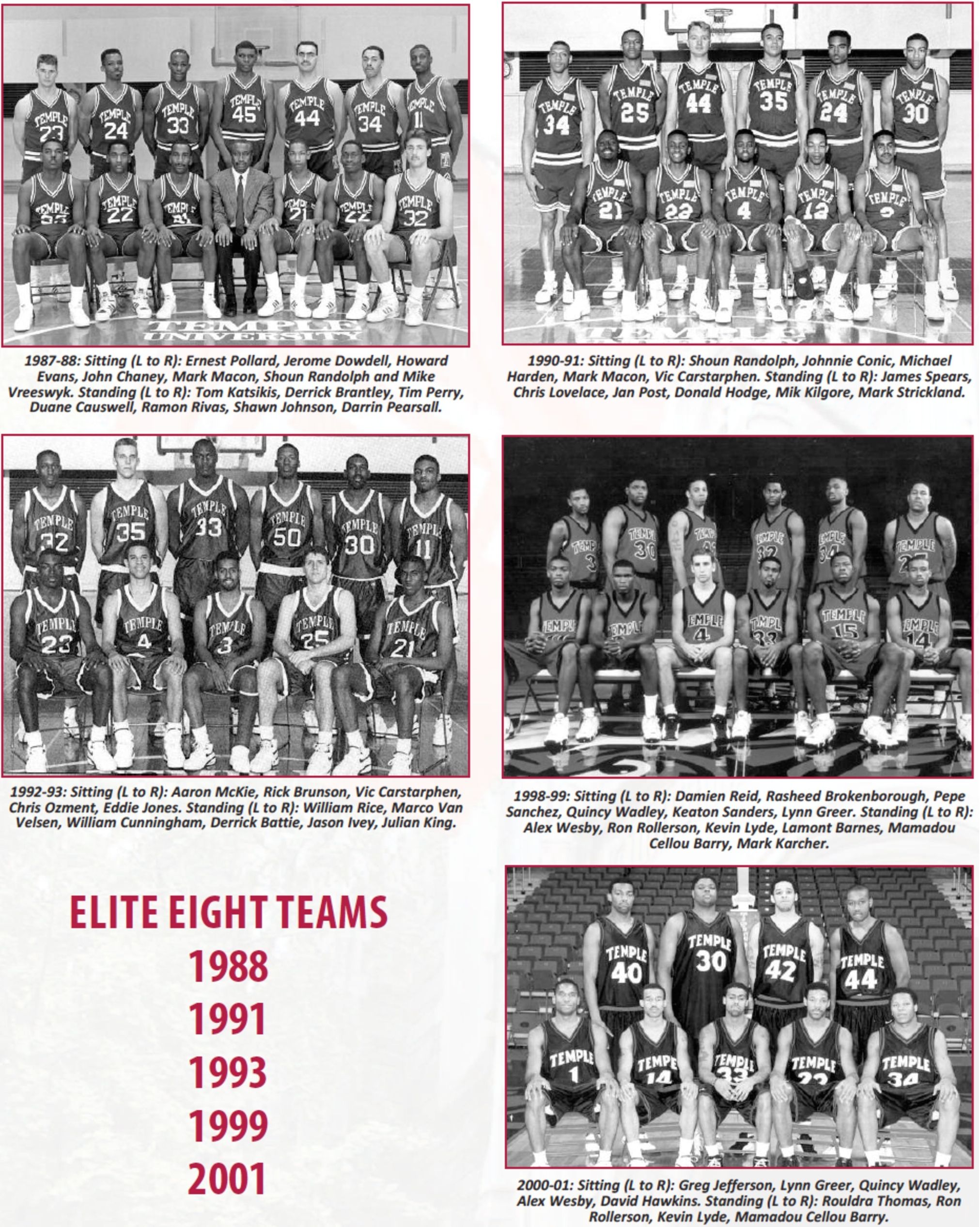
Over the past six decades things have changed considerably.  As you can see on the above picture, Temple has gone from an all-white basketball program to virtually all-black.

Temple Elite 8 Teams-page-0Over the past half century, while the rosters of college football and basketball programs experienced profound demographic shifts, the frequency and intensity of overt racism in most public spaces has decreased significantly.

Some shit you just can’t say publicly anymore.  Despite the hue and cry from critics of political correctness, that’s a good thing.  White supremacy needed to be reigned in.

In 1958, defeated Alabama gubernatorial candidate said, “You know, I tried to talk about good roads and good schools and all these things that have been part of my career, and nobody listened. And then I began talking about niggers, and they stomped the floor.”  Four years later, Wallace was sworn into office while standing on a gold star marking the spot where, a century earlier, Jefferson Davis took his oath as  president of the pro-slavery Confederate States of America.  During his inaugural address, Wallace proclaimed the following:

“In the name of the greatest people that have ever trod this earth, I draw the line in the dust and toss the gauntlet before the feet of tyranny, and I say segregation now, segregation tomorrow, segregation forever.”

Governor Wallace proved to be an extremely astute observer of white American voters during this period.  Keeping his promise to “never be outniggered again”, he swept into office with 96% of the vote in the 1962 general election.

Since then, things have changed considerably. Retribution for openly racist public statement is swift and harsh.  This is especially the case in the world of college and professional football and basketball where the overwhelming majority of participants are Black men.

A litany of cases have established a very clear precedent.  Keep that white supremacist racist shit to yourself.  The general public doesn’t want to hear or read it.

Howard-CosellHoward Cosell

In 1983, legendary sportscaster Howard Cosell was dismissed from Monday Night Football for  referring to Black players as “monkeys”.  Referring to Redskins receiver, Alvin Garrett, Cossell said “That little monkey gets loose, doesn’t he?” He used also used the same monkey allusion when he said “Look at that monkey go,” with respect to the Washington Redskins wide receiver Art Monk.

al-campanisAl Campanis

In April 1987, Dodgers executive Al Campanis was fired for telling Ted Koppel that he thought blacks “may not have some of the necessities to be a field manager or general manager” in baseball and articulating doubts as to whether blacks even desired management positions in the sport.

jimmy-the-greek

Jimmy “The Greek” Snyder

Eight months later on January 16, 1988, Jimmy “The Greek” Snyder was fired by CBS for publicly stating that Blacks were naturally superior athletes, at least in part, because they had been bred to produce strong children during slavery:

“The black is a better athlete to begin with because he’s been bred to be that way, because of his high thighs and big thighs that goes up into his back, and they can jump higher and run faster because of their bigger thighs and he’s bred to be the better athlete because this goes back all the way to the Civil War when during the slave trade… the slave owner would breed his big black to his big woman so that he could have a big black kid …”

Marge SchottMarge Schott

In November 1992, Charles “Cal” Levy, a former marketing director for the Reds, stated under oath that he’d heard then Cincinnati Reds owner Marge Schott refer to then-Reds outfielders Eric Davis and Dave Parker as “million-dollar niggers.”  Schott scknowledged  the “million dollar niggers” comment and said she was joking.  Around the same time she stated that she felt that Adolf Hitler was initially good for Germany and indicated that she did not understand how the slur “Jap” could be offensive.

During the same season, a former executive assistant with the Oakland A’s, Sharon Jones, said she heard Schott state: “I would never hire another nigger. I’d rather have a trained monkey working for me than a nigger,” before the start of an owners’ conference call.  On February 3, 1993, she was fined $250,000 and banned from day-to-day operations of the Reds for the 1993 season. Donald SterlingDonald Sterling

More recently, in April 2014, then Clippers owner Donald Sterling was banned from the NBA for life and fined $2.5 million by the league after private recordings of him making racist comments were made public.  Sterling was forced to sell the franchise after recording were made public in which he stated to his girlfriend,  “It bothers me a lot that you want to broadcast that you’re associating with black people”, and, “You can sleep with [black people]. You can bring them in, you can do whatever you want”, but “the little I ask you is … not to bring them to my games”.

danny-ferry1Danny Ferry

In September 2014, it came to light that Atlanta Hawks General Manager Danny Ferry described Luol Deng in the following manner: “He has a little African in him. Not in a bad way, but he’s like a guy who would have a nice store out front but sell you counterfeit stuff out of the back.” Ferry  implied that all persons of African decent are two-faced liars and cheats. He was placed on an indefinite leave of absence by the Hawk organization.

Clearly, social norms have emerged whereby it is inappropriate to make explicitly racist statements within sports centered contexts.  The aforementioned racist statements and the swift severe  consequences are indicative of informal understandings that have emerged to govern individuals’ behavior within the world of sports.

These postings of these “fans” run counter to the progress Philadelphia’s colleges and universities have made in the area of inclusion and diversity, especially in athletics.  Jay Wright, Fran Dunphy, Phil Martelli, John Giannini, Jerome Allen and Bruiser Flint run programs that are beyond reproach in this regard.  Each program prominently features Black players on a regular basis.  These young men are often touted as the face of the Athletic programs and in some cases become representatives of the institution as a whole.

The overwhelming majority of fans support and embrace the players as Owls, Explorers, Hawks, Quakers, Wildcats and Dragons. Nonetheless, there remain a few holdovers from a much darker earlier time in American history.  For the pointed white hood is no longer needed to preserve anonymity.  The most vile posters use pseudonyms to  protect their anonymity.

 So what can be done?

The prominence of racist discourse on Temple and Villanova fan message boards suggests that this is unlikely to change for the foreseeable future. Therefore, the athletic departments need to engage with football and basketball supporters and work with them to reduce an anachronistic anti-other that retains a  place in the everyday discourse for some of the alums and supporters. Cultivating a respectful and tolerant attitude toward Blacks and Black communities will likely present a challenge when confronted by subgroups of racist white male sports fans that continue to find outlets to express racist discourse overtly and covertly.

Some might feel that such an approach is an encroachment upon the free speech of racists.  So what, let them continue their mean spirited divisive rants against Black athletes and Black communities.  What’s the worse thing that could happen?

Well… we don’t have to imagine. We can just take a quick stroll through the not-to-distant past….

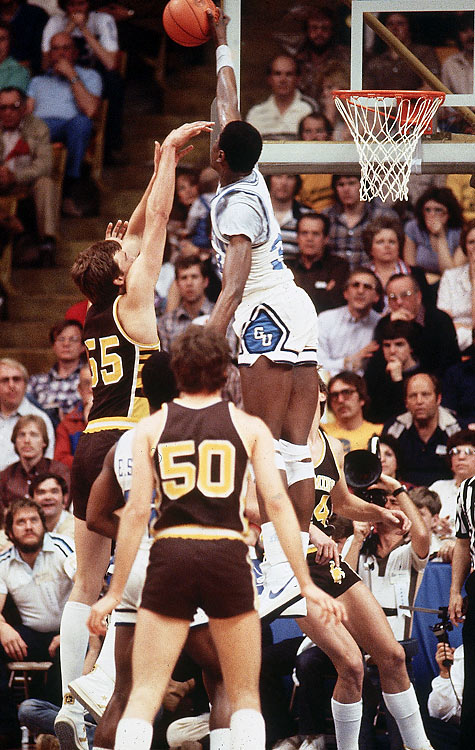
patrick-ewingPatrick Ewing, Georgetown

In January 1983 at the Palestra, Villanova fans held up several similar signs.  One bedsheet read “[Patrick] Ewing Is An Ape.”  One Villanova fan wore a t-shirt that read, “Ewing Kant Read Dis.”  While Ewing jogged on the court for pregame introductions, another Villanova fan threw a banana peel on the court.  That’s where this kinda shit ends up.  It needs to cease.

How should Black collegiate and professional athletes respond to racial taunts and epithets?

I’m not saying they should go all Ron Artest on ’em… But, I would understand. 

artest

← Back

Thank you for your response. ✨

So, when did you fall in love with the Big 5? Alton McCoullough to Temple, 1978!!

guy-rodgers-temple

Guy Rodgers (center), Naismith Hall of Famer

For me it was 1978.  College wasn’t the norm around my way.  I grew up in the southern section of Darby Township, PA a small rigidly segregated town bordering Southwest Philadelphia, about 2 miles from the Philadelphia Airport.  In the mid to to late 1970s, the southern end of Darby Township consisted of a cemetery, three traffic lights, Eddie’s Hot Dog stand, about 7 or 8 churches, 2 bars and a populations  of around 3,000 sports crazed Black people. Demographically similar to nearby Philadelphia and Chester, PA with an Apartheid-like political and social structure straight out 1960‘s small-town Mississippi, Darby Township was a wonderful place to grow up if you enjoyed sports. For most, however, the athletic journey ended with high school.

Looking back, it seems we punished opponents on fields and courts, at least in part, because we exercised very little political, economic and social power in Delaware County.  The Northern, predominantly white, section of Darby Township held, and continues to hold, political power through a permanent 3 (white) -2 (Black) representative structure on the Township Commission.  The political deck was and is stacked against Blacks in the southern end of Darby Township.  However, within the athletic realm, more or less, the playing field was fair.

In September 1977, I was 12 and like virtually every one of the other 200-225 boys in Darby Township Junior-Senior High School, I wanted to play for one of the Darby Township Eagles varsity squads. That was the long-term goal.  There wasn’t much else to do other than march with drill teams or go to bible study.  Being rhythmically challenged and a certified sinner, I chose basketball.  This was before the advent of personal computers and home video games. There was no cable television. Cell phones were something on the Jetson’s cartoon. Crack cocaine had yet to be invented and disseminated within poor and working class Black communities. There was no AAU circuit.  No programs sponsored by sneaker companies.  It was truly a different and far less complicated time.

Jim Williams-page-0

Jim Williams, Led Temple in scoring and rebounding from 1963-66

For most boys, there was but one outlet.  In Darby Township you went to school and after school you went to practice. Then, when you came home, you played some more.  Finally… when the games came around, you tried to punish the opposition. That’s all I knew.  I didn’t realize that Darby Township, along with Chester and Darby-Colwyn were considered to be on the lower-end of the county’s socio-economic scale.  I just knew when the horn blew, Darby Township came to play.  Expectations were high and justifiably so.

In 1975, when I was 10 Darby Township won the State Class A Basketball title. Two years later in 1977, an undefeated Darby Township squad was knocked out of the PIAA playoffs by eventual state champion Elk Lake. That spring, DTHS finished second in the PIAA small-school track championship.

In the fall of 1977, I entered the Darby Township Jr-Sr High School. I was truly blessed.  This was the Golden Age of Darby Township Athletics. A period when Darby Township produced some of the greatest scholastic teams and individual performances in Delaware County history.  This was time when the dream of college became a reality for me and so many of my teammates and classmates.

CHANEY ALLEN ROBINSON

John Chaney

One of the first things I noticed upon entering the building was Cardall Baskerville. While the rest of the nation beyond Darby Township focused on Walter Payton, Franco Harris and Tony Dorsett, Baskerville was my football hero. In my mind, he was the greatest running back on the planet. He averaged 6.9 yards every time he toted the rock. You had to see it in person… He would run through a lineman and linebackers like they made of goose feathers and popsicle sticks. Once beyond the line of scrimmage, he would cut sharply, start running upright, change gears and leave defenders smelling fumes for huge chunks of yardage.  Damn… He was good!

How good was Cardall? Darby Township’s coach, Alonzo Covert, said at the time, “He has everything a coach could ask for in a running back.” Covert coached the Eagles to the school’s first undefeated, untied season that year.  Baskerville’s exploits were recognized throughout the area.  The Philadelphia Eagles Alumni Association named Baskerville Delaware County’s Player of the Year. On December 18, 1977 during halftime of the Eagles vs. Jets game at Veterans’ Stadium Baskerville was introduced to 56,000 fans.  In my 12 year old mind, this was huge… I thought the whole world knew about Cardall.

Every day, I would be in awe just watching him walk through the halls.  The future seemed so secure.  Surely he would go to college and then off to the NFL. Shit… I knew he would win the Heisman like Bonner’s John Cappelletti and go on to NFL glory. He was the best in Darby Township, that meant he had to be better than a guy from Bonner.  There were no naysayers… There was no doubt that he was good enough… “This is just the beginning of what Delaware County is going to hear about Cardall Baskerville,” said Covert. “I have received many inquiries about him from colleges that play major college football. They always ask if he can be a Class A college player. I tell them he can be a Class A-plus player. I believe that he could play for Nebraska or Oklahoma or Southern Cal and I’m talking about next year.” You would hear whispers that Syracuse and Penn State were in the school to see him… Man, I was impressed.

Unfortunately, his football career ended at Darby Township High School. Like so many extremely gifted, record setting, young Black Darby Township athletes, Baskerville did not qualify academically to play collegiate sports. He never played beyond scholastic level.  To this day everyone that saw him play remains convinced that the nation was cheated because Cardall didn’t get to keep toting that rock at the collegiate level.  His life would end tragically when he committed suicide a few years later.  It didn’t make sense… How could he be that good and NOT go to college?

Marck Macon

Mark Macon

That really shook me up. How could the best player on the best team in the area not go to college. I tried unsuccessfully to make sense of this situation… I was young, impressionable and did not possess adequate analytical tools… All I knew was… Nobody could stop him. They never lost a game. This didn’t make any sense. Was the system rigged?  I had no understanding of SAT exams and the college admissions process.  It just didn’t seem fair… He was better than everybody.  I felt doomed.  If Cardall couldn’t make it, I had absolutely no shot!

Could anyone actually make it out and play in college out of Darby Township?  At 13, I knew a couple of DTHS alums like Leroy Eldridge (Cheyney St.) and Chris Arnold (Virginia St.) had went on to star at historically Black colleges, but even they were very few and far between.  Moreover those guys graduated in the 60s and were pretty far removed from me… What about the guys I went to school with?  Was college a possibility?

Alton McCoullough and Vince Clark, Baskerville’s extremely talented running mate, would answer those questions for me when they enrolled in Temple University in 78 and 79 respectively.

A key player on the undefeated 1977 Darby Township basketball that lost to Elk Lake in the Final Four, McCoullough led Darby Township to the State Championship game in 1978 where they lost to Father Geibel.

But most importantly, Alton went onto Temple University. At that point in Darby Township, this was a gigantic accomplishment. A kid from Darby Township was playing basketball at the highest collegiate level. While we were all from the “wrong side of the tracks”, “Big Al” was from the “Center.” The Center is a Delaware County Public Housing Development… It’s what some call “the projects.”  At the time, my family was living in another subsidized housing development a few blocks from the Center.

aaron-mckie

Aaron McKie and John Chaney

If “Big Al” could go from the Center to Temple, we all could go to college.  Immediately, I loved Temple.  I spent the next four years buying newspapers just to see the box scores. There was no ESPN, no Comcast Sports, if you wanted to follow college sports you had to exert a little effort.  Big Al went on to have a very solid career at Temple. Over four years (1978-192) he would score 1,051 points and grab 673 rebounds while playing on one NCAA tournament team.

However, his biggest accomplishments, his most important feats did not take place in McGonigle Hall. They took place down the Center court.

In a way, I’m sure he never fully understood, Alton brought Temple University to Darby Township and influenced a generation of young Black boys.  He didn’t bring the bricks and mortar.  He didn’t bring the books.  He brought the “idea” of Temple to Darby Township. Al and his teammates were real live Temple ambassadors in Darby Township.

Every summer, Al would bring Rick Reed, Kevin Broadnax and Neil Robinson to play in the Darby Township Summer League. While Lynn Greer, Sr., Leroy Eldridge and other highly regarded players competed as well, the buzz was most intense when Big Al and the boys from Temple were up next.  I was never disappointed.  It during those moments that I began to grasp the difference between high school and NCAA Division 1 athletics.  Broadnax was the first person I ever saw extend his arm parallel to the court while dunking with enormous force.  He jumped that high.  Robinson was one of the tallest players in the league and one of the better ball-handlers.  This did not make sense to my 13 year old mind.  Rick Reed was just the man.  I remember it like it was last week.  Temple Basketball was part of Darby Township, Darby Township basketball was Temple basketball as long as Al was on the team.

The games were played at the “Center” court.  This court was a “bottle throw” away from the projects. I know this because  my man “Peep-Sight” proved it when he hurled 4 or 5 beer bottles from the projects into the jump circle from the projects during one hot summer night when they wouldn’t let him play.

They simply swept up the glass and kept it moving… Darby Township had it’s share of “issues.”

The college boys from Temple, for me, represented what was possible.  They let me believe I could overcome the whatever issues presented themselves.  They gave me hope.  Al and the other Temple players were incredibly accessible. They spent hours hanging and talking with the younger guys and, of course, made time for the young ladies that gathered on the fringes of the court every night.  Temple, from 1978 to 1982, became Darby Township’s team. One of my friends and teammates, Robert Carter, became so enamored with Rick Reed’s game that he literally adopted the moniker “Rick Dunk” which stuck throughout his own illustrious playing career.

Temple University gave young Black boys in this small community hope.  By adopting Alton and Vince, Temple let us know that we were good enough. Temple wanted us. Temple respected us.

eddie_jones_1994_02_20Eddie Jones

In 1979, Baskerville’s running mate, Vince Clark, would set a state single game rushing record by piling up 438 yards against Yeadon. Clark, like McCoullough the year before, would accept a scholarship to play at Temple. He would go on play two years seasons for the Owls carrying the ball 35 times and gaining 167 yards. That same year Jim McGloughlin from neighboring Collingdale also agreed to play at Temple. St. James’ Donny Dodds would also join the Owls shortly after.

For young kids, Black and White, from the “wrong side of the tracks” Temple University seemed like the only place that would welcome us. In retrospect, once Alton and Vince “made it” to Temple, one could sense a change among young poor Black boys in Darby Township. College was now a very real option. The question was no longer if, but where, would you go.

I fell in love with the Big 5 basketball and Temple University in 1978 when Alton McCoullough enrolled at Temple University. That love was reinforced in 1979 when Vincent Clark moved to North Broad Street.  Until then, I really didn’t know anyone other than my teachers that had attended college. By embracing Alton and then Vince, Temple broadened my horizons.  By bringing Temple basketball to Darby Township every summer, Alton provided a lot of guys with role models, inspiration and a a clear example of what was possible.

Doug Ambler and Rick Pergolini were young guidance counselors at Darby Township during this period. They often cite the period of 78-82 as the Golden Age of Darby Township Athletics. According to them more Black boys from Darby Township went on to college during that era than at any other time in the history of Darby Township. It all started with Big Al going to Temple.

I know that idea of college wasn’t “real” for me until I saw Big Al, Reed, Broadnax and Robinson playing ball down the “Center.” If those guys could make it to Temple, I knew I was smart enough to go to college.

Ten years later, I had fellowship offers from schools like Michigan, Ohio State, California-Davis, Delaware, and Maryland-College Park. They wanted to pay my tuition and pay me to attend their respective graduate programs. Not bad for a kid raised by a single Mom on the “wrong side of the tracks.” Not gifted enough to be a Division 1 athlete, these schools were recruiting me to “study and perform research.”

The idea, the notion, the thought that I could really attend college grew from seeing Alton McCoullough and Vince Clark, my DTHS heroes go on to attend Temple University.

Tyndale_400

Mark Tyndale

Since then, I have followed Temple basketball closely.  I appreciate how Temple continues to provide young poor students and student-athletes an opportunity to improve their life opportunities.

For a quarter century, I watched John Chaney carve out a Hall of Fame coaching career at Temple’s, all the while loudly proclaiming that he was giving opportunity to the less fortunate among us. I bore witness to the example Coach Chaney set by confronting racial discrimination in a most direct and forceful manner. For instance, in January 1989, Coach Chaney emphatically declared, “The NCAA is a racist organization of the highest order… On this day, it instituted a new punishment on black kids who have already been punished because they are poor. Any time the NCAA, which is 90 percent white, considers the youngsters in Division I basketball and football, it discriminates, because 89 percent of the kids are black… I wonder what message they are sending. It’s another hardship for black kids made by white folk.”

That, for me, is Temple University.

Throughout my lifetime, Temple has represented the vanguard for racial equality and opportunity for advancement for Blacks in college sports.

Temple hired an African-American football coach when people were still wondering if we could play the quarterback position. Temple gave Dawn Staley, a product of the Raymond Rosen Housing Development in North Philly and her first opportunity to coach at the collegiate level. Right now, Temple has one of a few major college athletic programs headed by an African-American.

More than any other University in the region, Temple has provided opportunities for young poor and working class Black students and student-athletes.

xmas

Dionte Christmas

It’s hard to understand how Temple alums that came of age during the aforementioned eras allow a handful of alums and Temple sports fans to publicly spew bitter and racist vitriol aimed at the community surrounding Temple and it’s residents.  That’s NOT the Temple way.

Temple featured a Black back court of Guy Rodgers and Hal Lear in the mid-1950s. Jim Williams led Temple in scoring and rebounding in 1963-64, 1964-65, and 1965-66.  John Baum did the same in 1967-68 and 1968-69.  Ollie Johnson starred for the Owls throughout the early 1970s.

In 1978, Temple reached out grabbed a poor Black boy from Darby Township and gave him a chance to perform on the big stage.  As a result, the rest of the town embraced Temple and scores of young Black boys would go on to play sports and graduate from college.  At 13, I old took notice and embraced the dream of attending college and beyond.  Throughout my twenties and thirties, I wholeheartedly embraced everything John Chaney and the Temple basketball program represented.

As I approach 50, it pains me to see some Temple alums adopting perspectives that would have absolutely killed the spirit of that impressionable 13 year old boy.

But what hurts even more is the apparent unwillingness of the majority of Temple alums to confront racist, bigoted and homophobic statements in a way that affects change.  It needs to cease.

Hopefully, good will prevail and those articulating negative ideas will be made to feel uncomfortable.

One can only imagine what would have been written on a Temple message board when Rodgers and Lear played in the 1950’s.  Would Temple fans support the aforementioned position and statements of Coach Chaney?  I prefer to believe that the Temple community, as a whole, would have embraced their Black students and student-athletes.  After all, that’s the image Temple has cultivated over the course of it’s distinguished history.  It’s a legacy that is both admirable and valuable.

To a large extent, the impressions of contemporary high school students and student-athletes have of colleges and universities are driven by television and social media.  Thirty-seven years ago, my understanding of what Temple University represents was forged by extensive direct contact with and first hand observation of young men from the University’s athletic department.  I wanted to be like those guys.  I wanted to play college basketball.  As I got older, I wanted to follow the example set by Coach Chaney and confront bigotry, racism and discrimination head on.  I remain committed to that task.

To me… that’s the Temple way of doing things.  Maybe things have changed more than I thought on North Broad Street.

← Back

Thank you for your response. ✨


White Supremacy, Mike Brown and the American Legal System: An Apology to Young Black Males

“Good gracious. Anybody hurt?”

“No’m.  Killed a nigger.”

“Well, it’s lucky because sometimes people do get hurt.”

Mark Twain, Huckleberry Finn (1884)


Dear Young fella:

It’s confusing… it’s scary… it makes you want to lash out out. You feel like hurting someone… You feel like burning this muthafucka down! Shit ain’t right… Time after time… Day after day… You see the same thing. The images are displayed over and over on a multitudinous array of cable news networks.
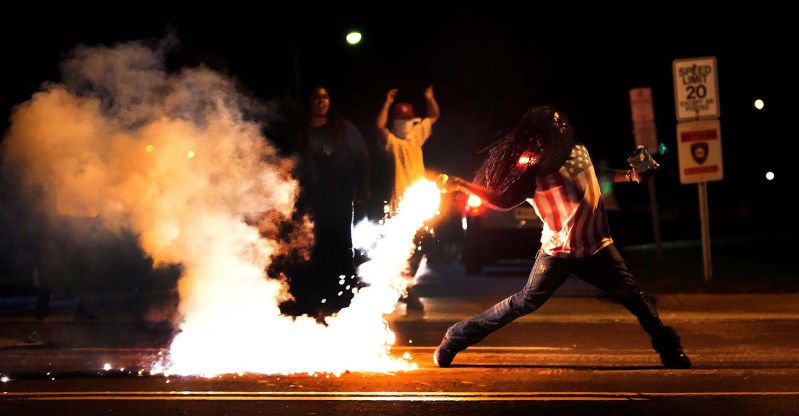
ferguson-riots1

Participant in Ferguson Rebellion

By now the script has been etched in your brain, “young Black male killed by police, no charges will be filed against officer.” Over and over again, we see unarmed Black males gunned down in an instant. There’s never any doubt about what happened. White police officer killed the unarmed Black male.

How the fuck are these assholes NOT charged, prosecuted and convicted?

The problem young fella… what you have a hard time understanding… what is causing you to feel the way you feel is the fact these acts are not “crimes” in America! Whites killing unarmed Black males, like YOU, while enforcing the “rule of law” has always been encouraged and rewarded. The “law” in the United States of America was NEVER intended to protect YOU young fella. The fact that you are frustrated and surprised by the manner in which the legal system dispenses “justice” in these matters is prima facie evidence of your mis-education.

I apologize… I’m truly sorry… I have complicit in this mis-education. As a teacher, mentor and adviser I have failed to arm you with an adequate understanding of where you live and how the legal system was designed to work. I have failed to clearly illustrate and explain how deeply ingrained the “legalization” of Black suppression is in American history. Like so many in my generation, I have allowed you to grow up believing that the phrase “Equal Justice under Law” applies to you.

For that, I apologize… I sincerely apologize for allowing you to actually believe that the high-minded ideas put forth by America’s Found Father’s actually guide the American legal system as it relates to you.  That was a very big mistake on my part.

I promise from this moment forward to be brutally honest with you… Young fella, from it’s inception, the American legal system has adjudicated and upheld racial deprivation. For well over two centuries, the language of the “law” has shielded the consciousness of white Americans from the plight of Black human beings subjected to inhumane, brutal yet perfectly “legal” and acceptable behaviors of white “law enforcement” officials.

Same shit… Different day…

Mike Brown, Eric Garner and Oscar Grant are merely some of the latest victims of America’s inhumane and immoral law enforcement and legal processes. They are among the latest links in a chain of legalized oppression and brutality that stretches back to colonial America.

Young fella… when it come to protecting the rights of Blacks against oppressive, brutal and even murderous police behaviors, American laws ain’t SHIT! They have NEVER been fair… The American legal system was NEVER been designed or intended to protect your right to life, liberty and the pursuit of happiness.
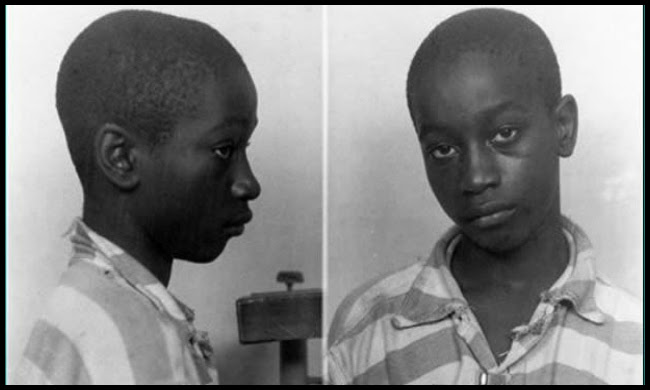
StinneyGeorge Junius Stinney, Jr. age 14, the youngest person executed in the USA in the 20th century

Truth be told young fella, you need to completely disregard the phrase Equal justice under law engraved on the front of the United States Supreme Court building in Washington D.C. Trying to bring that ideal in line with the actual experiences of your fellow Black males across this nation only causes confusion and deeply seated angst.

The racist oppressive patterns on display in contemporary America and the possibilities for your children and grandchildren are buried in the American past. It is here that you must begin your attempt to understand what just took place in Ferguson, Missouri.  Unfortunately, none of the mainstream – white controlled – media outlets and very few teachers have the fortitude required to provide you with the tools necessary to uncover this past.

As a result, you don’t know… you are lost… you have been mis-educated.

Please allow me to introduce you to the American legal system. More than any other legal system in the modern world, with the possible exception of Apartheid South Africa, the United States has devised and implemented a legal system which is simultaneously racist, brutally oppressive and committed to the protection of white individual and property rights: a white supremacist/democratic legal system.
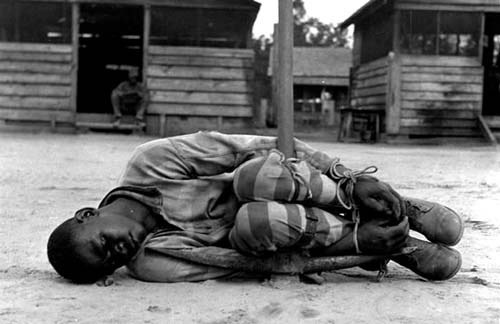
Black BoyLet’s take cursory look at some of the ways the American legal process was developed to establish, protect and enforce the rights of individual whites, whites as a group and white institutions while simultaneously imposing restraints on Blacks. As you struggle to digest and comprehend the failure of the system to hold Mike Brown’s killer accountable, it is a perfect time to assess the historical trajectory of the interrelationship between race and the American legal process.

It pains me to watch you trying to make sense of the racial dynamics playing out in police stations and courtrooms across America. The time has come… Youngfella… you must face the truth of the white supremacist foundations and origins of America’s legal system  with YOUR eyes wide open.  Only then will the lack of significant legal consequences for the killings of unarmed Black men at the hands of “law enforcement” officials begin to make sense.  Only then will you understand how such horrific actions are fully compliant with the “rule of law.”

For centuries… “law enforcement” officials have had license to kill YOU.  Despite what YOU have been taught, the rights afforded to American citizens have never been fully extended to Blacks, especially males.

This fact is indisputable. 

All you have to do is place YOURSELF in American society at any point in America’s history and you will begin to understand that George Junius Stinney, Jr., Emmett Till, Mike Brown and Eric Garner are inextricably interrelated.
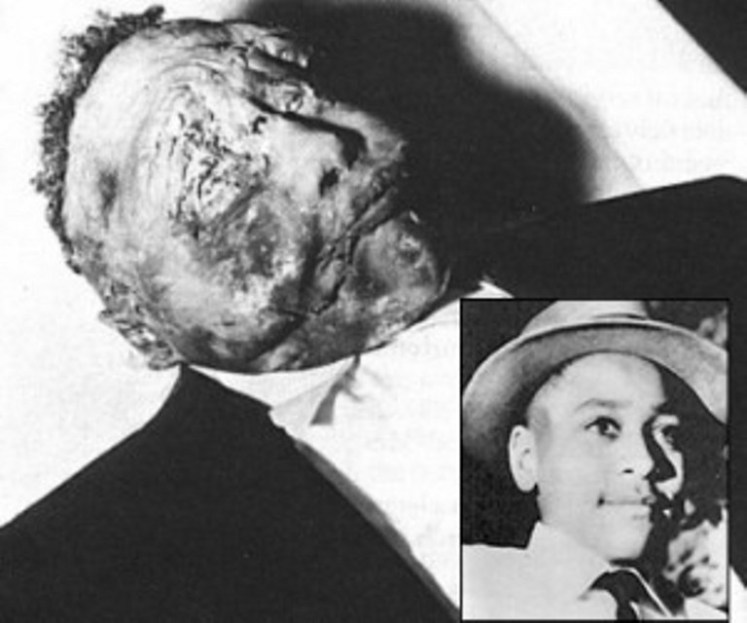
emmett tillEmmett Till, Murdered at 14 in Mississippi. White Supremacist killers confessed after being acquitted during a trial

Young fella… I must warn you… Since YOU have been taught to think of the law as a neutral instrument serving the entire community, it will be disconcerting to see that American laws were written and enforced in the most blatantly racist manner, favoring whites over Blacks.  The American educational system is incapable of speaking truth to power.  Only Blacks with awareness and knowledge can impart it to you.

Let’s go back to the very beginning… This problems you see in Ferguson and New York existed before the States were united.

In 1755, Colonial Georgia passed laws entitled “An Act for the Better Ordering and Governing Negroes and Other Slaves in This Province.” Ponder, for a moment, the following question: How were the rights of people like YOU protected under these “laws”? Place yourself, a young Black man, in Colonial America. Take a minute… Imagine YOU simply could no longer continue living as the equivalent to a mule, cow or pig… Imagine YOU wanted to find your Momma, you long for your Dad, you want to find your sister, you need to be reunited with your wife and your children that had been sold and shipped away… Suppose you decided to leave your “home” and set out in search of your family and/or your freedom… What did the “law” say about your right to do so?

According to the prevailing “law” in Colonial America, there was no prohibition for killing YOU. In fact, your killer would be rewarded. According to the “law,” a “law enforcement” official was given one pound sterling for presenting YOUR “scalp with two ears.” That’s right… As they say the “law” is clear… YOUR “scalp with two ears” attached to it could be submitted for remuneration.

Your “scalp with two ears” could be exchanged for cash.

I know… I know… That’s not the way the story is told in American movies and literature.  In the old cowboy westerns they constantly talked about Native Americans “scalping” innocent white people. Scalping is always associated with the “savage” Native Americans.  In reality, however, white Americans were rewarded for scalping Black men with the temerity to actually desire freedom.

Young fella… This is a clear example of how Colonial American legal systems dealt with YOU. In some ways, barbaric Colonial laws such as this foretell contemporary events.  Over the past couple of years, George Zimmerman “presented” local officials in Sanford and state officials in Florida with Trayvon Martin’s corpse. He was rewarded with donations totaling at least $314,099.17 to his legal defense fund. Officer Darren Wilson “presented” official in Ferguson with Mike Brown’s corpse and in excess of $432,000.00 was donated to his legal defense fund.

Think about that young fella… think about that… Understand the beast YOU are dealing with…

You have been taught that the Founding Fathers devised the preeminent example of modern liberal democracy. You have been repeatedly told that they developed a government based on popular consent with respect for the equal rights of all.

Young fella you were mis-educated!

You were intentionally deceived. The standard story of America’s formation is deceptive because it is too narrow. They were teaching you the history of relationships among a small minority of Americans. They were focusing exclusively on relationships among wealthy white men of predominantly northern European ancestry.

A truer telling of America’s history would place white male supremacist ideologies at center of the plot. It would go something like this: Life, Liberty and the Pursuit of White Supremacy…

The narrative would spell out the racist and sexist practices that defined the relationships between this relatively small white male minority with the overwhelming majority of the population constituting the subjugated groups (Blacks, Native Americans and women).

Young fella… When these white supremacist, racist, sexist elements are kept in plain view the history of America’s legal system looks quite different. My aim here is to help you understand that the historical frame of reference and the analytical tools provided to you in school are inadequate. The experiences of your ancestors have been, more or less, written out of the script. As such, the tools provided by the American educational system are simply inadequate form performing the task at hand.  Greater understanding of contemporary legal proceedings and racial strife can be achieved by replacing the narrowly circumscribed lessons they teach in school with a more realistic view of America.

A_Southern_chain_gangSouthern Chain Gang, circa 1903

So young fella… at it’s founding in 1787, how did the United States, legally speaking, deal with YOU? How were Black men taken into account? For purposes of taxation and representation, the “Founding Fathers” determined that YOU would count as 3/5 of a human being. You were considered about 60% of a human being.  The importation of captured and enslaved Blacks from Africa was given constitutional protection for another twenty years.  Also, enslaved Blacks who escaped from one state to another had to be delivered to the original owner upon claim, a provision that was UNANIMOUSLY adopted by the “Founding Fathers.”

The Three-Fifths Compromise, is located in Article 1, Section 2, Paragraph 3 of the Constitution. It reads as follows:

“Representatives and direct Taxes shall be apportioned among the several States which may be included within this Union, according to their respective Numbers, which shall be determined by adding to the whole Number of free Persons, including those bound to Service for a term of Years, and excluding Indians not taxed, three fifths of all other Persons.

Moreover, from the moment of inception, US constitutional and legal processes continued and further perpetuated the racial injustice and oppression that prevailed in Colonial America.

When white males of northern European descent set out to “form a more perfect Union, establish Justice, insure domestic Tranquility, provide for the common defense, promote the general Welfare, and secure the Blessings of Liberty to ourselves and our Posterity” they did not include YOU the the equation. YOU were most likely enslaved and they intended for you to remain enslaved for the duration of your natural life. More specifically, the federal “law” they developed expressly forbade YOU from changing your status by escaping to another part of the country.

The Founding Fathers inserted the following in Article IV, Section 2:

No Person held to Service or Labour in one sate, under the laws thereof, escaping into another, shall, in consequence of any Law or Regulation therein, be discharged from such Service or Labour, but shall be delivered up on Claim of the Party to whom such Service or Labour may be due.

Youngfella… YOU had no rights in America upon it’s founding. If you were taught otherwise in school you have been hoodwinked… you have been bamboozled.

Seventy years later, the US Supreme Court would make YOUR legal standing painfully clear. Unfortunately, it seems that many Americans, in general, and teachers, in particular, would rather distort the history of this nation than face the extent to which the American legal system was designed and intended to uphold and strengthen the concept of white supremacy. Nonetheless, in a rather remarkable moment of clarity and honesty the nature of the American legal system was laid bare for all to see… if they are willing to look.

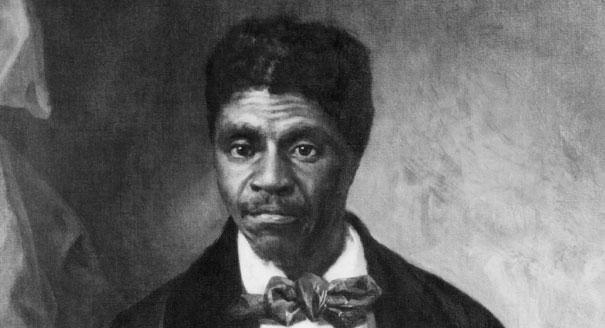
dred_scottDred Scott

In 1857, the Supreme Court handed down a monumental decision in the case Scott v. Sanford. Dred Scott was an enslaved Black man whose owner had taken him to live in free areas of the country. Having witnessed freedom, having smelled freedom, having tasted freedom, having touched freedom, Scott longed for it to such an extent that he took dramatic steps to attain it. Scott sued for his freedom on the grounds that living on free soil rendered his “enslaved” status null and void. He tried to utilize the American “legal system” to gain control of his destiny and his labor.  Scott sought recognition of his basic humanity in the courts.

Like so many Black Americans today, Scott didn’t fair very well in the courts. Youngfella… This is what Chief Justice Roger B. Taney wrote in response to Scott’s claim:

“It is difficult at this day to realize the state of public opinion in regard to that unfortunate race which prevailed in the civilized and enlightened portions of the world at the time of the Declaration of Independence, and when the Constitution of the United States was framed and adopted; but the public history of every European nation displays it in a manner too plain to be mistaken. They had for more than a century before been regarded as beings of an inferior order, and altogether unfit to associate with the white race, either in social or political relations, and so far unfit that they had no rights which the white man was bound to respect.”

Hold up… Hold up… Let’s take our time and review the core of the Supreme Court ruling again…. Blacks have “no rights which the white man was bound to respect.”

That, young fella, was the law of the land as interpreted by the US Supreme Court.

America’s educational system, with its’ extensive focus on white male political actors and their conflicts with one another, has failed abysmally to teach YOU (and white for that matter) how the rights of Blacks have been systematically suppressed through the legal system.  Every day in classrooms across America, “certified” teachers fail to help Blacks understand how the “rule of law” has been very effectively used as a weapon in the hands of those committed to maintaining white supremacy in the United States of America.

In this subtle and nuanced way, white males have been “rioting” in American legislative houses and courtrooms for more than three centuries.

Following a brief period of enlightenment (1865-1877) at the end of the Civil War, white supremacists, once again, utilized the American legal system to systematically deprive Blacks of the most basic rights and protection from abuse. Beginning in the 1870’s Jim Crow “laws” started to emerge across the American South. Through these laws, YOU were separated from whites is areas of public life. YOU were relegated to inferior accommodations on trains, in depots and on wharves.

JimCrowDrinkingFountainJim Crow Drinking Fountain county courthouse lawn, Halifax, North Carolina, 1938

The Supreme Court, once again, affirmed YOUR lack of legal standing by outlawing the Civil Rights Acts of 1875. In an instant, you were effectively banned from white hotels, barber shops, restaurants and theaters. Across much of the country, there “laws” were enacted requiring separate schools.

In 1896, the Supreme Court upheld, sanctioned and formally legalized Apartheid-like segregation is the form of the “separate but equal” principal in the Plessy v. Ferguson ruling. With that ruling, the American legal system entrenched a white supremacist caste system that perpetuated the racial exploitation and financial super-exploitation of individual Blacks and Black families families for the better part of the next century.

Legally sanctioned American Apartheid would reign supreme for the next seven decades.

Like YOU today, Blacks at the turn of the 20th century searched for answers… They tried to figure out the best way to deal with white supremacy and the racist dynamics of the American social/economic/political/legal systems.

By 1920, many Blacks were searching for an escape from the explicitly white supremacist, rigidly racist and profoundly oppressive American social order. Marcus Garvey’s Universal Negro Improvement Association (UNIA) attracted millions of followers. The UNIA was an ambitious organization of people of African descent which encouraged people of color to look to Africa both as an ancestral homeland and a hope for a future. Garvey claimed over 2,000,000 UNIA members by 1919. A year later, he claimed over 4,000,000 had joined the movement.

By 1921, Garvey was the leader of the largest Black organization of its’ type in American history. Frustrated Blacks flocked to the UNIA. As of August 1921, there were 418 charted division and another 422 awaiting charters. If one factors in another 19 chapters, there were a total of 859 UNIA branches.

By 1923, Garvey was convicted of mail fraud. Young fella… The American “legal” system was the means by by which the Garvey movement was destroyed.

MarcusGarveyFaceSideMarcus Garvey, 1924

This how American “justice” worked for Garvey. In a memorandum dated 11 October 1919, J. Edgar Hoover, the future Head of the FBI wrote: “Unfortunately, however, he [Garvey] has not as yet violated any federal law whereby he could be proceeded against on the grounds of being an undesirable alien, from the point of view of deportation.” They were not investigating any criminal activity. Clearly, Hoover explicitly acknowledges that Garvey wasn’t engaged in any criminal activity. The aim… young fella… was to deport Garvey and eliminate him as a threat given his proven ability to mobilize Black Americans. The “law” would be used to suppress his “Back-to-Africa” movement.

Toward this end, in November 1919 an investigation was begun into the activities of Garvey and the UNIA. Toward this end, Federal “law enforcement” agencies hired James Edward Amos, Arthur Lowell Brent, Thomas Leon Jefferson, James W. Jones, and Earl E. Titus as its first five African-American agents.

On January 12, 1922 Garvey was arrested for alleged mail fraud. In 1923 he was convicted. In February 1925, his appeals ran out and he entered the federal penitentiary at Atlanta. In 1927 his sentence was commuted and he was deported to Jamaica where his ship landed on December 10, 1927.

From the perspective of a white supremacist government and legal system, the mission – deportation of Garvey – was accomplished.
White supremacy was firmly entrenched.

Slowly, beginning in the 1940’s organizations led by men such as A. Phillip Randolph began to slowly chip away at the edges of white supremacist hegemony. A significant factor allowing this progress was attempt by the century’s greatest white supremacist, Adolph Hitler, to subjugate the European continent.  Fully engaged engaged in World War II, the US government desperately needed Black soldiers in the arena and Black labor in the factories.  Recognizing the increased leverage they possessed Black leaders pressed for increased opportunities in the workplace.

The fierce opposition faced by Blacks seeking gainful employment provides a stark illustration of the depth and breadth of white supremacist ideologies and patently racist practices in cities like Philadelphia, Pa.

trolley1First black motormen for Philadelphia’s transit system

On August 1, 1944, eight Black men began training for trolley car driver jobs within the Philadelphia Transit Company (PTC). These were solid relatively well-paying jobs.  White PTC workers refused to work alongside Black trolley drivers. Thousands of racist whites chose to shutdown the entire public transportation system rather accept eight Black men into their ranks.  On the first day of the strike, 3,000 PTC workers gathered in a trolley car barn and made clear their determination to remain off the job until the Blacks were removed from trolley car driver positions.

Once the strike was underway, fueled by white supremacist notions, PTC workers began to “wild out.” Immediately, it became unsafe for African Americans to travel in predominantly white sections of the city. A group of whites driving through black neighborhood shot a 13-year-old African American girl without warning. There were other instances of racially motivated – white on Black – violence in the city the night after the strike began and the following morning.

The racist PTC workers impacted the war effort. After one day of striking, U.S. Army production of war materials in Philadelphia was cut in half due to the transit stoppage, and Navy production diminished by 70%. War workers could not get to their jobs. On a daily basis, the PTC carried 300,000 war workers.

On Friday, August 4, the committee representing 6,000 PTC employees on strike met for the third day and unanimously approved continuing the strike until PTC revoked its decision to promote the eight African American workers.

Young fella… 6,000 white Philadelphians were striking, engaging in terroristic violence and, as a result,  holding up war production in Philadelphia because they did not want eight (8) Black men to work as trolley car drivers.

White supremacy is a muthafucka…

However, they miscalculated President Roosevelt’s resolve.  On Saturday, August 5, President Roosevelt sent 5,000 heavily armed soldiers into Philadelphia to crush the strike by whatever means necessary. The Army set up encampments in Fairmount Park and brought in ammunition, including machine guns.

pta-phila-transit-1944-21

The strike, which was the largest racially motivated strike of the World War II era and led to the loss of over 4,000,000 man-hours in war production factories, ended on the morning of Monday, August 7, 1944. By September 1944, all eight African Americans were driving PTC trolleys.

Young fella… It literally took 5,000 armed federal troops, at the height of WWII, to integrate 8 Black trolley car drivers into the Philadelphia Transit Company.

That’s American history… That’s Philadelphia history… Your teachers do not cover this…

strikes-pta-phila-transit-1944I know you have learned about Rosa Parks, Dr. Martin Luther King, Jr. and the Civil Right’s Movement of the 1950s and 1960s… Those lessons are taught ad infinitum for 28 days every February…

Your ability to understand the rampant killings of unarmed Black men would be greatly enhanced by greater awareness of manner in which the white supremacist ideas have persisted throughout US history.  YOU would recognize immediately that Black corpses have long appeared after visits from US “law enforcement” agents.

By the late 1960s, the Black Panther Party had more or less succeeded the Dr. King’s Southern Christian Leadership Conference (SCLC) as the most influential Black organization in America.  By the end of 1968, the Panthers had chapters in several dozen states and a membership in excess of 5,ooo.

By the end of 1969, the Black Panthers had been targeted by 233 separate “law enforcement” actions by the Federal Bureau of Investigation (FBI) under the leadership of J. Edgar Hoover.  This was fifty years after Hoover initiated his effort to neutralize of Marcus Garvey.  That year 27 Black Panther Party members were killed by local, state and federal police. Another 749 were jailed or arrested.

Hoover was particularly concerned with an extremely bright, articulate and politically astute young Panther from Chicago.  Fred Hampton was 19 years old when the FBI opened on him in 1967.   Over the next twenty four months, Hampton’s FBI file expanded to twelve volumes and over 4000 pages. The Feds placed a tap on Hampton’s mother’s phone in February 1968. By May of that year, Hampton’s name was placed on the “Agitator Index”, and he would be designated a “key militant leader for Bureau reporting purposes.”

Fred_HamptonFred Hampton, Black Panther Party

In late 1968, the FBI’s Chicago field office brought in an individual named William O’Neal. In exchange for having felony charges dropped and a monthly stipend, O’Neal agreed to infiltrate the BPP as a counterintelligence operative.  He joined the Party and quickly rose in the organization, becoming Director of Chapter security and Hampton’s bodyguard.

On the evening of December 3, 1969, O’Neal slipped a powerful sleep drug into a drink that Hampton consumed during the dinner.  His aim was to incapacitate Hampton so he would not awaken during the subsequent police raid. O’Neal then left Hampton’s apartment.   Around 1:30 a.m., Hampton fell asleep in mid-sentence talking to his mother on a wire tapped telephone. 

At 4:00 a.m., the heavily armed police team arrived at the site, divided into two teams, eight for the front of the building and six for the rear. At 4:45 a.m., they stormed into the apartment.  O’Neal provided the FBI with a detailed map of Hampton’s apartment.

Fred_Hampton_floor-plans

Map of Hampton’s Apartment provided by FBI Informant William O’Neal

Once the raid ensued Mark Clark, sitting in the front room of the apartment with a shotgun in his lap,  was shot in the heart and died instantly.  His gun fired a single round which was later determined to be caused by a reflexive death convulsion after he was shot.  By all accounts, this was the only shot the Panthers fired.  The police fired between 82-99 shots.

Fred_Hampton_murder_scene_bedroom_bloody_mattressFred Hampton’s mattress and bullet holes in wall

The police showered the head of the south bedroom where Hampton slept with automatic gunfire.  Hampton was heavily sedated and unable to awaken as a result of the barbiturates O’Neal had slipped into his drink. He was lying on a mattress in the bedroom with his pregnant fiancée, who was eight-and-a-half months pregnant with their child.  Two police officers discovered him with a severe wound in his shoulder.  Another Black Panther Harold Bell reported that he heard the following exchange:

“That’s Fred Hampton.”
“Is he dead?… Bring him out.”
“He’s barely alive.
“He’ll make it.”

Fred_Hampton_dead_bodyFred Hampton’s dead body on floor of his apartment

Two shots were heard, which it was later discovered were fired point blank in Hampton’s head. According to Johnson, one officer then said:

“He’s good and dead now.”

Youngfella… despite all of this evidence… The federal grand jury did not return any indictment against anyone involved with the planning or execution of the raid.  Just like Officer Darren Wilson in the Mike Brown case, the killers of Mark Clark and Fred Hampton were NEVER held accountable for their actions.  They walked… Just like Darren Wilson, the officers involved in the raid were cleared by a grand jury of any crimes.

The FBI snitch, William O’Neal, killed himself in 1990 after admitting his role in setting up the assassination of Hampton.

Young fella… As I said at the outset… Whites killing unarmed Black males, like YOU, while enforcing the “rule of law” has always been encouraged and rewarded. The “law” in the United States of America was NEVER intended to protect you youngfella. The fact that you are frustrated and surprised by the manner in which the legal system dispenses “justice” in these matters is prima facie evidence of your mis-education.

I should’ve told you how they do us…

Sincerely,

Delgreco K. Wilson

← Back

Thank you for your response. ✨

Philly Pride & Triple Threat is Focused on Education

PPTT(L to R) Kamal Yard, Philly Pride & Triple Threat, Bill Gibson, Chief Enrollment Manager for Secondary Schools, Nick Regina, Deputy Secretary for Enrollment Management and Eric Worley, Philly Pride & Triple Threat

Philly Pride & Triple Threat (PPTT) is committed to serving youth in and around the Philadelphia area in three distinct arenas; Education, Athletics, and Life.

Educationally, members of the foundation receive the necessary academic incentives and support to assure success in the classroom. Athletically, members of the foundation compete on a well organized basketball team and are involved in other basketball related activities. The two main goals athletically are; development of fundamental skills and exposure to college coaches. From a Life standpoint, participants are coached and mentored by high character and quality individuals with the primary goal of instilling appropriate life lessons in the individual students.

Eric Worley and Kamal Yard are diligently working together to inspire promising inner city youth to be leaders, champions and student-athletes as well empowering them to be successful in high school, college and life.

Specifically, these gentlemen use basketball as a “hook” to engage young men and women in the program.  The larger, more important objective is to help Philadelphia area youth access high quality educational opportunities, internalize positive value systems and refine life skills that will prepare them for the day the ball stops bouncing.

Their track record is extremely strong.

Rysheed JordanRysheed Jordan, St. John’s University, Philly Pride & Triple Threat Alum

Well over 30 collegiate athletes have come through the program. St. John’s Rysheed Jordan and DePaul’s Brittany Hrynko are both projected to go in the 1st round of the NBA and WNBA draft respectively.  The PPTT program has developed some of Philadelphia’s most talented players in recent years.  Many have prospered in some of the most academically challenging independent and Catholic high schools in the area.  Recent Temple University commit Levan Alston (Haverford School), St. Joseph’s University commit Chris Clover (St. Joseph’s Prep), Tony Carr (Roman Catholic), Sean Lloyd (Mt. Zion Prep, MD), Josh Sharkey (Archbishop Carroll), and Lamar Stephens (Haverford School) have come through their ranks.  In each case, the young men were well-prepared for the rigorous academic programs they encountered.

Philly Pride & Triple Threat is, clearly, one the leading youth sports development programs in the Greater Philadelphia region.  They take the responsibility of preparing students very seriously.  Over the past couple of years, Philadelphia’s public schools have faced unprecedented budget problems and experienced massive teacher and counselor layoffs. An already under-served group of urban students have found themselves virtually abandoned.  As a result, the roles of Worley and Yard have evolved and expanded.

They have become de facto school counselors for a significant portion of the 500 or so students in their program. More and more, they have been asked to help guide more students from poor and middle-class families to the area’s top middle and high schools. By default, Philly Pride & Triple Threat has been providing students with the kind of personalized counseling that students from more affluent families tend to get from private counselors or their school-based guidance counselors in the suburbs. They have worked tirelessly to establish relationships with Independent and Catholic Schools in Philadelphia out of necessity.

Brittany HyrkroBrittany Hrynko, Depaul University, Philly Pride & Triple Threat Alum

As noted earlier, Philadelphia is the midst of an unprecedented series of budget cuts. The cuts were to the bone!! In 2013, the Philadelphia school system laid off 3,783 employees, including 676 teachers and 283 counselors. Along with teachers and counselors, those losing their jobs included 127 assistant principals and 1,202 aides who monitor the cafeteria and playgrounds. Most recently, The SDP raided the The existing Philadelphia Federation of Teachers Health and Welfare Fund, which has about $40 million built up in it. The future for Philadelphia’s public schools is very bleak.

Nonetheless, every day Yard and Worley work with students and parents hungry for good school placements.  They recognized that they needed to become much more knowledgeable about the application and financial aid process at tuition-based schools. Toward that end, they recently met with Nick Regina, Deputy Secretary for Enrollment Management and Bill Gibson, Chief Enrollment Manager for Secondary Schools for the Archdiocese of Philadelphia.

Yard says, “Mr. Regina and Mr. Gibson made us feel that our students would be welcomed in Catholic schools. I learned some important things that I can’t wait to share with our families.”  He gained a better understanding of the processes in place within Catholic High Schools.  According to Yard, “The Catholic high schools are very real options for our kids, we’ll make every effort to link our parents with admissions staff in several Archdiocese schools.”

Worley, a former teacher and principal in Philadelphia’s public and charter schools was also excited. According to Worley, “Catholic high schools are accessible and affordable for many our kids. I know first hand, how frustrating it can be for parents seeking a better school placement for their child. I look forward to helping our students access and navigate the application process.”

PPTTLogo

Yard and Worley also have a PPTT High School Assist Project, which will help sixth through eighth grade student-athletes succeed in middle school and leverage that success to gain admission to excellent college preparatory high schools. The HS Assist Project will offer academic instruction/tutoring, homework help, life skills development and test preparation for sixth through eighth graders.

The PPTT College Assist Project, will continue to provide high school student-athletes with the individual support necessary to be successful in high school and to prepare for college. College Assist Project support includes SAT and other test preparation, high school counseling, application/financial aid workshops, college visits and NCAA eligibility and recruiting guidance.

If you want see the fruits of Yard’s and Worley’s labor just peruse the rosters of Inter-Ac and Catholic High School teams or check your TV listings and find some Big East games, women or men.

← Back

Thank you for your response. ✨

Remembering the “Gentle” Big Man: Lari Ketner

Lari and Bru

Lari Ketner and Bruiser Flint, Umass Basketball

Twenty years ago, Lari Ketner pumped in 20 points, 10 rebounds and six blocks to lead the Roman Catholic Cahillites to the Catholic League Championship in the historic Palestra on the campus of the University of Pennsylvania. The 1993-94 Roman Catholic team is widely regraded as one of Philadelphia’s most talented scholastic teams over the past twenty-five years. According to LaSalle University legend, Donnie Carr, “Lari was the best big man I ever played with.”

Ketner served as an anchor in the paint for Roman Catholic teams that featured Donnie Carr, Arthur “Yah” Davis, Eugene Small, Tamir Harbin, R.C. Kehoe, Ronnie Conway, Will McKnight, Chris McNesby and John Atkinson. The following year, Roman would reach the final again. This time, Roman would lose to Archbishop Carroll. That loss in the Championship game ended a streak of 20 consecutive playoff victories.

Lari would go on to play at UMass where he was recruited by John Calipari who left after Ketner sat out his freshman year. Playing for Bruiser Flint, Lari frequently displayed astonishing athleticism for man standing 6’10” and weighing 280 lbs. After three solid seasons, he was drafted into the NBA where he played for three teams in two seasons.

Lari & AquariusLari and Aquarius Ketner

Earlier this month, Lari passed away after a long battle with a rare form of colon cancer. His passing has deeply impacted his Philadelphia family members and friends. Donnie Carr remembers Lari as “A great person. He was ‘too nice’ at times. Lari was truly a gentle soul and above all else he was a great friend.”

A celebration of Lari Ketner’s life will be held on November 2, 2014. All of his Philadelphia family members, friends, teammates and the entire Philadelphia basketball community will pay their respect to the “gentle” Big Man.

Lari-page-0

A Tragedy in Song: “Hot Nigga” by Bobby Shmurda

Very insightful!!

marquesbwatson's avatarM.B. Watson

Screen Shot 2014-09-02 at 2.27.34 PM

About a week ago, as I enjoyed abnormally slow Starbucks Wi-Fi, two young women walked up to my friends and me. They had a question that I did not expect until after it was asked. It was a cultural question composed of so many layers that I doubt they understood. I’m sure they failed to understand ONLY through lack of trying. That one question opened my already ponderous mind to a sea of worrisome thoughts. What was this awful question?

“Hey, can you guys teach us the Shmoney dance?”

Now, before (or after) you chuckle at how ridiculous my predicament was, understand that the song “Hot Nigga” had been on my mind for awhile. Not only because of how catchy it was or how infectious the featured Schmoney dance is. See, the song had plagued my thoughts because I couldn’t help but view it differently that most of the 8,000,000+…

View original post 1,189 more words