Category Archives: Uncategorized
Kwalifī
Rich Paul, NBA Super Agent Visits Philly & Discusses The Business of Basketball
Rich Paul is CEO and Founder of Klutch Sports Group. He is one of the most influential people in American sports. As a result, he is constantly in demand. People seek his advice, they value his input. One moment he’s talking nutrition and child health with with First Lady Michelle Obama. The next, he’s talking with anyone from hip hop mogul Jay-Z, to Beats Electronics co-founder Jimmy Iovine to NBA commissioner Adam Silver.
He’s a very busy man…

Rich Paul, CEO & Founder of Klutch Sports Group (Picture: Kareem Black)
It comes with the territory when you represent prominent NBA players like Phoenix’s Eric Bledsoe, Cleveland’s Tristan Thompson, Washington’s Kevin Seraphin, Miami’s Norris Cole, San Antonio’s Cory Joseph and of course, Cleveland’s LeBron James.

Rich Paul & LeBron James (Photo: Johnny Nunez/WireImage)
Even with all the demands on his time, Paul makes time to deal with issues like Black business development and college preparedness for urban students. Paul and his clients are among the most socially conscious prominent Blacks in professional sports. Early Sunday morning on January 10, Paul joined Rodney Veney, Delgreco K. Wilson and Tyrone Pitts to discuss business development and strategic thinking for Black enterprises in the world of sports.
Veney is a Philadelphia-based, Business Manager with extensive relationships among NBA players and one of the Senior Directors of the Philly Pride Basketball Club. Wilson and Pitts are co-founders of kwalifī, an innovative smartphone app that allows student-athletes to track their progress toward meeting NCAA and NAIA eligibility requirements. The meeting centered on the development of business opportunities for Blacks within youth, collegiate and professional basketball.
Paul offered some very insightful analysis and commentary. Subjected to heavy doses of criticism and skepticism when he founded Klutch, Paul has proven to be a very formidable negotiator and representative for his clients. He has a very clear understanding of the situation faced by urban and rural high school student-athletes attending under-performing schools. More importantly, Paul has developed a very astute business acumen. From the streets to the board room, Paul just gets “it”.
Over the past couple of years, Paul has been through some extremely contentious negotiations. He orchestrated the return of LeBron James to Cleveland and a contract extension for Eric Bledsoe with the Phoenix Suns in the summer of 2014. This past year, he secured a 5-year $82 million contract for Tristan Thompson with Cleveland as well as a “lifetime” contract for Lebron James with Nike.
As noted earlier, Paul is both street savvy and corporate sharp. He lost multiple childhood friends to the penitentiary and gun violence by the time he was 18. Those experiences toughened him and made him the person he is today. Paul is fully committed to making sure young men reach their full potential in life, even when the basketball dreams do not pan out. Access to educational opportunities is paramount for Paul.
He wants to see young men and women from tough situations better themselves through educational opportunities.
Pitts noted, “Rich is a very knowledgeable guy and he really understands where we are trying to go with kwalifī… Everybody doesn’t get it, but Rich got it immediately. I was really surprised by his intimate knowledge of Camden. He knows what inner city kids are dealing with.”

Rodney Veney (left), Rich Paul (center) and Tyrone Pitts (right)
Rodney Veney connected Rich Paul with Wilson and Pitts. Veney said, “Once I understood what kwalifī is all about, I was all in… We had a conference call over a month ago. We were going to fly to Cleveland, but Rich insisted on coming to Philadelphia to meet. I deal with kids and their families every year as they try to gain admission to college. It’s really frustrating because so many people lack a real understanding of the rules and regulations. The kwalifī app is an important tool for families seeking college scholarships.”
The mission of kwalifī is to empower student-athletes and their parents. Delgreco Wilson describes it in the following way, “We want kids to take control of their own eligibility process. If there are no interventions, many, many kids will not make it to college. The new rules are real barriers for low-income Black and Brown kids.”
“We are going to need corporate sponsors and corporate partners to get our app in the hands of every high school student-athlete in America. Rich Paul has demonstrated an ability to build partnerships with some of the most prominent corporations in the world of sports. We are fortunate to have talented people like Rodney Veney on our team. Rodney is able to see the big picture and he immediately understood how a guy like Rich Paul could provide invaluable insight and guidance. From day one, I told Rodney, I trust your judgement. He is truly an under appreciated resource in the Philadelphia basketball community.”
The kwalifī app is available for a free download at www.kwalifi.com.

The Paucity of Black Coaches: Does it Matter?
African-Americans have long dominated college basketball on the court. Every year, college send their coaches into Black communities in search of talented Black basketball players. These coaches beg, plead and some even try to bribe young Black men to come play for their colleges and universities.
In the overwhelming majority of instances, the Head Coaches are white. The players are, for the most part, Black.
Does this matter?
Should players, their parents, AAU coaches and others involved in the school decision process consider the racial background of the coaches?
If they do not consider the racial background of the Head Coaches, will the situation ever improve?
Are Black males destined to remain the “talent”? Will their presence on the sideline ever match their presence on the court?
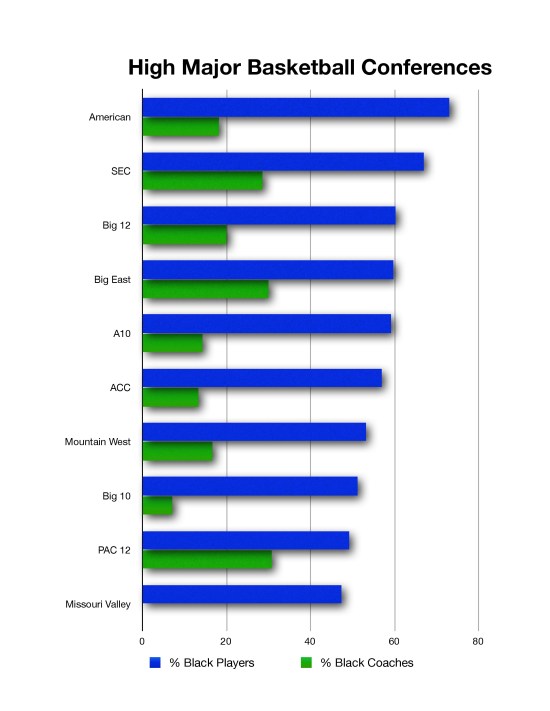
As you can see on the chart (above), Black players are disproportionately represented in the uniforms. These are ten of the biggest conferences with the largest basketball budgets in the nation.
In the Missouri Valley Conference, Blacks make up about half the players and there are ZERO (0) Black Head Coaches in that league. ZERO!
If Black players never see Black Head Coaches and Black Athletic Directors, how will they envision themselves in these positions of authority?
A Real NCAA Rule Change Casualty
Today, I received a text message from a good friend of mine. He’s highly regarded high school basketball coach. Over the years, he has sent numerous players to some of the best college basketball programs in the nation. He’s known as a stern taskmaster that does things the right way. He’s asked the Black Cager to address his parents and players in the past. We’ve always been happy to oblige.
Today, he needed help. He needed me to talk to a parent. He asked if I could spell it out for Mom.
Her son, “Javonte” (not his real name) is a “Dead Man Ballin”!!
At 6’8″ 240 lbs, he is a beautiful physical specimen. He is a high level athlete with a smoothness to his game. On the court, Javonte has a chance to be very special. He just turned 17 and is already playing at a very high level for high school. Possessing text book form with feathery touch and excellent release, Javonte grew up around the game. His older brothers were All-State players. As a result, he shows a feel for the game that cannot be learned on the fly. With a strong handle, he is adept at creating shots for himself and can spot up or pull up off the dribble. He is very good at creating offense for his teammates. Javonte has a tremendous basketball body with a big frame, wide shoulders, enormous hands and long arms.
Big East, Big 10, ACC, Atlantic 10 and SEC coaches have been drooling at the thought of Javonte joining their program. They have been constantly hitting him up on twitter, instagram and snapchat.
None of them have seen his transcript…

Mom refused to take the coach’s advice. When he transferred in prior to the start of his 11th grade year, the coach told Mom, “Your son has dug a big hole for himself… it’s gonna be tough.”
He had spent his freshman and sophomore years at a Catholic High School. During that period he had taken and completed 12 core courses. His grades were 6 D’s and 6 C’s. He had a 1.5 core GPA.
Coach, very much aware of the 2016 rule changes, stressed the importance of getting straight A’s going forward. Coach hoped the kid would at least get mostly A’s with a few B’s. Kid proceeded to fail English and get a D in Algebra as a Junior.
Coach pleaded with Mom and the kid to go to summer school before 11th and again before 12th grade. Coach explained over and over again that he needed to get those D’s off his report card.
“D’s are GPA killers!”
He would say over and over, to no avail. Mom and her boyfriend wanted the boy to play on the Nike EYBL circuit and summer school would get in the way…
On the first day of school in September, when the homeroom bell rang, the NCAA had him in their sights….

When the teacher, taking attendance for the first time, called his name…
“Javonte, Javonte?”
The finger was on the trigger… Once he raised his hand and responded…
“Here….”
He was done… Dead Man Ballin’…
His senior year had officially commenced. With that, the poor grades on the transcript depicted above were “locked in”.
He cannot retake or replace any of those grades in an attempt to raise his core GPA to the new 2.3 minimum.
His refusal t0 follow the directions of his coach cost the family anywhere from $200,000 to $300,000 in scholarship funds.

Like a cop after an accident in the middle of the night… Like a military chaplain after a young man steps on a land mine…
It was my responsibility to let his mother know that her son is a Dead Man Ballin’…
Before he plays a single game in his senior year, he is ineligible for a Division 1 athletic scholarship…
This fucked up situation is playing out in High Schools and homes in Black communities across the country… Unnecessarily so!!
2016 NCAA Eligibilty Requirements


Learning Disabilities and NCAA Eligibility: Open Letter to Parents
Say your son or daughter has a learning disability. They are bright and inquisitive, but they learn differently.
If your child receives special education services, he must have an Individualized Education Program (IEP). That’s the law. An IEP is an important legal document. It spells out your child’s learning needs, the services the school will provide and how progress will be measured.

Several people, including parents, are involved in creating the document. The entire process can be a great way to sort out your child’s strengths and weaknesses. Working on the IEP can help you figure out ways to help him succeed in school.
Creating an effective IEP often takes time, effort and patience.
If your child is also an elite scholastic athlete, there are some other very important factors that must be taken into account.
Your child’s AAU/Grassroots coaches and High School coaches should help walk you through the legal language and procedures so it’ll be easier for you to participate. The more they know about the process, the better they can advocate for your child.
Even with an IEP your child will be required to complete 16 NCAA approved core courses.
The AAU/Grassroots coaches should help you identify a high school with a strong special education component. They should help you find a school with NCAA-approved core courses for special education students.


IMHOTEP High School in Philadelphia is one such school. As you can see, IMHOTEP has 18 special education classes listed on their NCAA APPROVED Core Course list. If your son or daughter has exhibited elite-level athletic abilities and you are NOT in a position to pay $40,000 to $65,000 to cover the cost of the first year of college, ask questions…
Ask to see the list of NCAA APPROVED Core Courses… If they don’t have a strong special education program, consider another placement. If they do NOT have NCAA APPROVED special education Core Courses, find a high school that does.
Because of your son’s or daughter’s athletic abilities, many people will have opinions. They will criticize your school selection. They will question your motives. Ignore them.
They will NOT help you pay for college if your son or daughter is not eligible. Put your child in the best possible situation to excel athletically and meet increasingly stringent NCAA eligibility guidelines.
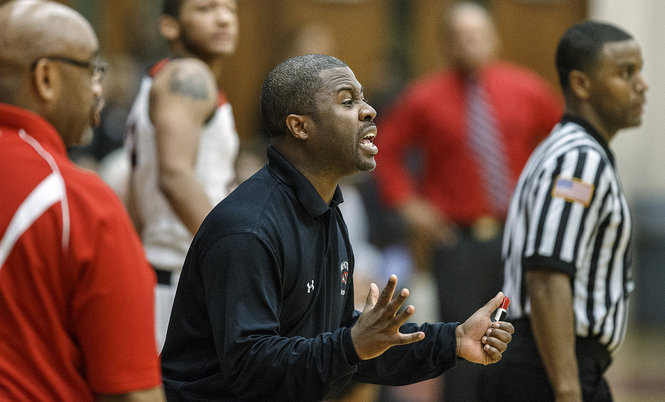
Andre Noble, Imhotep Boys Basketball Coach
Find a school that has taken the time, like IMHOTEP, to make sure that their special education classes were reviewed and approved by the NCAA.
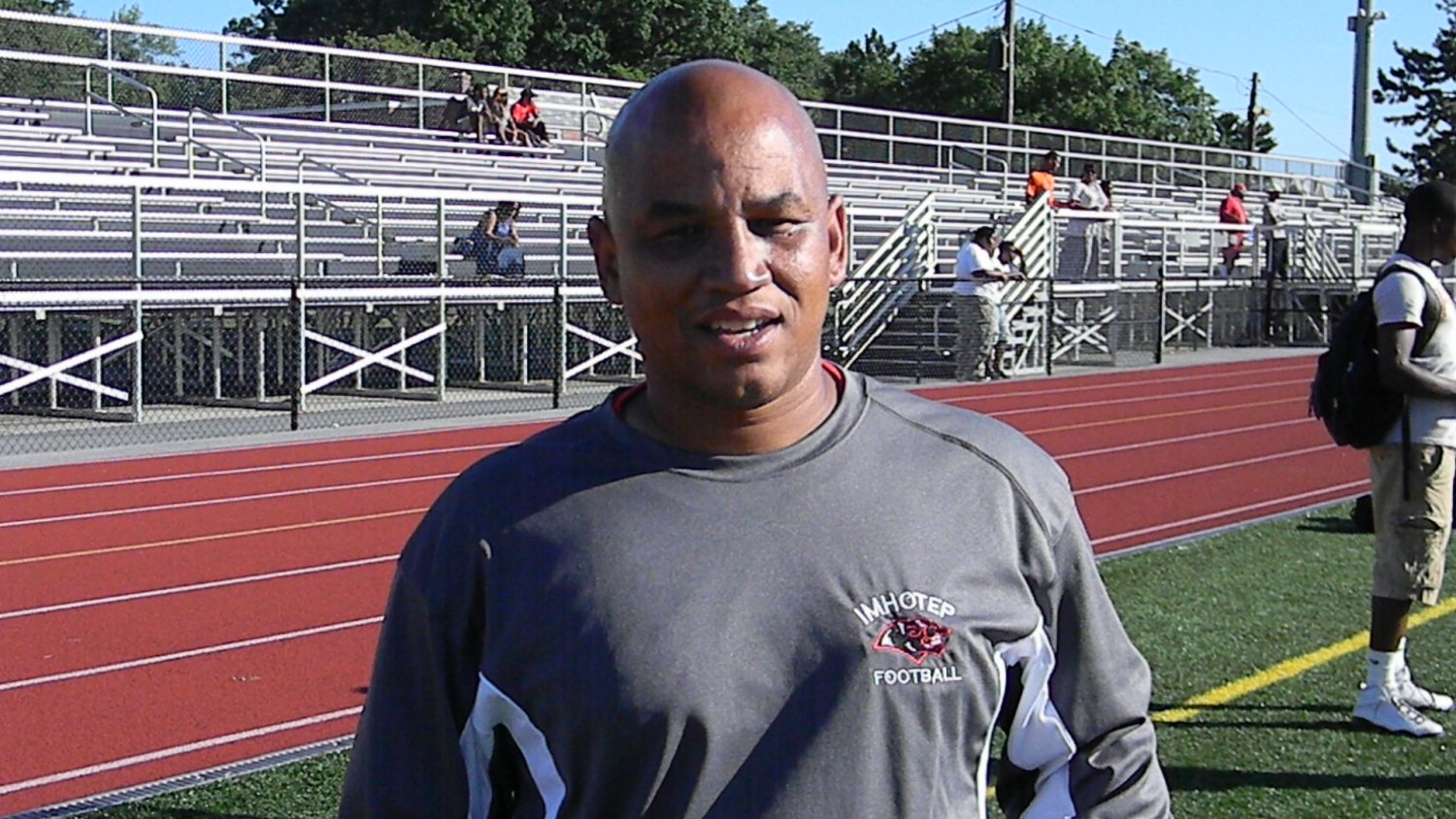 Albie Crosby, Imhotep Football Coach
Give your child the best possible chance to earn a college scholarship… Everything else is bullshit… I’m just sayin’….
The IRRATIONAL Choice to Attend Neighborhood Public Schools: Don’t Do It!!
I often wonder: How do parents send their children to neighborhood public schools in cities like Detroit, Camden, Chicago and Philadelphia? Seriously… How do they do it?… Why do parents continue to entrust these schools with the task of educating their precious kids? It just doesn’t make sense… Parents have choices. There are public magnet schools, some good charter schools and very affordable Independence Mission Schools. With very few exceptions, parents should NOT send their children to neighborhood public schools. It’s time to jump off the sinking ship…

Independence Mission School students
Let’s start from a point where we make an important assumption about parental actions in urban areas like Philadelphia, PA, Camden, NJ, Newark, NJ, Baltimore, MD, Chicago, IL and Detroit, MI. The assumption is so widely held among Black Americans that it is seldom discussed explicitly.
The assumption is that Black parents want their children to learn. I assume that Black parents want their children to receive a first rate education. This, I believe to be fundamentally true. It’s deeply ingrained as direct result of the Black American experience. Black Americans innately understand that access to a quality education is of paramount importance. Throughout the overwhelming majority of American history, whites in power have worked diligently to deny Blacks access to high quality educational opportunities. Indeed, a stated aim of the government was to violently impose ignorance on Black Americans.
The following is the verbatim “Act Passed by the General Assembly of the State of North Carolina at the Session of 1830—1831” (Raleigh: 1831).
Whereas the teaching of slaves to read and write, has a tendency to excite dis-satisfaction in their minds, and to produce insurrection and rebellion, to the manifest injury of the citizens of this State:
Therefore, Be it enacted by the General Assembly of the State of North Carolina, and it is hereby enacted by the authority of the same, That any free person, who shall hereafter teach, or attempt to teach, any slave within the State to read or write, the use of figures excepted, or shall give or sell to such slave or slaves any books or pamphlets, shall be liable to indictment in any court of record in this State having jurisdiction thereof, and upon conviction, shall, at the discretion of the court, if a white man or woman, be fined not less than one hundred dollars, nor more than two hundred dollars, or imprisoned; and if a free person of color, shall be fined, imprisoned, or whipped, at the discretion of the court, not exceeding thirty nine lashes, nor less than twenty lashes.
II. Be it further enacted, That if any slave shall hereafter teach, or attempt to teach, any other slave to read or write, the use of figures excepted, he or she may be carried before any justice of the peace, and on conviction thereof, shall be sentenced to receive thirty nine lashes on his or her bare back.
III. Be it further enacted, That the judges of the Superior Courts and the justices of the County Courts shall give this act in charge to the grand juries of their respective counties.
Similar laws were in place across the United States. From the early 1700‘s through the Civil War, white Americans feared that black literacy would prove a threat to the prevailing social order which featured a barbaric chattel slave system. The peculiar institution relied on ensuring that enslaved Blacks remained dependent upon white masters. Whites in colonies and subsequent slave states instituted laws forbidding slaves to learn to read or write and making it a crime for others to teach them. In most states, whites were substantially fined and Blacks were subjected to 30-40 lashes on his or her bare back for teaching Black Americans how to read or write.

Enslaved Black revealing scars from whipping administered by white slave owner
Following the Civil War, whites established an Apartheid-like system of Jim Crow schools designed to ensure that Blacks were not adequately educated. This system remained entrenched through the 1960’s and 1970’s in many parts of the country. Schools for white children received more public money. Fewer Blacks were enrolled in school. There were not as many public schools available for Blacks. Many school buildings for African Americans had leaking roofs, sagging floors, and windows without glass. They ranged from untidy to positively filthy, according to a study issued in 1917. If black children had any books at all, they were hand-me-downs from white schools.

White Classroom in the United States in the 1930s
Even if they are unaware of the specific details of the struggle to access to education in America, Black parents know that it is extremely important. Black parents know that for centuries, real educational opportunities were routinely denied to Black children.

Black Classroom in the United States in the 1930s
Black parents, like all parents, want better for their children. When you talk to them they express preference orderings. They want access to good schools. They want to avoid bad schools.
So… How do parents in urban areas send their kids to neighborhood public schools? It just doesn’t make sense… As noted earlier, Black parents in today’s urban settings have very real choices… They must be unaware of the options available to them. Their decisions to enroll their children in neighborhood public schools MUST be based on limited and uncertain information regarding alternative educational placements. The Black Cager is dedicated to providing information in an accessible and easily understood manner to Black parents, grandparents and other caregivers.
So, how bad is it? The writing has been on the wall for a while… Black parents cannot say the were not warned…
First, they cut the funding. Then they watched the district suffocate as a result.
In June of 2013 Philadelphia Superintendent William R. Hite Jr. laid off 3,783 employees, because of the district’s financial crisis. The list included 676 teachers, 283 counselors, 127 assistant principals, and 1,202 noontime aides. “These … employees are more than numbers: these are people — professionals — who play important roles in the lives of thousands of students throughout our city,” Hite said at a news briefing.
Hite called the layoffs “nothing less than catastrophic for our schools and students… Every aspect of the district will feel the impact — schools, regional offices, and central office — along with employees ranging from senior administrators to support staff.”

Water damage and mold on wall at Furness HS, School District of Philadelphia
Two years later, the catastrophe has been realized. Approximately, 83 percent of Philadelphia public school students in grades 3-8 failed the state Pennsylvania System of School Assessment (PSSA) exam in math. In reading, 68 percent failed and 63 percent failed the science exam. Apologists will cite the “new” version of the test as the main factor explaining the horrific performance. It can explain some of the increase in the number of failing students. However, a majority of Philadelphia public school student failed the old test as well.
The fact remains, for years an overwhelming majority of Philadelphia’s public school students have been performing abysmally on standardized state assessments. One can only conclude that, for the most part, students attending neighborhood public schools are simply incapable of competing with students in surrounding suburban public schools and Philadelphia area private schools.
More than 8 out of 10 students cannot perform grade level math!
The bill for years of academic incompetence and startling underperformance is about to come due. Philadelphia students will be the ones that have to pay. The School District of Philadelphia also released results on the state’s Keystone Exams, which students must pass to graduate starting with the Class of 2017. The proficiency rate in Algebra I was 38 percent (compared to 39 percent in 2014), 29 percent in biology (26 percent in 2014) and 49 percent in literature (52 percent in 2014).
Plainly stated, if the 2017 rules were in place in 2014, 71% of Philadelphia’s public high school students would not have been unable to graduate from high school because the failed the biology exam, 62% would have been held back by their Algebra I score and 51% by the literature score.
Here’s where it gets really tricky for Districts serving poor Black and Brown students… Failing students are allowed to undertake alternative projects. But districts across the state say the projects will drain resources as schools try to provide students with the additional instruction needed for them to complete the task. Philadelphia has already experienced a succession of budget cuts that reached the bone marrow. Similarly, Chester Public Schools does not have adequate funds to meet the regular payroll for staff and faculty. Where will Harrisburg, Philly and Chester get the money for the additional instruction? They won’t…
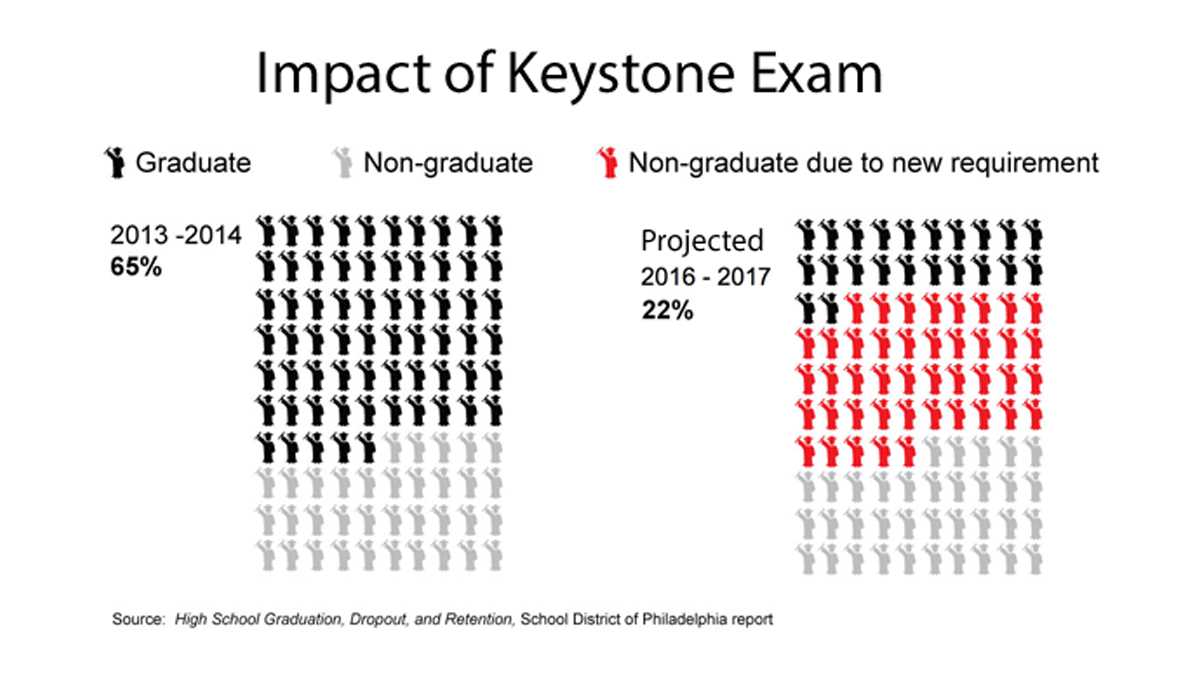
Projected Impact of Keystone Exam of Philadelphia Graduation Rates
Truth be told… Many, perhaps most, poor Black and Brown kids attending public schools in cities across the state of Pennsylvania will NOT graduate high school. They will start their adult lives an non-high school graduates with some sort of 2nd class “Certificate of Attendance.”
If at all possible, do NOT send your kids to poor performing neighborhood public schools. They are educational quicksand!!
If you must rely on public education, do your research. Find out about magnet programs, identify high performing schools, learn about the application and admission processes. Make the best decision for YOUR child.
We can all continue to support the idea of public education. We can vote for political candidates that allocate adequate resources to public schools. We can volunteer in our local schools.
But when it comes to making a decision about your child, you must make a decision that reflects your understanding of what’s best for your child. With that in mind, I just do not understand how parents send their kids to neighborhood public schools in Philadelphia. The ship is sinking fast…
Why Did He Commit to Them? Toward A Better Understanding of the College “Decision” Process
What the fuck? Why?
Why did he commit there? Why didn’t he choose us? Why didn’t he come to our school?
Our academics are better! We win more! We produce more pros! Shit makes no sense…
Many resort to knee-jerk accusations that the kid was “bought off” to explain the decision… They had to cheat… Why else would he choose them over us?
Every year around this time, passionate alums and casual observers rack their brains trying to make sense of decisions made by 18 and 19 year old elite Black male student-athletes. Indeed, an entire multi-million dollar industry has emerged dedicated solely to tracking the college selection processes of elite predominantly Black male student-athletes. Scout and Rivals are two of the biggest media enterprises dedicated to in-depth coverage this annual race to sign the very best scholastic ballers. Rivals was purchased for $100 million by Yahoo in 2007. Scout generates over $100 million in annual revenues.

Malik Ellison committing to St. Johns
Despite intensive media coverage, very little thought is given to the actual decision-making process itself. Core questions at the center of the ‘mainstream’ dialogue are fairly easy to delineate: Where will Black male athletes sell their athletic labor in return for an athletic scholarship? Which predominantly White NCAA Division I institution will profit generously in return?
The Black Cager is dedicated to going a little deeper than that. I want to foster understanding. So… How can we begin to make sense of these “decisions” made by thousands of young Black men entering collegiate athletics every year?
I want to provide a basic framework for understanding the all too often overlooked decision-making process. While the analytical focus is on urban Black male basketball players, the framework can be applied across racial and ethnic backgrounds as well as geographic settings. Many white ballers from the cornfields of the mid-west face the same circumstances.
My basic hypothesis is that predominantly white college sports fans, alums, writers and even coaches assess the decision-making process from a purely “rational” point of view. In doing so, they consistently fail to understand and appreciate the limits or “bounds” the student-athlete operates under. As a result, the observers are usually confused and unable to comprehend why decisions are made. This confusion leads many to make unfounded and unwarranted accusations about the character and integrity of the process, the student-athletes and their families.
What are the limits and constraints? What are the “bounds” imposed upon student-athletes making college decisions? Elite Black male student-athletes facing college decisions have to work under three unavoidable constraints.
- They only have access to limited, often unreliable, information regarding possible alternatives and their consequences,
- The human mind has only limited capacity to evaluate and process the information that is available. And,
- only a limited amount of time is available to make a decision.
Therefore even student-athletes intent on making rational choices are bound to make satisficing (rather than maximizing or optimizing) decisions in complex recruiting situations. This vital fact is overlooked by disappointed and frustrated supporters of programs that lose recruiting battles. Moreover, it is not addressed by ‘mainstream’ sportswriters and analysts trying to explain outcomes to their targeted audiences.
All they know is, to them, shit don’t make no sense… As a result, message boards are flooded with nasty, vile and even racist attacks on young men that chose a program other than theirs.

Tamyra ‘Mookie’ Laws committing to Holy Family University
Fans fail to understand that these limits (bounds) on rationality make it nearly impossible for student-athletes and their families to consider every contingency, necessitating reliance on advisers, ‘handlers’ or even agents operating behind the scenes.
Black male student-athletes, like everyone else, are to some extent rational beings in that they will try to logically understand things and make sensible choices. This is rightfully assumed by most observers. Collegiate sports fans, alums and college coaches assume that student-athletes have preferences among the colleges offering scholarships that allow them to state which option they prefer.
From a purely rational perspective, these preferences are assumed to be complete (the student-athlete can always say which of two college programs they consider preferable or that neither is preferred to the other) and transitive (if college A is preferred over college B and college B is preferred over college C, then A is preferred over C).
However, observers make the mistake of assuming student-athletes take account of ALL available information like academic reputations, graduation rates and probabilities of events like winning conference championships, appearing in the NCAA tournament and being drafted by an NBA team. It is further assumed that a student-athlete weighs the potential costs and benefits in determining preferences, and acts consistently in choosing the self-determined best choice of action.
That’s how most causal observers think the process works. But…. That’s not how it actually goes down…
For elite Black male student-athletes the college recruitment process is extremely daunting and complex, and they do not have the capacity to understand everything. As noted earlier, they only have access to limited, often unreliable, information regarding possible alternatives and their consequences. Yes… college coaches are able to make an unlimited amount of phone calls and text messages to recruits. Of course, they do everything they can to get their message across to the young men.
For many student-athletes this quickly results in hundreds of calls and/or text messages per day. As a result, coaches begin to sound like Charlie Brown’s teacher, “whaaan, whann, whann, whann, whann…”
Coaches understand this, even if fans don’t, so they rely on the development of intermediaries like AAU/grassroots coaches, HS coaches, family members, friends, girlfriends, etc. to deliver messages to student-athletes. Unfortunately, in many instances, the “interests” of the intermediaries supersede the interests of the student-athletes. “If he comes with us, we’ll take care of you or your AAU/HS program” is the message the intermediaries hear. In this way, information reaching the student-athlete becomes limited and unreliable regarding possible alternatives and their consequences.
At this point, the possibility of a truly ‘rational’ outcome has been compromised. The student-athlete is receiving skewed information.

Rakeem Christmas Graduated from Syracuse University in 3 years
Further complicating the process is the fact that the human mind has only limited capacity to evaluate and process the information that is available. This is especially so for urban Black male student-athletes. The athletes and their family members very often do not possess the intellectual tools required to adequately understand the process as it unfolds.
It’s really bad… Really, really bad…
On August 24, 2015, the Philadelphia Inquirer reported that “nearly half of all adults in [Philadelphia] – more than half a million men and women – lack the basic skills necessary to qualify for postsecondary training or hold jobs that permit them to support a family. Many function below eighth-grade levels.”
How are parents and grandparents that can’t read supposed to sort through the labyrinth of NCAA regulations and appropriately weigh the options available to them? They can’t….
The student-athletes themselves may be in an even worse position. A recent study by the Schott Foundation for Public Education found that the four-year HS graduation rate for Black males in many of America’s urban areas was profoundly abysmal. Detroit, MI (23%) has the lowest Black male graduation rate in the country (in Detroit only 13% of White males graduate from high school within a four year period), followed by Philadelphia, PA (26%), Clark County, NV (27%), Pinellas County, FL (28%), Cleveland, OH (28%), New York, NY (28%), Chatham County, GA (28%), Richmond County, GA (29%), Duvall County, FL (29%), and Norfolk, VA (31%). For the 26% that remain engaged in school, in 2014, 42 percent of students met the reading standards bar set by the state on the Pennsylvania System of School Assessment, down from 42.3 percent. In math, 45.2 percent met standards, down from 46.9 percent.
Plainly stated, many student-athletes and their families lack the educational foundation necessary to adequately process, evaluate and process information available on the various collegiate programs offering athletic scholarships.

DeAndre Bembry dunking on VCU
Then on top of that, there is limited time to make a decision. The NCAA manages the daily operations of a National Letter of Intent (NLI) program that includes 650 Division I and Division II participating institutions. Through the establishment of signing periods, the NLI program imposes deadlines on student-athletes and their families. And, there’s always the possibility that another player may take the desired scholarship.
Most elite Black male scholastic student-athlete are confronted with limitations imposed by poor educational backgrounds, a lack of understanding NCAA regulations and other factors. Given this set of circumstances, there is no way student-athletes can have a complete understanding of the recruiting process before having to make a decision.
Within this context, truly ‘rational’ decisions become impossible… What emerges are decisions that are ‘good enough’…
Information, more or less, tends to change people’s decision. Every student-athlete is limited by the decisional limitations outlined above. The better the athletic prowess, the more complex the issues become, thereby increasing the cognitive load. And where there is cognitive overload, student-athletes rely upon coping mechanisms to arrive at a decision.
They settle for a school that is ‘good enough’ as opposed to finding the ‘best school’. Black male student-athletes end up choosing a school that meets most of their goals instead of going for the optimal solution.
This is where college fans and alums become confused. They wonder: Why did he choose a school that hasn’t been to the tournament in 10 years? Why did he choose a program that doesn’t have as many NBA players as ours?
In choosing college destinations, in can be argued that there are no optimal decisions, but choices that are in some sense locally optimal at best. The implications of these decisions are based on bounded rationality, which is senseless to observers applying rational logic, but completely sensible for the student-athlete making the decision.
Elite Black male student-athletes do exactly what makes the most sense to them, in the context of the moment, with their current understanding. If you are a white college educated-male with college educated parents that were in a position to pay for your education you likely have no frame of reference for understanding this process.
It ain’t personal… Cut the kids a break…
Youngfellas.. If you are the best player in the gym? Leave….
… and go find a gym where guys will push you and make you a better player. Charles Brown, Jr., A Saint Joseph’s University 2016 commit took this advice to heart and tracked down Jameer Nelson and Emmanuel Mudiay of the Denver Nuggets. He spent some time working out with the NBA players. Most importantly, he listened as they talked about different aspects of conditioning and mental preparation necessary to play at the highest level.

Charles Brown (Philly Pride/St. Joseph’s University) and Big 5 Hall of Famer, Jameer Nelson (Denver Nuggets)
Over this past Spring/Summer Brown exploded on the national scene with a series of phenomenal shooting performances for Philly Pride AAU on the Under Armour Circuit. As a result, he was heavily recruited by Big 10, SEC, Big East and Big 12 programs. A true Philadelphia and a man of his word, Brown never wavered from his verbal commitment to St. Joseph’s. “It was nice to see people recognizing that i could play at the highest level, but I made the decision to become a Hawk a while back. There’s nothing that could change my mind. My mother, my father and the rest of my family already feel like we are part of St. Joseph’s University. Coach Arnold and Coach Martelli have made us feel welcome. I can’t wait to play on Hawk Hill.”
Brown got a chance to gauge himself against the very best today. Emmanuel Mudiay was a lottery pick of the Denver Nuggets in the recent 2015 draft. He is expected to immediately contribute as Denver makes a push for the playoffs in the super competitive Western Conference. “Emmanuel is super athletic and highly skilled”, said Brown. “It’s really a pleasure to just watch him go about his business.”

Charles Brown and Emmanuel Mudiay (Denver Nuggets)
Brown reports to St. Thomas More Preparatory School next week. He will be playing in the New England Prep School League for the 2015-2016 season.
 The Black Cager