PHILADELPHIA, PA — The red brick walls of Hagan Arena have borne witness to a century of basketball, but they have never seen a moment quite like this. The Saint Joseph’s University athletic department sits at a crossroads that feels less like a fork in the road and more like a continental divide. The college basketball landscape has been fundamentally rearranged by the twin tectonic shifts of Name, Image, and Likeness (NIL) compensation and the transfer portal. As the university, in conjunction with a search firm, conducts a “national search” for a new athletic director to steer the Hawks through these turbulent times, the administration faces a decision that will define the program for a generation. The temptation to cast a wide net, to seek a savior from a powerhouse athletic department in the Big Ten, Big 12, ACC or the SEC, is understandable. But to do so would be a catastrophic misreading of the institution’s soul and the unique ecosystem in which it thrives.
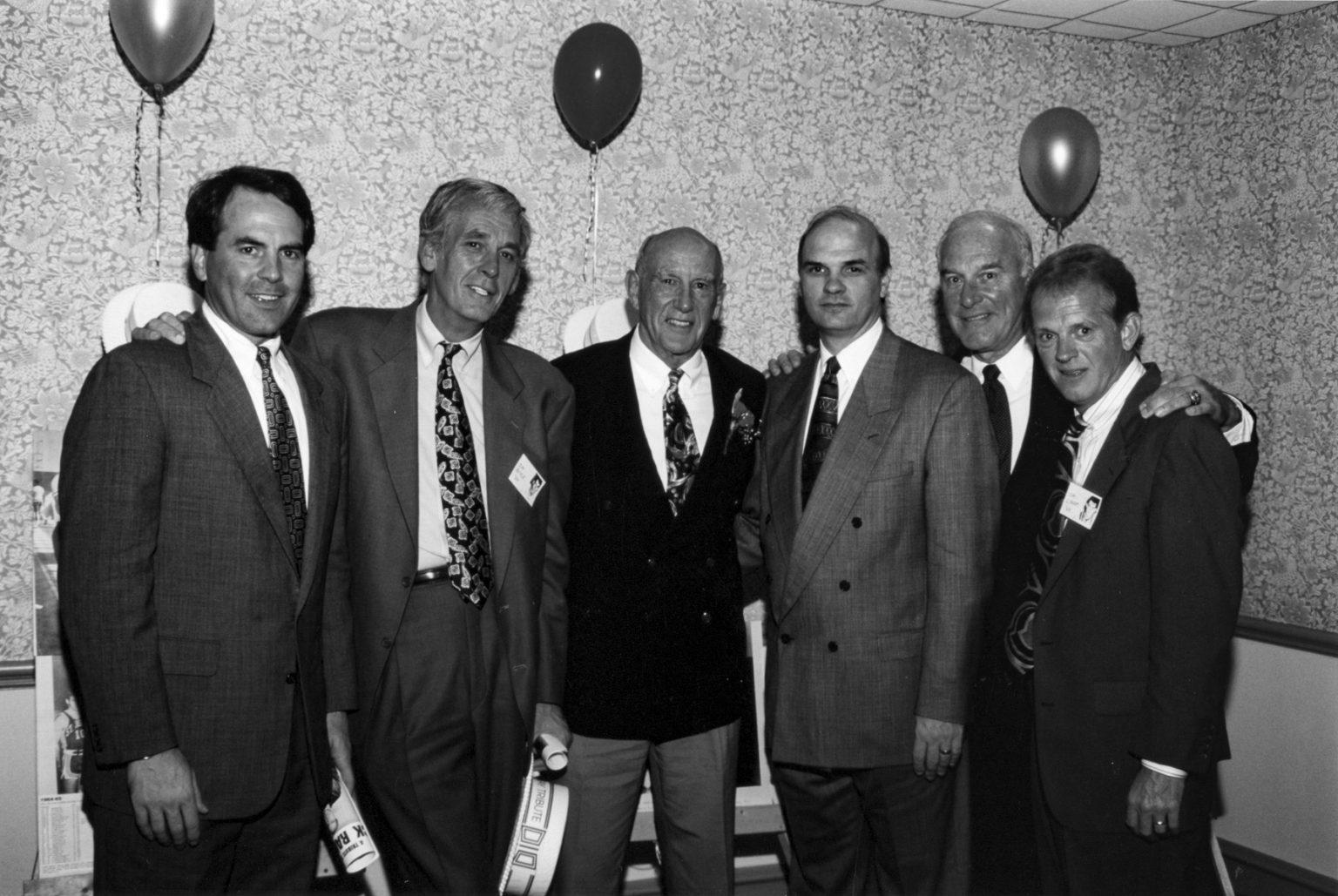
The only viable path forward is not to abandon the past but to embrace it with a full-throated, modernized fervor. Saint Joseph’s must identify an alum, a Hawk, who has spent their career navigating the new NCAA terrain. The primary prerequisite for the next athletic director must be an intimate familiarity with the Hawk program—a visceral, cellular understanding of the culture and tradition that, just two decades ago, placed this small Jesuit school at 54th and City Avenue among the pantheon of college basketball royalty.
The Legacy Forged in Crimson and Gray
To understand what is at stake, one must first appreciate the magnitude of what has been built. When Street & Smith’s magazine ranked the greatest college basketball programs of all time in 2005, Saint Joseph’s University was slotted at No. 43. Let that sink in. Out of more than 330 Division I programs at the time, a university with an undergraduate enrollment smaller than many high schools in the Philadelphia suburbs was ranked among the top 13% in the nation. This was no fluke. It was the result of a half-century of sustained excellence, a legacy etched by players who wore the uniform and then dedicated their lives to the program.
The résumé is undeniable: 21 NCAA Tournament appearances, 16 NIT berths, 77 appearances in the national rankings—51 of them in the top 10. The Hawks have sent 29 players to the NBA draft. This is the bedrock upon which the program’s reputation is built.
The Coaching Tree with Hawk Roots
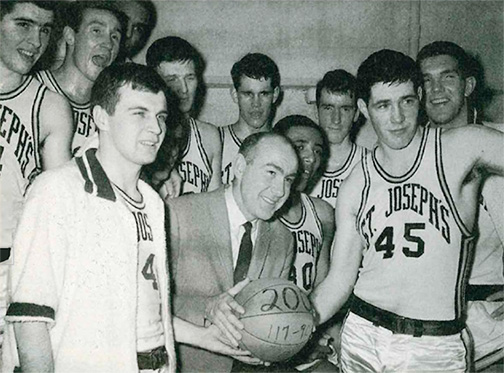
Crucially, the overwhelming majority of this success was orchestrated not by hired guns from afar, but by Hawk alums. These were men who had gone to battle on the court wearing crimson and gray, for whom the sting of a Big 5 loss and the euphoria of a hard fought Palestra victory were imprinted on their DNA.
The lineage begins with the legendary Hall of Famer, Dr. Jack Ramsay. From 1955 to 1966, “Dr. Jack” compiled a staggering 234–72 record, leading the Hawks to 11 NCAA Tournaments and the 1961 Final Four. When he departed for the NBA, the torch was passed not to an outsider, but to another Hawk, Jack McKinney. McKinney sustained the program’s altitude, guiding the Hawks to four more NCAA Tournaments between 1969 and 1974. The tradition continued through Harry Booth, Jim Lynam, Jim Boyle and John Griffin. Lynam, in particular, authored one of the most indelible chapters in program history during the 1980-81 season, leading the Hawks as a No. 9 seed on a magical run that saw them upset No. 1-ranked DePaul to reach the Elite Eight.
Hawk coaches and senior administrators carried the same pedigree. This is a program that has historically been self-sustaining, a closed loop of passion and knowledge passed from one generation of Hawks to the next.
And then there is Phil Martelli. While Martelli did not play at St. Joe’s, he served a decade-long apprenticeship on Hawk Hill as an assistant coach, immersing himself so deeply into the culture that he became its avatar. When he took the helm, he didn’t need to learn the words to “The Hawk Will Never Die”; he had been singing it for years. He understood that the program’s success was built on identifying overlooked, tough, intelligent players who fit a system and a culture, and then developing them over four years. That philosophy culminated in the program’s crowning achievement of the modern era: the 2003-04 team that went 27-0 in the regular season and ascended to No. 1 in the national polls.
The Uniqueness of the Philadelphia Basketball Ecosystem
This history is not just a point of pride; it is a practical map of the territory. Saint Joseph’s is situated in a geographic cauldron with eight other Division I programs within an hour of campus. Philadelphia is a quirky, guarded, and fiercely opinionated basketball town. It is a city of neighborhood legends, playground hieroglyphics, and a deep-seated skepticism of outsiders. The Big 5 rivalries with Villanova, Temple, La Salle, and Penn are not just games; they are civic institutions, fought on the historic floor of the Palestra, a cathedral of the sport.
This is not a place where you want to do a lot of on-the-job learning. An administrator coming from a massive state university in the South, Midwest, or West Coast would look at a map and see a crowded market. They would see the bright lights of the Big 5 and the proximity to powerhouses like Villanova and see only obstacles. They would not see the opportunity. They would not understand that a gritty win at Temple’s Liacouras Center resonates more deeply with the Hawk alumni base than a neutral-site victory in a tournament in Florida. They would not grasp the delicate diplomacy required to navigate the politics of the Big 5 while fiercely competing in the Atlantic 10. To parachute someone into this environment without a deep well of local knowledge would be to send them into a game without a playbook.
Navigating the New Reality While Preserving the Soul
This is not an argument for nostalgia or a retreat from the realities of modern college athletics. The emergence of NIL and the transfer portal has had an unprecedented impact, particularly on programs like St. Joe’s that lack the television revenue of a Power 4 football conference. The Hawks cannot and should not try to match the raw financial compensation packages of the Alabamas and Kansases of the world. That is a fool’s errand.
Therefore, the identity forged over 75 years is no longer just a nice story; it is the program’s only sustainable competitive advantage. In an era of mercenary free agency, the promise of a genuine family, a proven developmental system, and a connection to a tangible tradition is a powerful recruiting tool. It is the counter-programming to the NIL bidding war. It is the message that resonates with the right kind of player—the one who wants to be the next great Hawk, not just another jersey in a crowd.
The Case for a Hawk at the Helm
This is why the search for a new athletic director is the most critical moment for the program since the construction of the Hagan Arena. The pool of candidates with SJU degrees who are currently immersed in the new NIL and transfer portal world may not be deep, but it contains highly qualified swimmers. There are alumni working in athletic departments across the country who have spent the last three years on the front lines of this revolution. They understand the mechanics of assembling a compliant NIL collective. They understand how to evaluate talent in the portal. But crucially, they also understand the culture that makes those pieces fit together.
They understand that the Hawk is not just a mascot but a symbol of tenacity. They know that the most beloved players in program history weren’t always the most talented, but they were always the toughest. They understand that the community at 54th and City is not a customer base; it is an extended family that has been showing up for a century.
To ignore this internal resource in favor of a shiny object from a football school would be an act of institutional malpractice. Plucking an administrator from a Big State University and planting them on City Avenue, hoping they can absorb the nuances of Hawk basketball through osmosis, is a recipe for cultural erosion. They might balance a budget, but would they understand the budget of emotion and pride that fuels a Big 5 upset?
The road forward for Saint Joseph’s must be a synthesis of old and new. It requires a full-throated embrace of the Hawk tradition—the Ramsay way, the Lynam way, the Martelli way—with the modifications necessary to compete in the NIL/transfer portal era. It requires a leader fluent in both languages: the language of the collectives and the language of the Catholic, Jesuit mission. It requires a Hawk. The tradition they must be hired to protect is not a relic to be displayed in a trophy case. It is the compass that has guided this program through 75 years of change. To throw it overboard now, in the stormiest seas the sport has ever seen, would be to sail blindly toward the rocks.
 The Black Cager