PHILADELPHIA, PA – In the hallowed halls of Georgetown basketball lore, a tradition of transcendent big men looms large: Patrick Ewing, Alonzo Mourning, Dikembe Mutombo, Greg Monroe, Othella Harrington, and Roy Hibbert. To that lineage, the Hoyas now add a new name—Thomas Sorber. The freshman center from Philadelphia, already making waves with averages of 19 points, 8.7 rebounds, and 1.3 blocks through his first three collegiate games, is more than just a promising player; he represents the program’s clearest path back to national prominence.

At 6-foot-9 and 250 pounds, Sorber blends physicality and finesse in a way that recalls the greats of Georgetown’s storied past. His high school accolades are substantial: as a senior at Archbishop Ryan, he averaged an imposing double-double with 18.9 points, 11.2 rebounds, and 4.8 blocks per game. On the Nike EYBL circuit, he showcased his versatility for Team Final, displaying the kind of court awareness and soft touch that have made him a nightmare matchup for opposing bigs. But Sorber’s potential extends far beyond his statistics.
Under the tutelage of new head coach Ed Cooley, Georgetown basketball is undergoing a seismic shift. Cooley, known for his success at Providence, has a proven track record of rebuilding programs and instilling a winning culture. Sorber, a cornerstone recruit ranked No. 50 nationally in the Class of 2024, is the perfect player to anchor Cooley’s ambitious vision. Together, they aim to revive a program that has been mired in mediocrity since its last NCAA Tournament victory in 2015.

The Heir Apparent
Georgetown’s identity has always been synonymous with dominant post players. From Ewing’s national championship in 1984 to Hibbert’s leadership during the Hoyas’ 2007 Final Four run, the big man has been a symbol of both power and pride. Sorber’s presence rekindles that legacy. His polished footwork, ability to control the paint, and burgeoning outside shot make him a modern adaptation of Georgetown’s traditional mold.
But Sorber’s value extends beyond his individual skill set. As Nate Hodge, his AAU coach, astutely observed, Sorber’s combination of size, skill, and feel for the game could make him “something really special” as he continues to refine his conditioning and shooting range. Those are precisely the attributes Georgetown needs to reestablish itself as a force in the Big East and beyond.
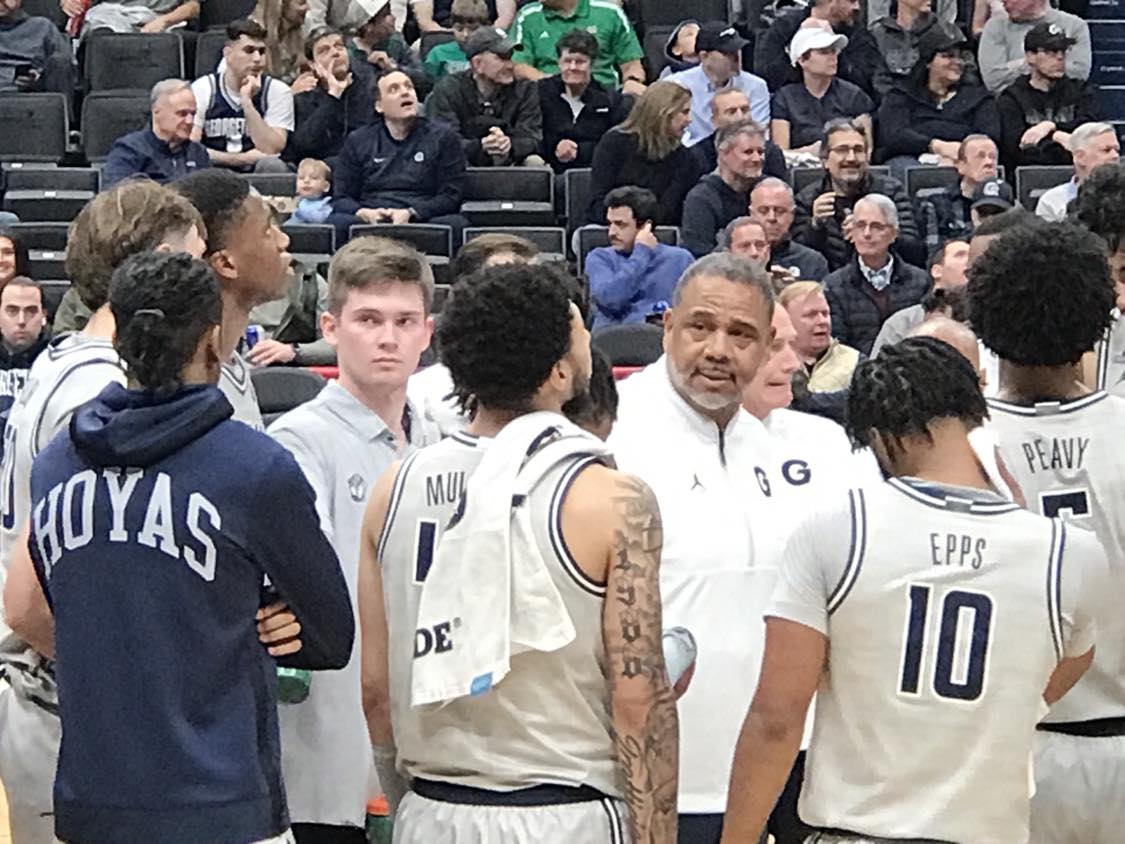
A New Era of Leadership
The importance of Cooley’s leadership cannot be overstated. Georgetown’s previous era, led by Patrick Ewing, was defined by nostalgic optimism that quickly soured into disarray. Now, with Cooley at the helm, the Hoyas have a tactician who excels at player development and cultivating team chemistry. Sorber, described by his high school coach Joe Zeglinski as “unselfish” and “a coachable kid,” embodies the type of player who will thrive under Cooley’s system.
Off the court, Sorber has already earned admiration for his humility and respectfulness—a foundation that will serve him well as he becomes the face of a rebuilding program. His teammates love playing with him, a testament to his leadership and character.
The Road Ahead
For Georgetown, Sorber represents more than just hope; he is a reminder of what the program can be at its best. The Hoyas’ return to relevance won’t happen overnight, but the early signs are promising. Sorber’s ability to impact both ends of the floor, combined with Cooley’s strategic vision, offers Georgetown fans something they haven’t had in years: belief.
The path forward will be challenging. The Big East remains one of the toughest conferences in college basketball, and the Hoyas must contend with powerhouses like UConn and Marquette. But with Sorber anchoring the post and Cooley steering the ship, Georgetown has a chance to reclaim its place among the nation’s elite.
For now, the echoes of the past reverberate in the present, as Thomas Sorber steps onto the court at Capital One Arena. His presence is a declaration: Georgetown basketball is back, and its future starts now.
 The Black Cager