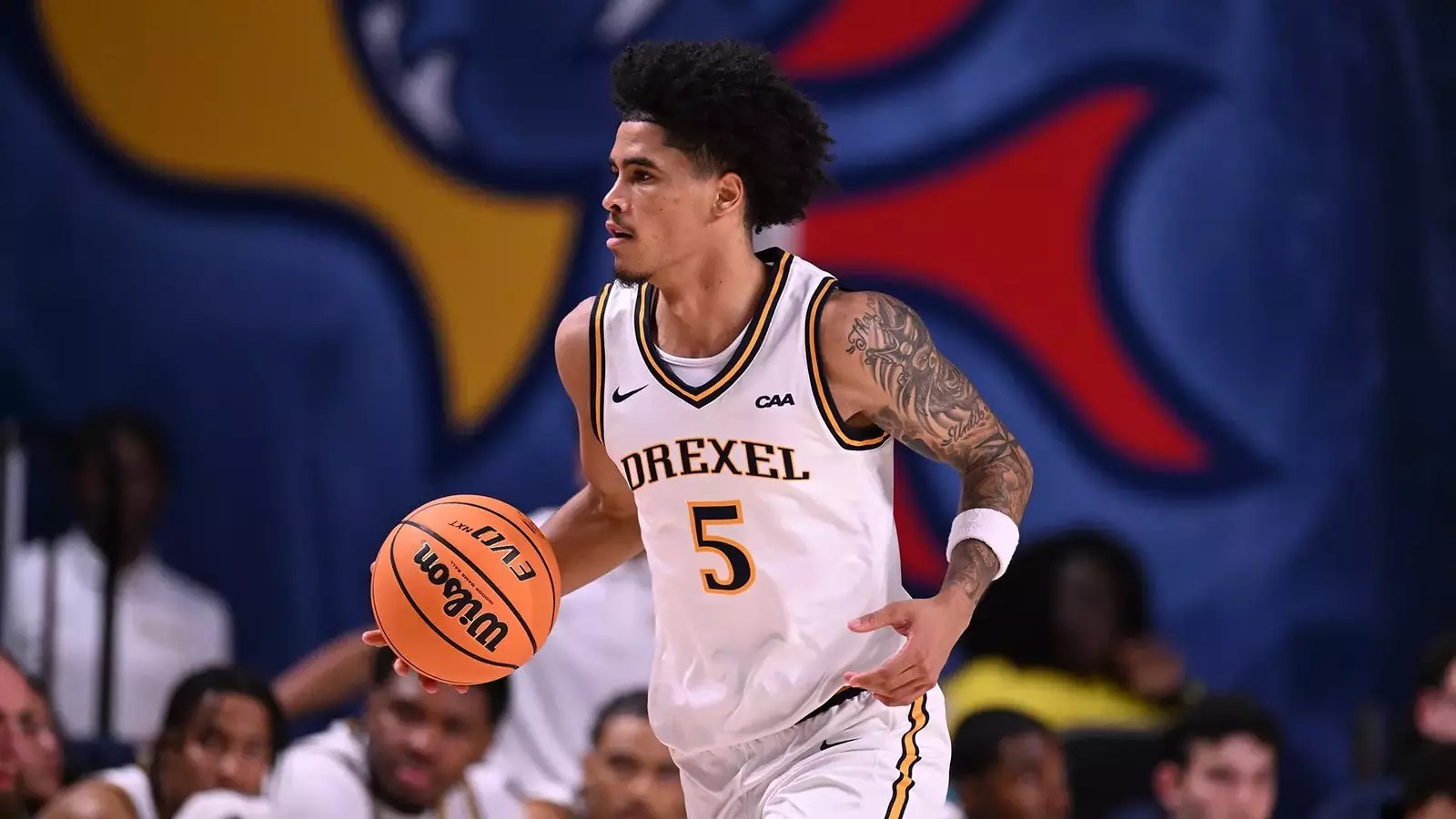
PHILADELPHIA, PA – In the ever-evolving ecosystem of college basketball, where the transfer portal and NIL opportunities have reshaped the traditional landscape, players like Drexel University’s Kobe Magee are a rarity. Magee’s emergence as an elite college basketball player this season is a testament to a journey almost unrecognizable in today’s game: one marked by patience, commitment, and steady growth.

Magee, a junior guard, is averaging 16.5 points per game on an impressive 54.7% shooting from the field and 48.1% from beyond the arc. His production, coupled with 31.4 minutes of relentless effort per game, has propelled Drexel to an unexpectedly competitive season. The Dragons record stands at 5-3 after the first 8 games. This is no small feat for a team that lost its entire starting lineup from last year, including its top five scorers, to either the transfer portal or exhausted eligibility.
Head Coach Zach Spiker was left with a daunting task: rebuild a program gutted by the loss of Amari Williams (now at Kentucky), Justin Moore (Loyola Chicago), and other key contributors. But Magee, who came to Drexel as a true freshman and spent his first two years playing limited minutes (7.8 as a freshman, 18.2 as a sophomore), has answered the call to lead in spectacular fashion.

His path stands in stark contrast to those of his peers, including former high school teammates at Allentown’s Executive Education Charter School. Jevin Muniz, Jeremiah Bembry, and Moustapha Sanoh—all Division 1 talents—have navigated the revolving doors of the transfer portal, seeking better opportunities and larger stages. Magee, meanwhile, stayed put.
When asked why he resisted the siren call of the portal, Magee’s answer was as refreshing as it was rare: “Honestly, it’s the love that they are giving me. The coaching staff, the preparation, and the time they consistently take out of their day to help me and my teammates get better. I really appreciate the level of competitiveness that we’ve achieved in this program. I also believe Drexel is a place where I can grind and make it from the bottom. I see all the people transferring for more money. But I don’t play for money; I truly play for the love of the game.”
Magee’s commitment is about more than basketball. A business entrepreneurship major with excellent grades, he embodies the ideals of the student-athlete in an era where those ideals are often overshadowed by financial incentives and career pragmatism.

For Spiker, Magee’s development is a point of pride. “Kobe came to Drexel as a very young true freshman,” Spiker reflects. “He had to compete against older, stronger, and more mature players from day one. He worked on his body, worked on his craft, and has always been ready when called upon.”
This season, Magee has done far more than simply step up. With Drexel facing the grueling competition of a Coastal Athletic Association (CAA) and Big 5 schedule, Magee has shouldered the scoring load while serving as the team’s emotional anchor.
Magee’s path is increasingly rare in a sport where the transfer portal and NIL have become dominant forces. College basketball today often rewards immediate impact over gradual improvement, and programs are built on an annual shuffle of talent. In this context, Magee’s steady climb at Drexel—a mid-major program often overshadowed in the Philadelphia basketball hierarchy—is both a throwback and a revelation.
In many ways, Magee represents the antithesis of what college basketball has become. He is not chasing greener pastures or larger paydays. He is chasing excellence on his terms, embracing the grind, and trusting the process.
His former high school teammates’ journeys highlight the contrast. Jevin Muniz has moved from Delaware State to Florida Gulf Coast. Jeremiah Bembry has traveled from Florida State to West Virginia to Oakland University. Moustapha Sanoh, initially at Rider, now plays for Jefferson University. Each has sought to navigate the sport’s new realities, but none have stayed the course like Magee.
Kobe Magee is the kind of player coaches dream of building programs around. He represents something endangered: a college athlete who sees value in growth, loyalty, and team culture. In an era defined by the quick fix, Magee’s journey is proof that the long road can still lead to greatness.
For Spiker and Drexel, Magee is not just a player. He is the heart of a team and a beacon of hope for a program finding its way in a turbulent landscape. And for college basketball as a whole, Magee is a reminder that while the game may change, the virtues of hard work and perseverance will always have a place in it.
Magee’s rise is a story worth celebrating—not because it is flashy or immediate, but because it is rare and enduring. For Drexel and for college basketball, players like Magee might just be the bridge between what the game was and what it could still aspire to be.
 The Black Cager