Black Athletes, Race and the Rise of NCAA Eligibility Requirements

Imagine this scenario, a scientist develops a gas that kills mosquitoes but can cause some people to go blind.  Let’s say, the gas only blinds white people with blonde hair and blue eyes.  A few people with white people with brown or black hair might get sick but they don’t go blind.  Some with brown or green eyes may get a headache, but they don’t lose their vision.  Blacks, Asians and Latinos are unaffected by the gas.  At the request of the Mayors, the scientist decides to release the gas in New York, Boston and Philadelphia.  All of the mosquitoes are killed but over 200,000 white people with blonde hair and blue eyes lose their ability to see.

Did the scientist discriminate against people with white blonde hair and blue eyes?  Furthermore, suppose the scientist says, “I’m not targeting any specific group, I’m just killing mosquitoes.”  Investigators would ask, “Did you know the gas would cause people with blonde hair and blue eyes to go blind?”  The scientist answers, “yes, but I didn’t target them specifically… I just released the gas to kill mosquitoes.”  How would you view the scientist? Is he a racist? Would it matter that he says he didn’t “target” people with blonde hair and blue eyes?  Whatever his intentions, white people with blonde hair and blue eyes were disproportionately harmed by the intervention.

duke-team-1966-67Duke Men’s Basketball Team, 1966-67

From 1905 through the early 1970’s, major NCAA college basketball and football programs fielded teams that were predominantly white.  In the south, major college athletics was exclusively the preserve of white males for these seven decades.  During this entire 70 year period, there were no substantial “academic reforms” initiated by the NCAA.   In 1959, the NCAA determined that 12 credits per semester defined normal progress.  In 1965, a 1.6 minimum GPA was established for continuing eligibility.  In 1973, the 1.6 rule was replaced with a simpler requirement of a 2.0 high school GPA for initial eligibility, and restoring institutional authority over determining normal progress.

Please note, when the players were overwhelmingly white, academic standards were either non-existent or incredibly low.

1966AlabamaCrimsonTideAlabama Crimson Tide Football Team, 1966

Throughout the 1970’s major college revenue sports underwent a “tanning”  process as Blacks became a majority of the football and basketball athletes.  By the the early 1980’s, Blacks represented the lion’s share of scholarship athletes in revenue sports.  NCAA Eligibility requirements soon emerged as a means of excluding many Black student-athletes from competing at the NCAA Division 1 level.  Like the scientist in the earlier hypothetical, the NCAA says it did not “intend” to disproportionately impact Blacks.  It just happened.
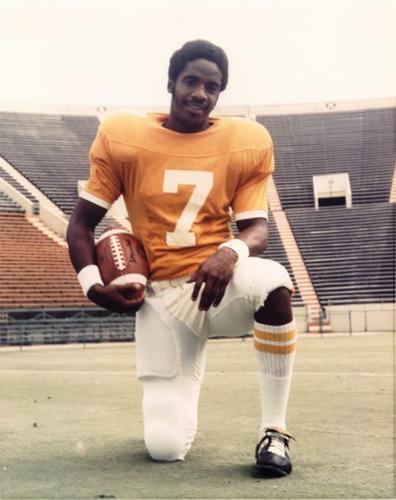
Condride HallowayCondredge Holloway, Tennessee Volunteers, 1st Black QB (1972) in the SEC

With abandonment of rigid Apartheid-like segregation in the South, the 1970s witnessed a rapid influx of Black student-athletes in major college football and basketball. College coaches across the country were, finally, able to recruit the best student-athletes. This resulted in a dramatic increase in the number of Black student-athletes in major college programs. In about 10 years, Blacks went from being formally excluded to a majority of the players.  The rapid increase in Black student-athlete representation was accompanied by calls for academic reform.  Some felt the reforms were intended to halt and even reverse the gains made by Black athletes.

Charlie ScottCharlie Scott, the first Black scholarship athlete at UNC

Over the years,  a few outspoken critics forcefully asserted that academic reforms were racially motivated. In January of 1989, Temple Coach John Chaney declared, “The NCAA is a racist organization of the highest order… On this day, it instituted a new punishment on black kids who have already been punished because they are poor. Any time the NCAA, which is 90 percent white, considers the youngsters in Division I basketball and football, it discriminates, because 89 percent of the kids are black… I wonder what message they are sending. It’s another hardship for black kids made by white folk.”  Coach Chaney wasn’t alone in voicing displeasure.

Also in January of 1989, Georgetown Coach John Thompson walked off the in protest before the start of a game against Boston College. At the time Thompson said, “I’ve done this because, out of frustration, you’re limited in your options of what you can do in response to something I felt was very wrong…. This is my way of bringing attention to a rule a lot of people were not aware of – one which will affect a great many individuals. I did it to bring attention to the issue in hopes of getting [NCAA members] to take another look at what they’ve done, and if they feel it unjust, change the rule.”
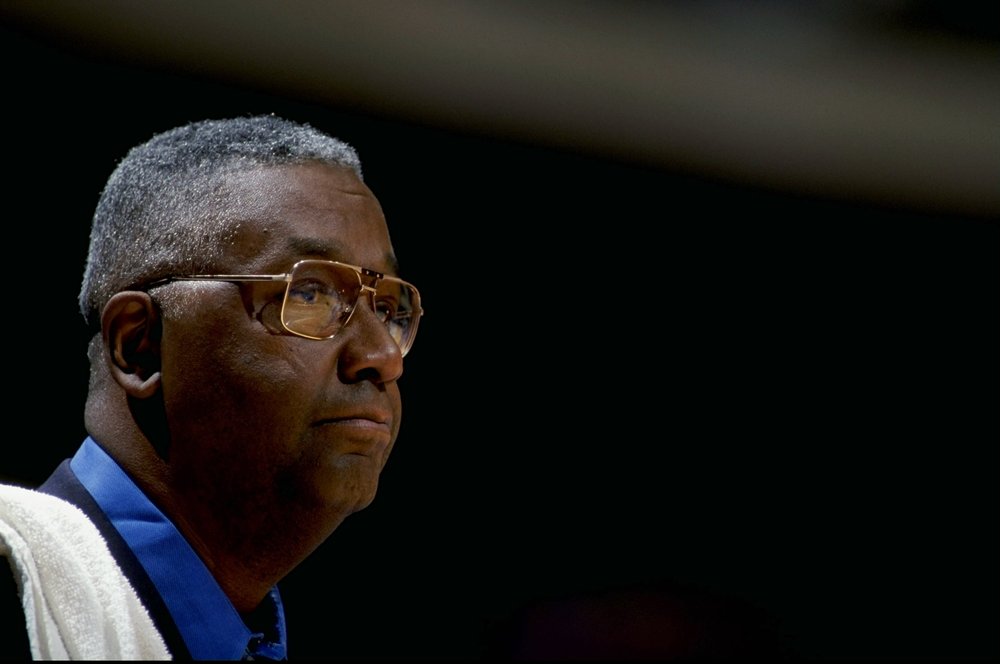
John ThompsonJohn Thompson, Jr., Former Georgetown Head Coach

The NCAA position regarding academic reforms has been consistent throughout the years. The NCAA officials said the legislation gave no consideration to racial implications, although it has been estimated that approximately 90 percent of the 600 students a year who will be affected are black.  Paradoxically, the NCAA is saying we know the reforms disproportionately impact Blacks but we gave no consideration to race.

Beginning in the early 1980s, the NCAA implemented significant changes in the freshman eligibility rules. The NCAA developed and implemented Proposition 48 at its’ 1983 convention. The racially disparate impact of the reform is beyond dispute. The rule change had a harsh impact on Blacks, especially those from low-income households.  Formulated in 1983 and fully implemented in 1986, Prop 48 rule stipulated, entering freshmen would be eligible for scholarships only if they had achieved a grade point average of at least 2.0 in 11 core college preparatory courses and, when it came to the two standard college entrance examinations, attained a minimum score of 700 on the Scholastic Aptitude Test (SAT) or 15 on the American College Testing Program’s exam.

Given the historical context of Apartheid-like segregation and the systematic exclusion of Blacks, many viewed the NCAA academic reforms as attempt to assuage the fears of racist University administrators and their supporters. These critics were especially concerned about the lack of African-American participation on the committee that developed the original Proposition 48 document. A reform measure that disproportionately impacted Blacks was developed, designed and implemented by an all-white committee.  It’s easy to understand why some feel that academic reforms are intended limited and even reduce the presence of Black student-athletes while simultaneously preserving the spirit and perception of racial inclusion.

Critics allege that Prop 48 and the subsequent reforms represent an attempt to devise a regulatory structure that would allow for some minority participation but facilitate continuation of the long standing tradition of predominantly white participation.

The racially disparate impact of the reforms are obvious. In one study, Richard Lapchick of the Center for the Study of Sport in Society, found that if Prop 48 had been in place in 1981, 69% of all males entering college on athletic scholarships would have been ineligible. More than two-thirds of the freshman male Black student-athletes would have been denied an opportunity to go to college on an athletic scholarship. Moreover, 54% of those student-athletes eventually graduated. That graduation rate was comparable to the graduation rate for all students which stood at 57%.

C48F2298Richard Lapchick, Center or the Study of Sport in Society

The loophole in the 1983 rule allowed “partial qualifiers,” students with a 2.0 high school GPA who didn’t make the requisite standardized test score, to attend college on athletic scholarships for one year. Although partial qualifiers lost one year of athletic eligibility and were not permitted to compete in their first year, they had a chance to gain eligibility by posting a 2.0 GPA during that year.

In 1990, the NCAA adopted Proposition 42, under which student-athletes failing to score at least 700 on the SAT or an equivalent score on the ACT and a 2.0 GPA were ineligible for any type of financial aid. Partial qualifiers were eligible for need-based, non-athletic financial aid.  Prop 42 was written and sponsored by the Southeastern Conference (SEC).  The SEC was the last major conference to allow Black participation.  The SEC voted to phase it in unilaterally even if the NCAA did not adopt the measure.

In 1995, the NCAA’s eligibility requirements became more stringent. The NCAA increased the number of required course from 11 to 13 and voted to implement a sliding scale in addition to retaining the SAT and ACT as a key component of the eligibility standards. Beginning August 1996, students with a 2.0 in 13 core course had to score at least 900 on the SAT. For each ten-point drop in SAT scores, student-athletes had to have a corresponding .025 increase in grade point average. Thus a student with a 2.5 GPA could score 700 and still be eligible.

In 2003, the NCAA enacted tougher standards for initial eligibility beginning with students first enrolling in the fall of 2008. The number of required core course went from 13 to 14.

In 2012, the NCAA approved another series of increasingly tougher reforms. Beginning is 2016, student-athletes would have to complete 16 core courses. Of those 16 core courses, 10 would have to be completed before the beginning of the senior year and grades from those core courses are “locked in” for computing a GPA once the senior year begins. In other words, there are no more emergency summer sessions in the senior year to rectify failing grades.

Mark EmmertNCAA President Mark Emmert

Additionally, a student-athlete must have a minimum GPA of 2.3 in those 16 core courses (up from 2.0) with an accompanying sliding scale SAT/ACT score. As originally conceived, a student-athlete with a 2.3 GPA would have to score 1080 on the SAT or an equivalent score on the ACT. Currently, a student-athlete with a 2.3 GPA has to score 900 on the SAT. Beginning in 2016, a student-athlete with a minimum GPA of 2.0 is considered an “academic redshirt.” He or she may practice with but not compete for his/her team for the first semester. Under present rules, a student-athlete with a 2.0 GPA could score a 1010 and be eligible for a scholarship and participation. Additionally, beginning this year, junior college transfers will be required to have a 2.5 GPA (up from 2.0) in their transferable credits.

At a subsequent meeting, the NCAA Division I Board of Directors maintained its support for higher grades and a core course progression. However, the NCAA adopted legislation that would keep for the foreseeable future the test score/grade-point average sliding scale at the current level for student-athlete access to financial aid, practice and competition in the first year.

The Board acknowledged that requiring prospects to meet a more stringent sliding scale starting in 2016 would negatively impacted low-income minority youth.  They publicly noted that there would have been a significant decrease in the number of eligible student-athletes from America’s inner cities.  The 1080 SAT requirement with a 2.3 GPA could have effectively eliminated tens of thousands of Black student-athletes.  For example 39 of Philadelphia’s 58 (67.2%) public High Schools have average SAT scores below 800.  The likelihood of student-athletes from these types of schools scoring 1080 or higher is virtually nil.

In effect too much of the football and basketball athletic talent pool would be off limits.  Those consequences led the Board to its decision to retain the current sliding scale standard.

For nearly seventy years, from 1905 -1970, the NCAA consisted of conferences that explicitly practiced racial exclusion.  “Whites only” was the guiding feature of the Atlantic Coast Conference, Southeastern Conference and the old Southwestern Conference. During this era there was almost no attention paid to academics by the NCAA.  By the early 1980’s Blacks became a majority of football and basketball student-athletes.  Since then, the NCAA has implemented five successive “academic reforms.”  Each reform package has been more restrictive than prior measures.  The scientists remain busy as ever in the lab.  Be on the lookout for blonde haired, blue eyed people walking into walls.

← Back

Thank you for your response. ✨

Psssssst… Let me Holla at ya for a minute: An Open Letter to HS Ballers

Young fella, I’ve been watching…. I’ve seen you fly all over the country playing in Adidas, Under Armour and Nike events. I’ve seen you attending “workouts.” I’ve seen the Chosen League highlights on youtube. The videos of you dribbling two balls through the cones, I’ve seen that. You running on the track with the parachute attached to your hip, I’ve seen that too. The killer crossover set to Meek Mills and the dunk backed up by Rick Ross, I’ve seen that too. Like I said, I’ve been watching. I watch because I LOVE you!

Because I LOVE you, I have to tell you the truth. You ain’t supposed to make it!

Let me say it again, I don’t want there to be any confusion. You ain’t supposed to make it.

Scoop

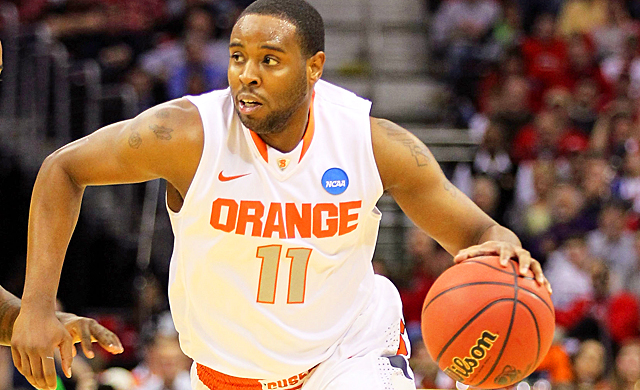
Scoop Jardine, Syracuse University

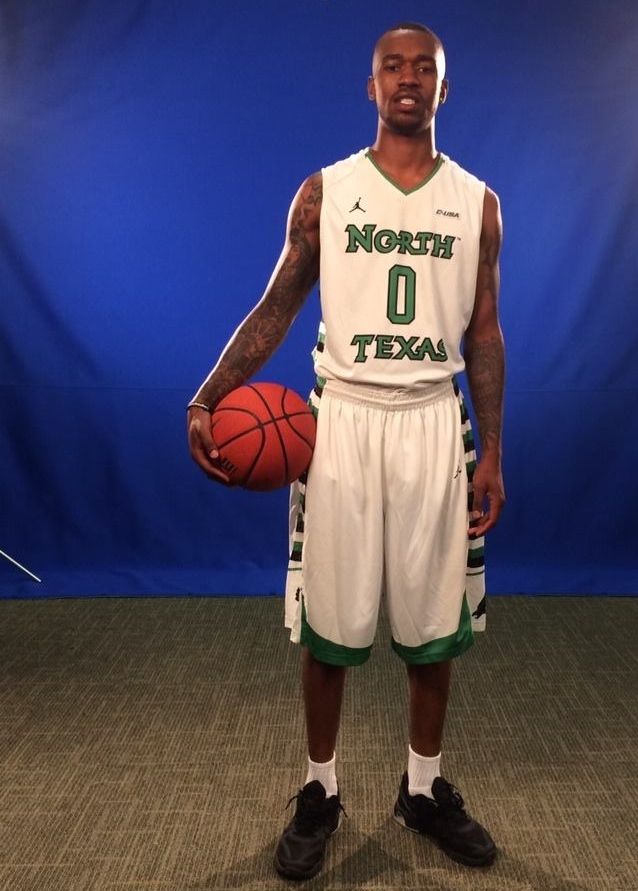
You see, these are confusing times.  A lot of Philly ballers have made it.  Please understand that I have had this same conversation with the overwhelming majority of area Division I players over the past 15 years or so.  I know exactly how they managed to meet NCAA eligibility requirements.  Scoop Jardine and Rick Jackson are graduates of Syracuse University.  I sat them down as 11th graders and we had this conversation.  Samme Givens and Chaz Crawford graduated from Drexel, but first we had to develop a plan to meet eligibility criteria.  Before Marcus and Markeiff Morris were able to accept scholarships from Kansas, they had to get through the Clearinghouse.  This is the same conversation I had with Dion Waiters, below (Syracuse), Rysheed Jordan (St. John’s), John Davis (Towson), “Biggie” Minnis (Rhode Island), Ja’Quan Newton (Miami), Anthony Durham (Rider), Carrington Ward (North Texas) and many others.

waiters

Dion Waiters, Syracuse University/Cleveland Cavs

Society at large and the American sports media are sending you mixed messages. On the one hand, corporate America (Nike, Under Armour and Adidas) makes it possible for you to fly to Atlanta, Vegas, Los Angeles, Indiana, Ohio, Miami and many other cities to play basketball in front of hundreds of college coaches. You play game after game all summer against some of the best players in the land.

At these events, you have been able to fully display your considerable athletic skills. The jumper is wet! The handle is tight! The vision is outstanding! All the skill development and strength training has finally come together.  You know it, your AAU coaches know it, your “handler” knows it and the college coaches know it, you are a BALLER!

On the other hand there’s what you don’t know and what they won’t tell you is: You ain’t supposed to make it!

I know that you are focused and working relentlessly toward earning an NCAA Division 1 scholarship. Now, what you need to know is that the odds are stacked heavily against you even graduating from high school.  In 2010, a major study found that Philadelphia, along with New York was the worst performing district in the nation with regard to Black male graduation rates. The five worst performing districts with large Black male student enrollment (exceeding 40,000) were New York City, N.Y. (28%); Philadelphia, Pa. (28%); Detroit, Mich. (27%); Broward County, Fla. (39%); Dade County, Fla. (27%).

2013 NBA Players Association Top 100 CampJaQuan Newton, Miami University

Think about that for a minute. Out of every 100 NYC, Philly and Detroit kids you that played with and against in those “Invitational”, “Elite” and “Exposure” camps only 28 will graduate high school in 4 years. That means 72 out of every 100 won’t earn a high school diploma on schedule.

I have to be honest with you young fella, I see Philadelphia’s 28% graduation rate declining significantly over the next few years. Let’s keep it real. Philadelphia is the midst of an unprecedented series of budget cuts. In 2013, the Philadelphia school system laid off 3,783 employees, including 676 teachers and 283 counselors. Along with teachers and counselors, those losing their jobs included 127 assistant principals and 1,202 aides who monitor the cafeteria and playgrounds.

CarringtonCarrington Ward, North Texas

In 2014, it was announced that high school students who live within two miles of school will not receive transportation support (an increase from 1.5 miles), impacting approximately 7,500 students at district, charter, and non-public schools. There will also be reduced services in alternative education programs, which will result in fewer higher-quality options for approximately 300 students. There will be less frequent cleaning of schools, fewer cleaning supplies, and delayed repairs at schools. The district will not fill 34 school police officer vacancies, reducing the number of officers available to support school climate and safety.

In the past year, the state of Pennsylvania (which controls Philadelphia’s public schools) and the city of Philadelphia have closed 23 schools, laid off teachers, guidance counselors, principals and school aides. They have decided to eliminate transportation support and 300 alternative education slots for your peers trying to earn credits toward graduation. They have openly declared they will provide you with dirtier and less safer educational settings this year.

Young fella, you ain’t supposed to make it!

It is important that you understand, they do have plans for your future. I don’t want you to think that they are not preparing to “serve” you. While your schools will be dirty and unsafe because of budgetary concerns, there’s a gleaming new state of the art $400 million prison under construction just outside of the city.

graterfordSCI Graterford

While only 28% of Black males graduate from Philadelphia’s high school on time, Pennsylvania Correctional (Prison) system is operating at approximately 105% percent capacity. This new prison will sit proximate to SCI Graterford. A few years ago, Mayor Michael Nutter noted, “Of the 2010 homicides, 86.9 percent were African-American males. African-American males were 65.5 percent of the admissions into the Philadelphia Prison System in 2010. About one-third of all PA DOC prisoners committed their crimes in Philadelphia County. Graterford is the nearest prison to Philadelphia. A lot of Philly offenders serve time there.

Young fella, they know you ain’t supposed to make it….

Nonetheless, you can do it. You can go to college. You can earn a scholarship. But there are some things you need to know. Who’s gonna give you this information? They are cutting assistant principals and guidance counselors to hire more prison guards. So, I’m gonna try to give you some useful information on this website.

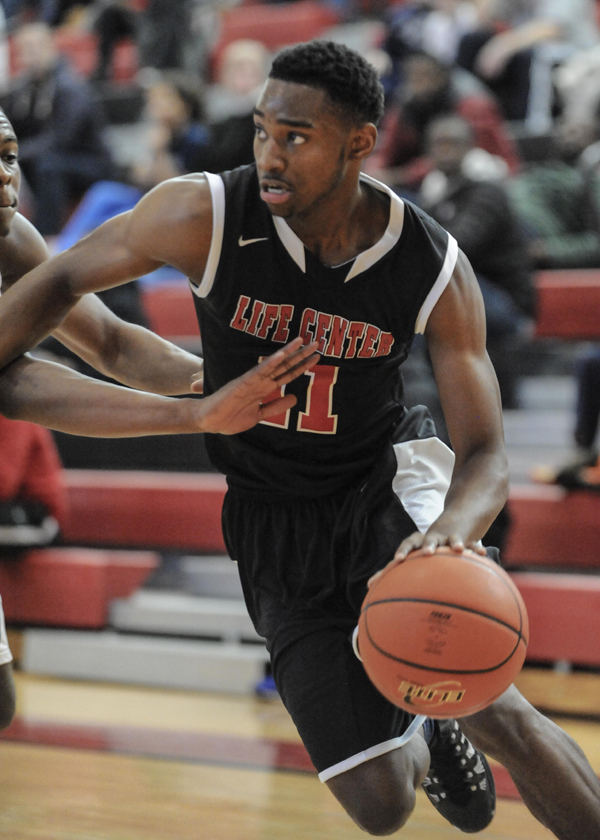
TraciTraci Carter, Life Center Academy, 2015

Class of 2015 (Seniors)
You are the last class that has a wide range of options available to meet NCAA eligibility guidelines. Even without full-time guidance counselors in many schools, there are some moves you can make to increase your chances of being NCAA eligible. For example, if you have a few Ds on your transcript from 9th, 10th or 11th grade you should retake those classes. Take them online or in the evening, but retake them! If your school won’t allow you to retake the classes because you already “passed” and earned the credit, pay to take the classes at another school.  It is important to make sure the other school’s courses are listed and accepted by the NCAA Eligibility Center. By increasing your GPA, you place much less pressure on your SAT/ACT score.

If you are a high major recruit, NCAA DI coaches began calling July 1st after your Junior year. Coaches can make unlimited phone calls/texts during the contact period. This means a coach can call/text you if he wants you. The rules still allow a coach to speak with a recruit anytime you make the phone call.

Young fella, if you are not talking to DI coaches on the phone by this point in your senior year it is time to consider DII, DIII or NAIA schools.

If DI schools wanted you, you would know.  They would have reached out to your AAU coach, your HS coach, your “guy” or your parents by now.  They are not under any restrictions.  Off-Campus contact is allowed.  Coaches are allowed to begin visiting off of their campus. Have they come to your school? Have they come to your home?

Coaches can bring you in on Official Visits starting the first day of classes. On Official Visits coaches pay to bring you in on a visit, host you on campus and pay for meals and game tickets.  Remember, you only get 5 official visits.  Be prudent in how you use them.  You should have already been making Unofficial Visits to D1 campuses if you plan to play at that level.

Class of 2016 (Juniors)
Everything is different for you. You have have meet far more stringent requirements. College bound student athletes first entering an NCAA Division I college or university on or after August 1, 2016 will need to meet new academic rules in order to receive athletics aid (scholarship), practice or compete during their first year.

You will still have to complete 16 Core Courses. However, ten (10) of the 16 core courses must be complete before the seventh semester (senior year) of high school. That is a new rule. You need to look at your transcript right now. Make sure you will have 10 cores before your senior year. Also, you must make sure seven (7) of the 10 core courses are in English, Math, or Science. These are requirements and if they are not met you will not qualify under new NCAA rules.

Also, the new minimum Core-Course GPA is 2.300. It is no longer 2.000. This is a significant increase. Many, if not most, student-athletes I have encountered over the past 15 years would not have met a 2.300 GPA requirement.

Moreover, and most importantly after this (your Junior) year, your grades are “locked in.” Unlike current seniors, you will not be able to retake classes in which you received Ds during your senior year. Every year, thousands of high school seniors retake classes to improve their core course GPAs. The NCAA is eliminating this option beginning with your class.

If you are an NCAA DI level recruit, You will begin receiving recruiting materials starting September 1st. Coaches will begin sending you letters or emailing you. The rules do not prevent you from emailing coaches, something you should have been doing since your sophomore year at least.

Basketball coaches can have off-campus contact at the start of classes your Junior year. Official Visits are allowed at the start of the school year. For women, they can begin making visits the Thursday after the NCAA Women’s Final Four.

Class of 2017 and 2018 (Freshmen and Sophomores)
If you plan on playing at the NCAA DI level, watch your grades! Do NOT earn Ds. They are unacceptable. Those Ds will make you NCAA ineligible.  Men’s Basketball coaches can begin calling, sending letters to and emailing recruits June 15th after your sophomore year.

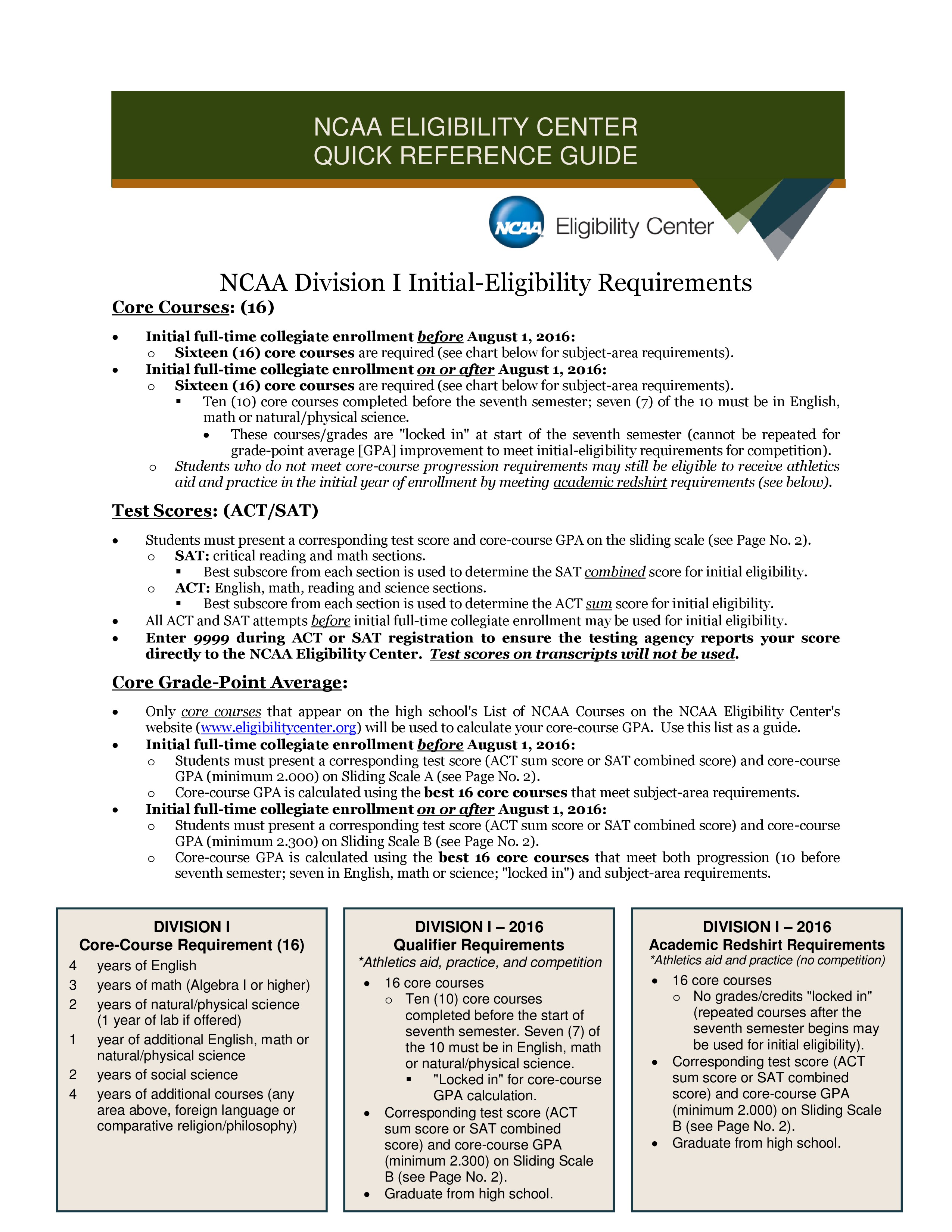
Quick_Reference_Sheet-page-0 Above please find the new 2016 NCAA guidelines. Below please find the new 2016 NCAA Sliding Scale.  Young fella, it won’t be easy.  It will take a LOT of planning and dedication to hitting the books.  But, you can make it.

Quick_Reference_Sheet-page-1You certainly cannot say “ain’t nobody give you a heads up”!

← Back

Thank you for your response. ✨


Baller or Thug? Can’t Be Both!

Image

It was the best of times, it was the worst of times, it was the age of wisdom, it was the age of foolishness…

Charles Dickens, A Tale of Two Cities (1859)

Very recently, we lost the greatest living Philadelphia ball player with the passing of Tom Gola (pictured below).  Wilt Chamberlain and Tom Gola are the ultimate representatives of Philadelphia ball players.  Earl Monroe, Gene Banks, Ernie Beck, John Chaney, Claude Gross, Tee Parham, Lewis Lloyd, Joe Bryant, Mike Bantom, Howie Evans, Anthony “Hubba Bubba” King, Rashid Bey, Lynn Greer are all outstanding Philly ball players.  Philly ball players have always used basketball as a means to access educational opportunities.  There are hundreds, if not thousands, of Philly ball players raising families and contributing to society well after the ball stopped bouncing.

However, in recent years I’ve noticed a troubling pattern of behaviors.  Being a Philly Ball player these days means having a double consciousness.  The identity is now divided into several parts, making it difficult or impossible to have one unified identity.  This is a significant and unfortunate change.  All of the players listed above are known for playing hard, tough winning basketball.

Tom Gola

Within the context of contemporary scholastic and collegiate basketball, the Philly ball player is developing a dual identity.  Unlike their singularly focused predecessors, many of today’s Philly ball players have two distinct and relatively enduring states that alternately control their behavior.  Like their predecessors, they play hard, tough winning basketball.  But, there’s this other “Philly Hard” identity permeating the recent crop of Philly ballers.  Double consciousness forces young Philly ball players to view themselves not only as student-athletes competing at the highest levels, but to also view themselves as they might be perceived by the folks in the “hood.” They cannot be perceived as “square”, “corny” or docile. Philly Hard players have to “keep it gully.”

What types of behaviors do “Philly Hard” players exhibit?  They range  from persistent refusal to comply with school, dorm, or team rules and expectations to selling a half-kilo of crack cocaine to an undercover DEA agent.  It’s important to understand that this not a new phenomena.  There have always been Philly Hard players.  In 1987, a North Philly kid from the Raymond Rosen projects led Millersville to a 27-4 record and a No.1 national ranking.  After that season, he robbed a home in Concord Township, Delaware County, threatened the 20-year-old resident with a toy pistol and beat her.  Around the same time he was charged with, and later pleaded no contest to, the attempted rape of a 20-year-old woman at gunpoint. He was charged with al least eight other burglaries over a two-week period in one month.

In 2002, a former Simon Gratz High School star who won a Public League basketball championship alongside NBA stars Rasheed Wallace and Aaron McKie, was sentenced to three to six years in prison for three holdups at a Rosemont ATM. This Philly ball player had averaged 20 ppg and 10 rpg in the Atlantic 10 conference before playing professionally in Europe.  In 2009, a freshman at a Big 5 school threw two baggies containing marijuana onto the ground during a police sting and had $1,030 cash on him.  He was arrested Monday night in Chester on charges of felony drug dealing and related offenses, including resisting arrest.

While the most of the negative behaviors of contemporary Philly Hard players are not felonious, they are far more frequent.  There is relentless drumbeat of Philly kids being disciplined, suspended and expelled from schools.  One player was suspended for knowing that a stolen student identification card was being used to order more than $100 worth of food.  Another was suspended for the 2013-14 season after being charged with first degree burglary and grand larceny.  Still another was suspended prior to the start of the season, and subsequently suspended for the remainder of the season due to a violation of the school’s Code of Conduct. Eventually, he chose to transfer to another program.  Yet another was suspended after trying to shoplift at Wal-Mart.

Earl Monroe

I ventured down to the Wells Fargo Arena on Monday evening and watched three young Philly ball players perform for the Phoenix Suns against the hometown Sixers.  It was an especially proud moment because, a few years ago, I watched all three work extremely hard to meet NCAA freshman eligibility requirements.  Diligence and determination paid off.  Their parents, James Christmas and Angel Morris, were focused on providing the structure and support necessary for these guys to make it to college.  One of the players was arrested as a freshman for bringing an Airsoft gun on campus that can shoot plastic BBs.  Fortunately, among this particular group of Philly ball players, that was an isolated incident.  Given the opportunity, they have made the most of it and now play in the NBA.

While riding home from the game, I received a text indicating that two more Philly players have been indefinitely suspended by their university.  In one night, I experienced the highest of highs, as I watched three Philly ball players live their NBA dreams, and the lowest of lows as I learned of two other young men placing their scholarships at risk.  This makes no sense.  Philadelphia’s amateur (Youth, AAU, Summer League, Church, HS and College) basketball community, has to do more.

Clearly, many of our young players have internalized a Philly Hard self-image that shapes their inappropriate responses to adverse and stressful situations faced while transitioning to college.  For now, there’s still a considerable market for good Philly ball players.  The coaches from respectable programs still pursue young Philly ball players.  However, there has to be a tipping point.  Those exhibiting the Philly Hard tendencies are going to inevitably make it much harder for the next generation of kids.

Too many young Philly ball players are struggling to reconcile their identity as a Philly ball player and a Philly Hard man.  Conflicted between behaving in a manner that reflects a Philly Hard perspective and exhibiting behaviors that are marketable and acceptable to college and professional coaches.

By exhibiting compliant and respectful behaviors he will be deemed a sellout and his Philly Hard stature is questioned.  By having repeated confrontations with authority figures and receiving multiple suspensions for misbehaviors he successfully establishes himself as Philly Hard and in some very important ways limits his ability maximize the true value of his athletic gifts.  This is the contemporary Philly ball player’s struggle to unite the different components of their identity.

As a basketball community, we have to find a way to diminish the impact of the Philly Hard image. Some how, some way.

PA, NJ and DE D1 BBall Budgets 2012-2013

Image

School

Basketball Budget

Pittsburg (ACC)

7,344,213

Seton Hall (Big East)

6,401,383

Villanova (Big East)

6,398,678

Penn State (Big 10)

5,056,643

Rutgers (AAC)

4,366,444

Temple (AAC)

4,080,845

Duquesne (A10)

3,891,806

Saint Joseph’s (A10)

3,089,503

Drexel (CAA)

2,633,240

Fairleigh Dickinson (NEC)

2,320,904

LaSalle (A10)

2,046,119

Bucknell (Patriot)

1,860,056

Delaware (CAA)

1,731,722

Delaware St (MEAC)

1,640,546

Monmouth (MAAC)

1,523,983

Lafayette (Patriot)

1,523,418

Rider (MAAC)

1,518,322

NJIT (Indep)

1,417,199

Wagner (NEC)

1,396,966

Lehigh (Patriot)

1,382,178

St. Francis (PA) (NEC)

1,368,916

Robert Morris (NEC)

1,356,722

St. Peter’s (MAAC)

1,170,516

Pennsylvania (Ivy)

1,082,006

Princeton (Ivy)

994,108

How much do local colleges and universities spend on Men’s basketball?  What is the difference between “big-time” programs and mid-majors?  Utilizing the chart and table listed above one can compare the financial commitments of PA, NJ and DE colleges to their respective Men’s Basketball programs.  There are a few surprises.

A few things immediately jump out when comparing the basketball budgets of PA, NJ and DE Division 1 programs.  Seton Hall has not been getting an adequate bang for their buck. But perhaps most surprisingly, Lehigh with one of the smallest budgets has the highest academic record, the 5th highest number of average wins and a lottery pick in last years draft. Drexel’s basketball budget is larger than two of the Big 5 programs (LaSalle and Penn).  Fairleigh Dickinson’s budget is very high given their very low average wins and poor academic performance.  Delaware State, a historically Black (MEAC) school is in the middle of the pack budget wise.    

← Back

Thank you for your response. ✨


Ranking Philly College Guards

With the college hoops season right around the corner, there are many local story lines worth following.  The Philadelphia region is, arguably, the finest place in America to watch amateur basketball.  Every year, Philadelphia produces a plethora of high school players that go on to make an impact at the collegiate level.  Also, there are always a few that come from other areas to make some serious noise at one of the area Division 1 programs.

More than any other position, the focus is always on “Philly Guards.”  They are known for toughness, tenacity and playing with a chip on their shoulder.  What follows is a ranking of college guards, either from Philly or playing at one of the Philadelphia area college programs.  I am sure there will be MAJOR disagreement over the place of some players.  Please feel free to let me know where you think I went wrong.

Image

1.  Tyreek Duren, Senior, LaSalle, 14.2 ppg, 3.3 apg, 2.9 rpg last season.

At 6 ft, 180 lbs., Duren is the consumate floor general.  He plays within himself at all times.  Duren is never flustered and runs John Gianni’s offense with precision.  An exceptional ball-handler, he consistently finds his teammates good looks.  When needed, Duren delivers big shots.

Image

2.  DJ Newbill, Junior, Penn State, 16.3 ppg, 4.0 apg, 5.0 rpg last season

The prototypical Philly guard, Newbill does everything well.  Standing 6’4” and weighing a solid 205 lbs., he strong and athletic.  Forced to play point guard after a season ending injury to Tim Frazier, Newbill excelled.  One of the top returning scorers in the Big Ten, having finished fourth (16.3) in 2012-13, DJ enters his junior season with nearly 800 career points, 11 20-point games and 41 career double-digit scoring outings and a chance to join the list of Penn State’s 1,000-point scorers.

Image

3.  Devon Saddler, Senior, Delaware, 19.9 ppg, 2.8 apg, 4.5 rpg last season

An explosive scorer, Saddler has been the focal point of the Delaware offense for the past three season.  A sturdy 210 lbs, he is simply too strong for most opposing guards.  Saddler has solid ball handling skills.  While he is a decent shooter, he can be streaky at times.  His strongest asset is his ability to get off a shot, seemingly, at will.  He is fearless and competes every second of every game.  Saddler will surely past the 2,000 point plateau early in his senior season.

Image

4.  Langston Galloway, Senior, Saint Joseph’s, 13.8 ppg, 2.3 apg, 3.6 rpg last season

An excellent all-around player, Galloway doesn’t have a real weakness in his game.  While he is known primarily as a long-range shooter, he has very solid ball-handling and passing skills.  For the past three years, he has been assigned the task of defending the best wing player on the opposing team.  A fierce competitor, Galloway gives a full effort every time he sets foot on the court.  A sneaky athlete, Galloway possesses an under-appreciated level of athleticism.  He is capable of finishing with authority around the rim with relative ease.

Image

5.  Franz Massenat, Senior, Drexel, 14.7 ppg, 4.2 apg, 2.4 rpg last season

A big point guard at 6’4” 180 lbs, Massenat is an excellent floor general.  Thrust into a leadership role immediately upon his arrival three years ago, he has evolved into one of the premier guards in the CAA.  A solid shooter, Franz excels at penetrating opposing defenses and finding his teammates on the wing or finishing at the rim.

Image

6.  Tyrone Garland, Senior, LaSalle, 13.1 ppg, 2.1 apg, 2.0 rpg last season

Thrust into the national limelight when his “Southwest Philly Floater” sent La Salle to the Sweet 16 with a thrilling 76-74 win over Mississippi, Garland is a well known commodity among Philly hoops aficionados.  An aggressive offensive player, he has excellent lift on his jump shot enabling him to get it off against taller defenders and in traffic.  Garland brings a high level of toughness to the LaSalle backcourt.  Look for his offensive production to increase significantly with the graduation of Ramon Galloway.

Image

7. Deshon “Biggie” Minnis, Sophomore, Rhode Island, Redshirt last season

A big, strong, pass-first point guard at 6’3” 205 lbs., Minnis is set to have a impact on the Atlantic 10 Conference after sitting out last year following a transfer from Texas Tech.  He spent last season being tutored by Bobby Hurley, arguably, the greatest college point guard over the last 25 years.  Blessed with exceptional court vision and a tight handle, Minnis will look to push the ball for Danny Hurley’s Rams this season.

Image

8.  Jordan Reed, Sophomore, Binghamton, 16.6 ppg, 9.5 rpg, 1.4 apg last season

Exploding on the college basketball scene as freshman, Reed nearly averaged a double-double.  A next-level athlete, Reed finishes around the rim with authority.  Known for dunking over much taller opponents, Reed is already one of the top players in the America East Conference.  As he develops his outside shooting and refines his ball-handling skills, Reed has chance to become one of the players in the country.

Image

9.  Pendarvis Williams, Senior, Norfolk State, 14.3 ppg, 4.5 rpg, 1.7 apg

The MEAC Player of the Year, Williams has exceptional size for a guard at 6’6.”  Capable of playing on and off the ball, he is a good shooter and solid ball-handler.  A very good athlete, He has been mentioned as potential NBA draft pick.

Image

10.  Ryan Arcidiacono, Sophomore, Villanova, 11.9 ppg, 2.1 rpg, 3.5 apg

Thrust into a leadership role following the early departure of Maalik Wayns to the NBA, Arcidiacono led Villanova in minutes played (34.0 mpg) and assists (3.5 apg).  He was a unanimous choice to the BIG EAST All-Rookie team and was named Rookie of the Week four times.  An exceptional ball-handler, he benefitted immensely from playing heavy minutes as a freshman.

11.  Damion Lee, Junior, Drexel, 17.1 ppg, 5.1 rpg, 1.8 apg

12.  Chris Fouch, Graduate Student, Drexel, Redshirt last season

13.  Rysheed Jordan, Freshman, Saint John’s, High School last season

14.  Brandon Austin, Freshman, Providence, High School last season

15.  Rondae Jefferson, Freshman, Arizona, High School last season

16.  Steve Vasturia, Freshman, Notre Dame, High School last season

17.  Sam Mills, Senior, LaSalle,  8.0 ppg, 2.6 rpg, 2.2 apg

18.  DJ Irving, Senior, Boston University, 14.2 ppg, 3.3 rpg, 3.6 apg

19.  Maurice Watson, Boston University, 11.2 ppg, 3.3 rpg, 5.4 apg

20.  Miles Cartwright, Penn, 13.5 ppg, 3.4 rpg, 3.8 apg

Others to watch:

Jabril Trawick, Georgetown

DaQuan Walker, UCF

Will Cummings, Temple

Josh Brown, Temple

Quenton Decosey, Temple

Ky Howard, NJIT

Chris Wilson, Saint Joseph’s

Kyle Molock, Saint Joseph’s

Lamin Fulton, Wisconsin-Green Bay

Hakim Baxter, UMES

Devin Coleman, Clemson

Jarrod Denard, Claflin (Division II)

Mike Terry, UDC (Division II)

delgrecowilson@outlook.com