By Delgreco K. Wilson
January 8, 2026
CAMDEN, NJ – In the annals of international diplomacy, the notion of a U.S. president seriously threatening to purchase or seize a vast, self-governing territory from a NATO ally would have been relegated to the realm of dark satire. Yet, as the Trump administration openly discusses offering Greenlanders individual cash payments or contemplating military force to “acquire” the island, we are witnessing a foreign policy doctrine stripped of diplomatic veneer. This crude transactional approach—where sovereignty is a commodity and alliances are obstacles—finds a disturbing parallel not in the halls of traditional statecraft, but in the violent, coercive tactics of Philadelphia organized crime. To understand the logic now emanating from Washington, one need look no further than the ruthless playbook of Philadelphia’s infamous Junior Black Mafia (JBM) and its mythologized street boss, Aaron Jones.

Both paradigms operate on a foundational principle: power is asserted not through legitimate authority or mutual benefit, but through the demonstration of overwhelming force and the calculated application of fear. For the JBM, whose motto was chillingly reported as “Get down or lay down,” control of the cocaine trade was enforced through intimidation and brutal violence. The Trump administration’s Greenland scheme, which Danish officials have labeled a threat requiring a defense of “the fundamental principles of the UN Charter and international law,” operates on a similarly crude binary. The offer of payments—reported to be between $10,000 and $100,000 per individual—is the “get down” option, a lavish but coercive inducement. The explicit refusal to rule out military action, chillingly underscored by the recent abduction of Venezuela’s president, is the “lay down” ultimatum made to an entire nation and its allies. The message is clear: acquiesce to the transaction or face the consequences.

The Godfather Fantasy: Cultivating Power Through Persona
The parallel extends into the realm of cultivated image. Aaron Jones was said to be obsessed with “The Godfather,” consciously molding his persona after Don Vito Corleone to command a mix of fear, respect, and loyalty on the streets of Philadelphia. He became a legendary figure, a “death before dishonor icon” whose name carried immense weight. This careful construction of an untouchable, dominant persona is a core tactic of gangsterism.
Similarly, the Trump administration’s foreign policy is deeply performative, centered on projecting an image of uncompromising strength and deal-making prowess. The public fixation on Greenland—a large, mineral-rich asset—is not subtle geopolitics; it is a power flex, a demonstration of America’s ability to rearrange the map to its liking. As analysts note, this aligns with a 19th-century “great power politics” mindset, where spheres of influence are dictated by strength alone. By floating the military option against a NATO ally, the administration cultivates an aura of unpredictability and ruthlessness designed to make other nations capitulate to lesser demands, much like a neighborhood bully establishes dominance.

The Illusion of Voluntary Association and the Reality of Coercion
A key tactic in both playbooks is dressing coercion in the garb of voluntary choice. The JBM, at its height, was adept at creating legitimate business fronts—from video stores to security firms—to launder money and project a façade of normal enterprise. The Trump administration’s preferred narrative frames the Greenland proposal as a potential “Compact of Free Association,” akin to agreements with Pacific nations. This suggests a partnership between consenting parties.
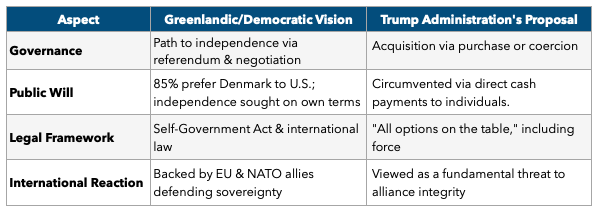
However, this illusion shatters against the reality of Greenlandic self-determination. Polls consistently show that while a majority of Greenlanders favor eventual independence from Denmark, an overwhelming 85% prefer remaining with Denmark over joining the United States. The island’s political future is a careful, democratically managed process defined by its 2009 Self-Government Act, which outlines a path to independence that must be approved by its people and the Danish parliament. The U.S. offer of cash payments is a blatant attempt to bypass and corrupt this sovereign process, treating citizenship and national allegiance as an individual financial transaction rather than a collective democratic will. It is a hostile takeover bid, not a friendly merger.
Table: Contrasting Visions for Greenland’s Future
The Cost of “Respect” and the End of Alliances
Ultimately, the gangster’s quest for “respect” is a zero-sum game that destroys the community it purports to lead. The JBM’s reign contributed to the devastation of Philadelphia’s crack era. The Trump doctrine, as applied to Greenland, threatens to incinerate the very foundations of the post-war international order. Danish Prime Minister Mette Frederiksen has stated unequivocally that a U.S. attack on Greenland would mean the end of “everything,” including NATO. European leaders have issued a unified rebuke, stating security rests on the “inviolability of borders”.
The administration’s justification—that Greenland is “covered with Russian and Chinese ships” and is a national security necessity—has been widely questioned by security experts. The U.S. already maintains the strategic Pituffik Space Base on the island under a defense agreement with Denmark. The real driver appears to be a desire for absolute control over territory, resources, and shipping routes, framed within a new “Donroe Doctrine” of regional dominance. Like a gangster who confuses fear for respect, this approach fails to see that true strength and security are built on reliable partnerships, not shattered alliances.
Conclusion: From the Streets to the World Stage
The comparison between a Philadelphia drug crew and the foreign policy of a global superpower is jarring because it should be unthinkable. Yet, the Trump administration’s maneuvers on Greenland reveal a logic that has abandoned diplomacy for intimidation, mutual security for unilateral gain, and international law for the law of the jungle. Aaron Jones’s JBM is a chapter in the history of Philadelphia’s organized crime. The method of governance it represents—coercion, transactional loyalty, and performative violence—must not become the blueprint for American statecraft.
The people of Greenland have a clear message for those who would try to purchase their homeland or seize it by force: “Greenland is not for sale, and Greenland never will be for sale”. It is a statement of dignified sovereignty that deserves more than a gangster’s reply. The world must hope that in the meeting between U.S. Secretary of State Marco Rubio and Danish officials next week, the language of diplomacy, law, and alliance can still prevail over the ultimatum to “get down or lay down”. The future of the transatlantic world may depend on it.
 The Black Cager