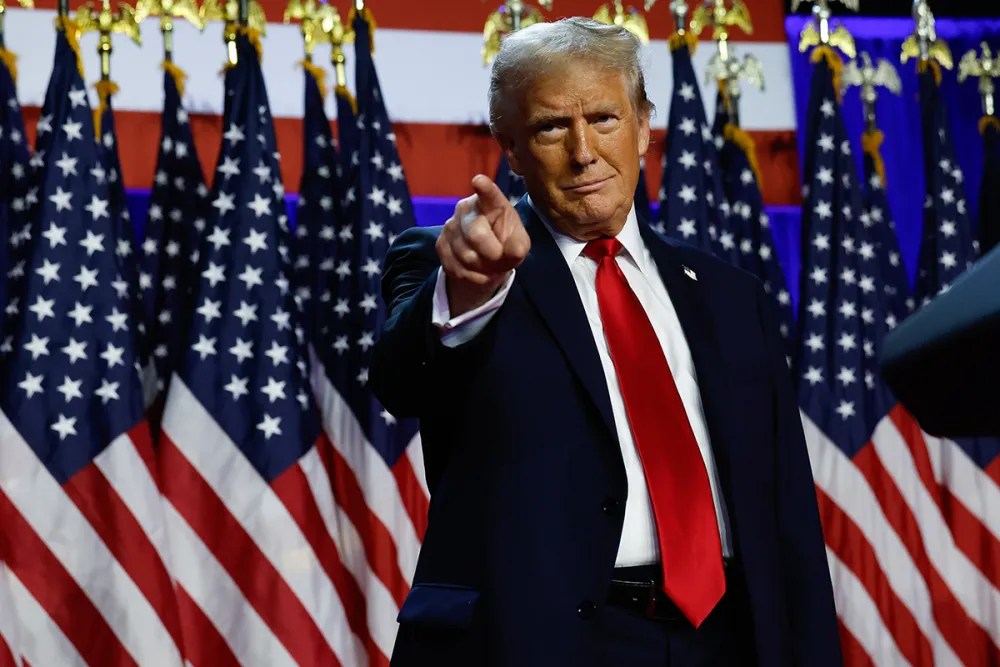
CAMDEN, NJ – In the early hours of Wednesday morning, Americans awoke to news that Donald Trump had been re-elected as president in a hard-fought campaign. Once again, the peaceful transfer of power through a free and fair election reinforced a hallmark of the American experiment: a democracy, as James Madison wrote, that preserves the “spirit and form” of governance by the people. To many, particularly Black Americans and communities historically marginalized, Trump’s victory reads as an existential threat to American democracy as they know it. But the prevailing narrative that American political culture has been a pristine example of democracy in world history—one that safeguards freedom for all—is, and always has been, incomplete.

America’s democracy has endured in form, but the substance of that democracy has always been as much shaped by exclusionary ideologies—racism, sexism, xenophobia—as by the ideal of equality. These dual forces have existed side by side since the nation’s founding, influencing not only who participates in politics but the very values that American governance upholds. With that reality in mind, perhaps it’s worth reframing what some see as the potential “end” of American democracy. While the Civil Rights Era may have come to a symbolic close last night, democracy in its original, sometimes mercilessly exclusive form, will likely persist, even flourish.
American democracy, founded in ideals of freedom and representative government, was also founded as a racial and gendered hierarchy. For nearly two centuries, the racist/white supremacist system with procedurally democratic features held firm, enshrining the values of White male property owners while excluding millions based on race, nationality, and gender. Women, enslaved Black Americans, Indigenous peoples, and other minorities were systematically denied full participation in what was nonetheless celebrated as a bastion of democratic governance. From its birth, America’s so-called democracy was a profoundly unequal system, designed for the enfranchisement and empowerment of a narrow group of wealthy, White men.
When the Founders issued their declaration of freedom to the British crown, declaring “all men are created equal,” they carved out that declaration to serve a select few. This sentiment laid the groundwork for a nation that would go on to build institutions catering to the privilege of a specific demographic. A revolution against monarchy and aristocracy—yes. But a democracy for all? Hardly. While revolutionary in comparison to European monarchies, America’s democratic spirit came bound with the chains of slavery, the forced dispossession of Native lands and rigid exclusion of women.
This enduring myth—that America has always stood as a beacon of equality—feeds a dangerous misperception. Many Black Americans fearing democracy’s end in light of Trump’s return are responding to a version of history that never fully included them. The American education system has long centered its lessons on the actions of wealthy, White Protestant men, pushing the contributions and sacrifices of Black Americans, Indigenous peoples, women, and other marginalized groups to the periphery. This has cultivated an understanding of democracy as a singular narrative of freedom and progress when, in reality, it is a deeply divided one.
To critique America’s selective version of democracy is not to minimize the contributions of Founders like Jefferson, Adams, Washington, and Franklin. Nor is it an appeal to disparage the “MAGA” movement’s resurgence. Rather, it is a call to recognize that America’s political culture is far more complex than the sanitized version we’ve long been taught. The stark reality is that racism, sexism, and xenophobia are as American as baseball, apple pie and hip-hop. These inegalitarian ideologies are as deeply ingrained in our political fabric as any notion of liberty. For nearly two centuries, America was considered a democracy while enslaving millions on armed labor camps, slaughtering and forcibly removing surviving Native Americans, and rigidly upholding an Apartheid/Jim Crow segregation system. Rest assured that American democracy, at least in “spirit and form,” will endure through the next four years and beyond.
True, the election of Donald Trump may well signal the end of the Civil Rights Era’s vision of democracy, but that vision is only a recent addition to American life. The structures that enabled the original version of democracy to exist—and indeed, thrive—in the face of brutality and exclusion still stand. To reclassify our current system as anything but democracy would require rethinking the foundational structures laid by the Founding Fathers themselves. We would have to classify Washington, Jefferson, Adams and Madison as antidemocratic. That is a project that, for now, remains highly unlikely.
Instead, it is up to Black educators, leaders, and all Americans who see through the myth to challenge the dominant historical narratives. An education system grounded in truth, not legend, will better serve our future generations. It will equip them to recognize the contradictions and complexities that define American political culture—a democracy that has always held equality and exclusion in uneasy balance.
 The Black Cager
well stated my brother!