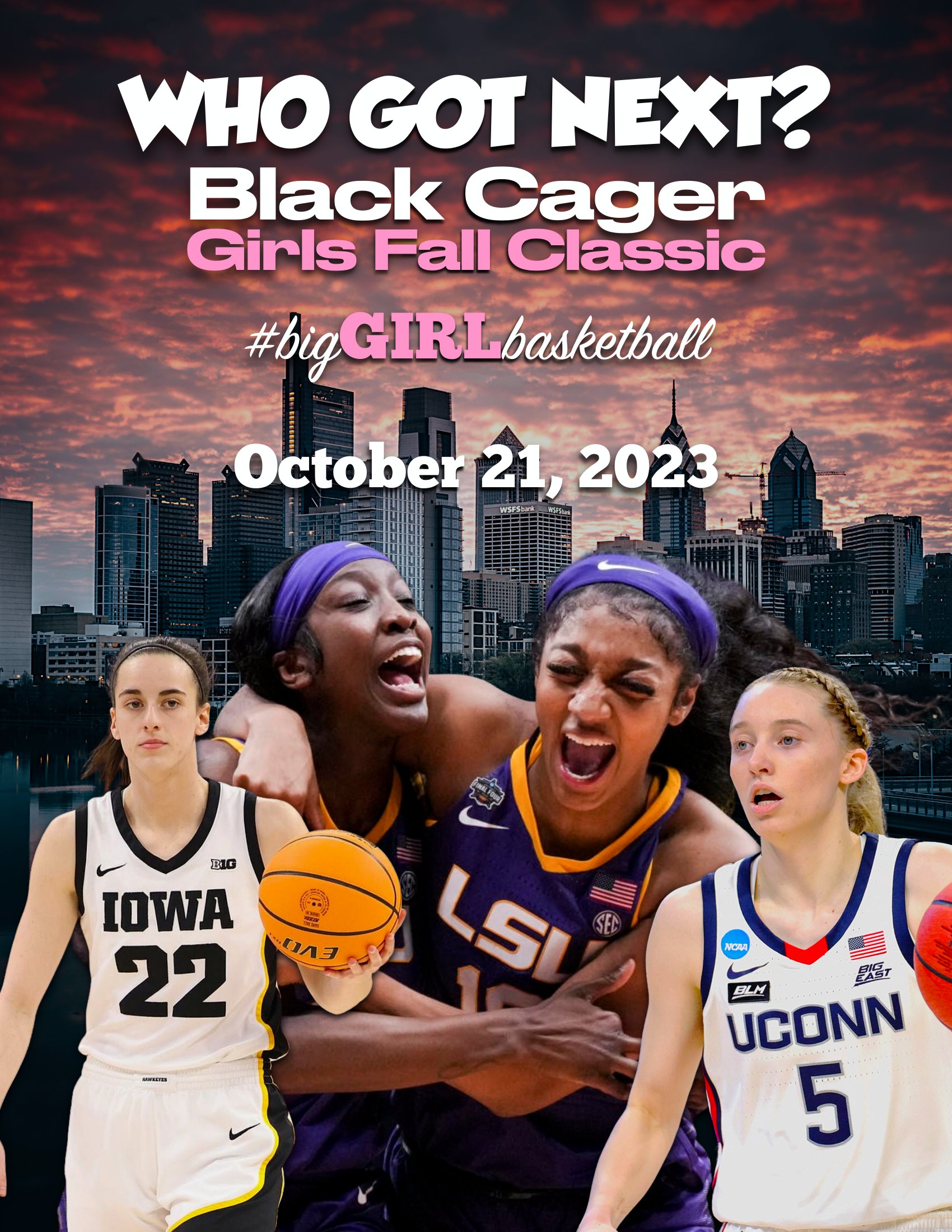
October 9, 2023, Philadelphia, PA – Black Cager Sports is thrilled to announce the launch of the inaugural Black Cager Girls Fall Classic, an event that promises to be a game-changer for girls’ high school basketball in the Greater Philadelphia region. This exciting tournament will take place at the Universal Audenreid High School Gymnasium located at 3301 Tasker Street in Philadelphia, Pennsylvania. The event will feature some of the most promising young female basketball players in the nation.
Since its inception in 2016, Black Cager Fall Classic has been a prominent platform for showcasing the talents of boys high school basketball players, many of whom have gone on to achieve successful professional careers. Notable alumni include NCAA All-American point guard Collin Gillespie, Atlantic 10 Player of the Year Ace Baldwin, Kentucky Freshman DJ Wagner and Atlanta Hawks rookies Seth Lundy and Isaiah Wong. Now, founder Delgreco Wilson and the Black Cager Sports team are extending their commitment to the growth and development of young athletes by introducing the Girls Fall Classic.
“Five years ago, a high school player named Angel Reese told me that I was unfair and did not give the girls game adequate coverage. Angel was right… We are incredibly excited to bring the Black Cager Girls Fall Classic to Philadelphia,” said Wilson, founder of Black Cager Sports. “Our goal is to provide young female athletes with the same opportunities for exposure and growth that we’ve offered to boys’ high school basketball players over the years. We are confident that this event will become an annual highlight for the city, the state, and the entire mid-Atlantic region.”
The modern Universal Audenreid Athletic facilities, which will serve as the venue for the inaugural Girls Fall Classic, offer an ideal setting for this prestigious event. This tournament not only promises thrilling basketball action but also aims to bring significant economic benefits to the South Philadelphia community.
“It will be nice to showcase Universal Audenreid High School to the great talent not only in our city but throughout our state and the entire mid-Atlantic region,” Wilson continued. “This event will undoubtedly bring a lot of business and excitement to South Philadelphia, and it’s something we’re looking forward to on an annual basis.”
The mission of Black Cager Sports has always been to provide exposure for high school student-athletes while attracting regional and national college coaches to high school basketball events in the Greater Philadelphia region. By doing so, the organization aims to enhance economic development and promote the area as a sports destination. The Girls Fall Classic is the latest step in fulfilling this mission. Black Cager Sports has consistently delivered one of the nation’s premier pre-season high school basketball events. Over the years, more than 100 athletes who have participated in the event have gone on to compete at the high-major Division 1 level, a testament to the level of talent and competition showcased in these tournaments.
The inaugural Black Cager Girls Fall Classic promises to be an unforgettable event for athletes, fans, and the Philadelphia community as a whole. Stay tuned for further updates, including the announcement of participating teams and game schedules.
For media inquiries, please contact: Delgreco Wilson Black Cager Sports blackcager@gmail.com 856-366-0992
About Black Cager Sports: Black Cager Sports is a leading organization dedicated to elevating high school basketball talent and providing exposure for student-athletes. With a track record of fostering the development of premier players, Black Cager Sports has become a cornerstone in the high school basketball community.
About Universal Audenried High School: Universal Audenried Charter High School provides a comprehensive education experience for students in 9th-12th grade. Our educational program provides both the academics needed for college admissions and the skills training that prepare graduates for meaningful entry level employment. Students in Career and Technical Education academies can earn up to nine credits at the Community College of Philadelphia.
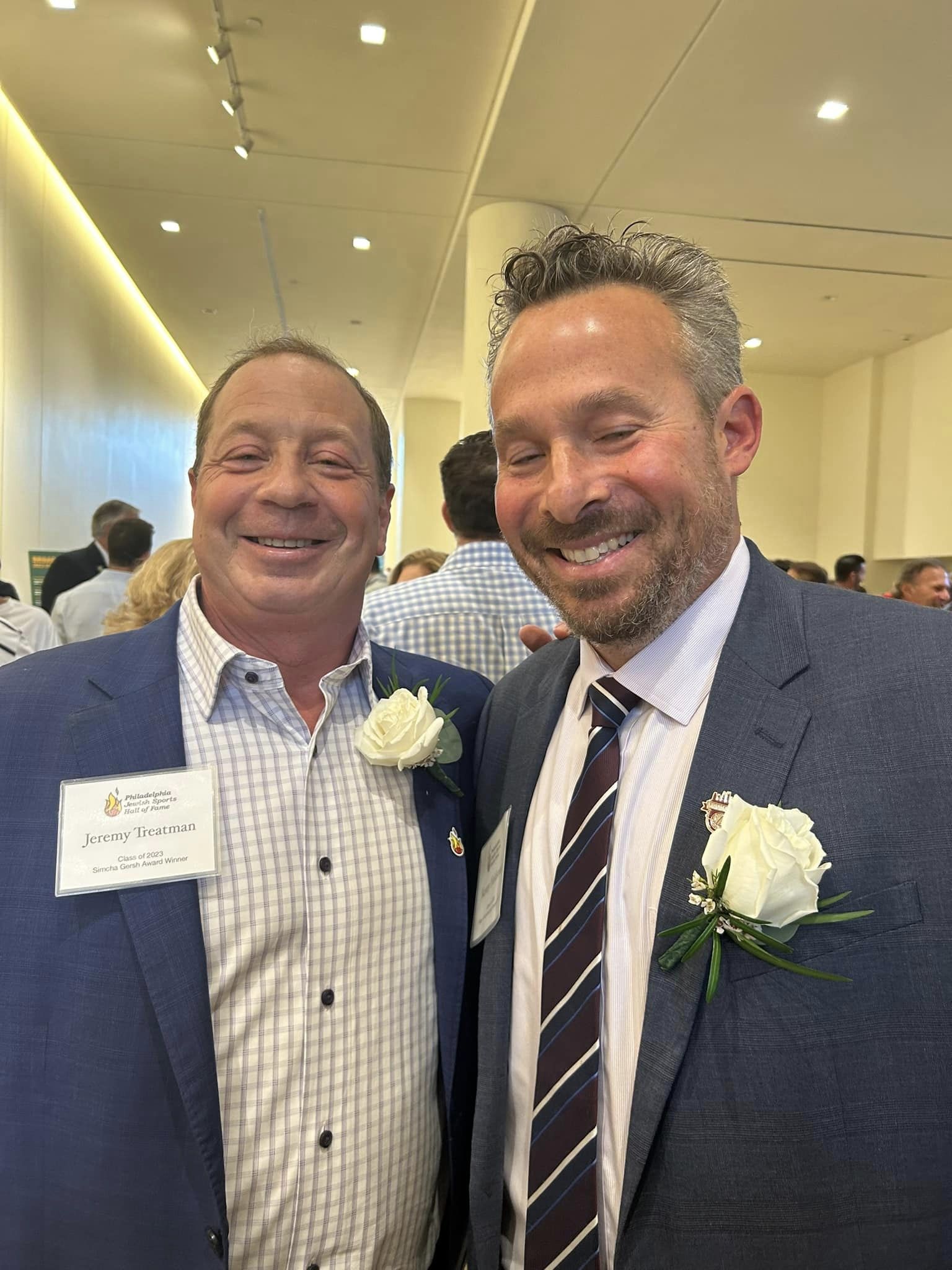
The history of Jewish basketball in the United States is a tale of resilience, passion, and a determination to break barriers. In the early 1920s, as Jewish immigrants and their American-born children sought acceptance in a new land, basketball emerged as a unifying force. The game became a vehicle for integration, a means to overcome discrimination, and a source of pride for Jewish communities across the nation. In this narrative, two contemporary figures, Jeremy Treatman and Kenny Holdsman, emerge as quintessential Philadelphia hoop heads, carrying forth the legacy of Jewish basketball in the City of Brotherly Love.
My homies: Jeremy Treatman (l) and Kenny Holdsman (r)
During a time when anti-Jewish sentiment was on the rise, basketball provided a platform for Jewish players to showcase their skills and demand recognition. In the face of discriminatory practices, Yale University’s recognition of Jewish players marked a significant milestone, demonstrating that sports could be a catalyst for acceptance and integration on campus. Nat Holman, a pivotal figure in this narrative, not only coached at CCNY but also played for the Original Celtics, a team that played a pivotal role in popularizing basketball across the country. Their barnstorming tours showcased the strategic brilliance and showmanship that characterized Jewish basketball.
The 1930s witnessed the establishment of independent teams, including the iconic New York Hakoahs and the Philadelphia Sphas. The latter, founded by future Philadelphia Warriors owner Eddie Gottlieb, began as an amateur group and evolved into a professional force, winning a staggering ten championships in leagues across the Philadelphia area and the East Coast. The Sphas not only exemplified excellence on the court but also embodied the resilience and determination of Philadelphia’s Jewish athletes in a changing America.
As professional basketball remained on the periphery, college basketball surged in popularity. Madison Square Garden became the epicenter of the sport, with New York schools boasting rosters filled with Jewish talent. A distinctive playing style characterized by constant motion and quick passing became synonymous with Jewish players, challenging teams with a different approach. The NIT and NCAA Tournaments witnessed the triumph of teams led by prominent Jewish players, culminating in CCNY’s historic “Grand Slam” in 1950.
Socio-economic success, suburban migration, and changing priorities contributed to the decline of a centralized Jewish playing presence in the sport and altered the landscape of Jewish basketball. While a few players like Lennie Rosenbluth and Art Heyman continued to excel, the torch was passed to Jewish coaches, general managers, owners and businessmen who left an indelible mark on the game.
In 2023, Jeremy Treatman and Kenny Holdsman were honored by the Philadelphia Jewish Sports Hall of Fame for their unwavering contributions to basketball in the Greater Philadelphia region. For a quarter century, Treatman’s Scholastic Play-By-Play Classics has been the top high school basketball showcase event company in the country. His formula is simple: invite the top teams and premier players in the country to compete at first class venues and watch the stands fill with knowledgeable and passionate hoops fans! Play By Play Classics have showcased 127 future NBA players and nine future WNBA stars, including: Kobe Bryant, Lebron James, Anthony Davis, Kevin Durant, Elena Delle Donne, Kyle Lowry, Maggie Lucas, Rajon Rondo, Dwight Howard, Jameer Nelson, O.J. Mayo and Michael Beasley.
More than 850,000 fans have attended his events and another 2M+ have watched games we’ve produced on television. They have hosted games at some of the nation’s landmark arenas and college campuses, with stops at Ohio State, US Bank Arena, Cameron Indoor Stadium, The Palestra, Temple University, Villanova University, The Dean Dome, St Joseph’s University, Greensboro Coliseum (NC), Dayton University, The Pyramid (TN), Sovereign Bank Arena (NJ) and many more.
Holdsman co-founded Philadelphia Youth Basketball (PYB) in the Spring of 2015 along with four other passionate civic leaders grounded by a common purpose: to leverage the iconic game of basketball to help today’s underserved youth overcome the most urgent and systemic issues facing their communities. Since then, PYB has been working hard to build a high-impact and high-quality program, organization, and future Youth Basketball, Education, and Communinty Empowerment center, quite literally “brick by brick”.
Since its inception, PYB has built a small but mighty staff team, diverse Board of Directors, community-based volunteer pool, and collection of dynamic advisory committees. They are proud of their broad donor network across Philadelphia and the tri-state region, breaking all lines of race, gender, ethnicity, and class – a true grassroots approach.
Early next year, Holdsman and PYB will unveil The Alan Horwitz ‘Sixth Man’ Center. Located in the Nicetown neighborhood of North Philadelphia, this 100,000 square foot world-class facility will be a second home for thousands of young people and a resource for the community, transforming lives for decades to come. The Center will provide everything that PYB believes young people need to thrive academically and intellectually, socially and emotionally, & civically and vocationally.
They stand as contemporary torchbearers of a rich tradition, representing the enduring spirit of Jewish basketball in the City of Brotherly Love. Through their passion, dedication, and commitment to the game, they continue to inspire future generations to carve their names in this storied legacy.
Jeremy Treatman received the Simcha Gersh Award and Kenny Holdsman received the Pillar Award for civic contributions to our City and its young people. The recognition by the Philadelphia Jewish Sports Hall of Fame is a testament to their profound impact on the game of basketball and their role in preserving a vital chapter in American sports history. As quintessential hoop heads, they stand on the shoulders of giants who paved the way for Jewish athletes in the world of basketball. Their contributions not only honor the past but also inspire a new generation to carry forth the legacy of Jewish basketball in the Greater Philadelphia area.
WARMINSTER, PA – September 20, 2023 – In the world of basketball, stories of meteoric rises are often reserved for the most exceptional talents. Jalil Bethea’s journey is one such tale that defies expectations and inspires admiration. As a sophomore, Bethea was a good young player. He came off the bench and provided instant offense for a strong Archbishop Wood team. One year later, he is a consensus top 10 player in the class of 2024. Let’s take a moment and put his rise in some sort of context for the uninitiated. In 2022, he was one of the top seven players on a 12-man Philadelphia Catholic League roster. In 2023, he is one of the top seven out of 550,000 HS players in the United States of America.
What Da Fuck? That’s truly incredible…
Today, Bethea committed to play college basketball for Jim Larranaga at the University of Miami. We celebrate not only the young athlete’s undeniable talent but also his commitment to “The U,” a testament to his dedication and hard work.
Jalil Bethea and his little brother Saleem just before his announcement
It’s not every day that you witness a player’s transformation from a local standout to a national sensation within the span of just one year. In 2022, Jalil Bethea was already turning heads as one of the top young performers on a good Catholic League team playing in Warminster, Pennsylvania. Fast forward to 2023, and he has solidified his position as one of the top players in the entire United States. After being hotly pursued by assistant coach DJ Irving for over a year, his commitment to the University of Miami has garnered immense attention, particularly since he had his pick of powerhouse programs, including Kansas, Villanova, Syracuse, Alabama, Temple, and many others.
Some well seasoned and astute basketball minds recognized his potential long before he entered the national spotlight. Amauro Austin, a respected figure in the world of Philadelphia basketball, saw Bethea as a top 20 prospect on a national scale before he even cracked the top 100. Likewise, former St. Joseph’s Hawk point guard Tasheed Carr identified Bethea as one of the most talented prospects in the region when he was still coming off the Wood bench.
Jalil Bethea’s mother, Jacqueline Kamper
Bethea’s game is a thing of beauty. Standing 6’4″ in shoes and possessing a solid frame, Bethea combines fluid athleticism with remarkable shooting prowess. He’s not the player who will physically dominate opponents; instead, he relies on his finesse and precision on the court. Bethea’s ability to shoot the ball is nothing short of extraordinary. Approximately half of his field goal attempts come from beyond the arc, and it’s a strategy that makes sense when you consider his status as one of the nation’s premier shooters. His shooting mechanics are a work of art—a quick, compact, and repeatable motion with an effortless release and textbook follow-through. His high release point and skill at creating separation off the dribble make him a formidable off-the-dribble shooter. Beyond just being a spot-up shooter, Bethea excels at running off screens, attacking closeouts, and punishing defenders who go under the pick and roll. With range extending to the NBA 3-point line and nearly 40% success rate from deep, he’s a shooter in a class of his own.
Bethea’s brilliance extends beyond his shooting. He’s a bright prospect with improving maturity and rock-solid fundamentals. His off-the-ball movement and willingness to make the extra pass make him a valuable asset to any team. While not a flashy shot creator, he keeps defenses honest and forces them to account for his presence on the court.
John Huggins and Jalil Bethea
Defensively, Bethea’s competitive nature and strong frame ensure he won’t be a liability. He fights through screens and demonstrates excellent technique and fundamentals. His defensive prowess will undoubtedly translate well at the high-major level.
As Bethea transitions to the University of Miami, fans can expect a player who thrives on creating and capitalizing on good looks from beyond the arc. In the modern game where floor-spacing and 3-point shooting are at a premium, Bethea brings superstar potential with minimal risk. It’s a fairly safe bet that he’ll participate in the McDonald’s All-American game and play heavy minutes as a freshman in the ACC.
Bethea’s rise from a local standout to a national sensation is a testament to his work ethic, talent, and the guidance of John Mosco, John Huggins and the rest of the Wood staff. The University of Miami has secured a gem, and the basketball world eagerly anticipates the next chapter in Bethea’s remarkable journey.
He is the latest in an increasingly long line of cerebral and highly skilled guards to emerge from the Archbishop Wood program. The Wood staff and the Team Final EYBL program, in the span of 12 months, took a decent high school player and transformed him into one of the top 2-3 shooting guards in the nation. This year they will reap the benefits of the hard work as Bethea will be unleashed on the Catholic League one last time. The final season of the Jalil Bethea show is playing in the “Boy’s Gym” at Archbishop Wood High School in Warminster this winter. Catch that shit now, the price goes up considerably once it moves to Miami next year.
Philadelphia’s Black basketball community is a vibrant and passionate group with immense potential. However, it is not without its challenges, particularly when it comes to cooperating and organizing large-scale events. This essay will delve into some of the complexities that often hinder collective efforts within this community, exploring the interplay between “rational choices” exhibited by organizations like the West Chester Basketball program and the City of Basketball Love (CoBL) and self-defeating “frustrated” behaviors engaged in by some Blacks in Philadelphia’s basketball community.
2022 Black Cager Fall Classic
Josh Verlin’s recent success in organizing the 2023 CoBL Interstate Shootout highlights the logistical intricacies involved in staging such events. In a social media post, Verlin proudly stated, “Two days. 108 teams. More than 1,000 players. More than 40 colleges. No clue how many hundreds (thousands?) Of parents and fans… The 2023 CoBL Interstate Shootout is a wrap. Thank you so much to everybody who had a hand in making this our biggest and best team event EVER.”
An endeavor of this size and scope demands meticulous planning, including venue scouting, bid solicitation, vendor coordination, and communication with teams and referees. It necessitates budget management, contract negotiations, and various other administrative tasks. Successfully executing such a large event is a considerable achievement. It also represents an excellent opportunity to raise funds to support an organization’s core mission.
Say… you have a 100 teams paying $225 each to play two games. That will result in $22,500 in revenue from registration fees. Say… each team has 10 fans/family members paying $10 each. That will generate another $10,000 in gate receipts. Say… each fan will spend another $5 at the concession stand, that will generate another $5,000 in concession revenue. For a two-day event, the total revenue would be approximately $37,500. That’s not even taking into account potential revenue from event sponsorships.
Let’s assume facility rental costs of $5,000. Let’s set referee costs for 100 games at $60 per game for a total of $6,000. There will be trainer costs for two days, set that at $1,500. Set scorekeeper/table costs at $20 per game for 100 games, that’s another $2,000. Ticket takers/security will be another $1,000. Insurance will be, maybe, a $1,000. Cost of goods sold at concessions would be around $1,000. In this hypothetical example there will be a total of around $17,500 in expenses.
2022 Black Cager Fall Classic
The gross profit for a well-managed showcase would be somewhere in the range of $20,000. Not bad for a two-day HS basketball event. High school coaches get to see their players in game situations. Small college (D2, D3 and JUCO) coaches get an opportunity to scout prospects. Players test themselves against good competition. Referees get some valuable game speed work in preparation for the upcoming season. Young people earn some money working the event and the sponsoring organization raises funds to support its mission. Organizing these large scale events is without a doubt a very rational choice. A true win-win situation.
The crux of the matter lies in the following question: why can’t Black individuals within this community collaborate to organize and manage similar events? Given the predominance of elite Black players in the region, there is an inherent potential for Black-run platforms that facilitate exposure to college scholarship opportunities.
2022 Black Cager Fall Classic
Furthermore, the financial potential of such an event is substantial, as outlined in the aforementioned projections. The revenue from registration fees, gate receipts, and concession sales, coupled with careful expense management, could result in a significant revenues to help further the organization’s core mission. Organizing and running these types of large scale events makes sense on many levels for Black organizations. Simply stated, one would expect to see extensive cooperation and engagement.
However, rational choice theory, though a generally applicable framework, has limited applicability to decision-making among some Blacks within the Greater Philadelphia basketball community. The reason for these limitations is that behavior among basketball guys in the Greater Philadelphia region comes in two fundamentally distinct varieties: “motivated” and “frustrated.” On one hand, the guys at West Chester and CoBL are motivated. On the other hand, many Blacks within the Philadelphia Basketball community are frustrated.
I will argue here that action that is instigated by frustration may be regarded as “sensible,” although it takes certain forms that a casual observer would consider the height of irrationality. It is sensible because it is well adapted to exigent circumstances that press upon many Black basketball guys at most times and in most situations. By “well adapted” I mean engaging in frustrated behavior performs well certain ineluctable functional imperatives of existence in the Philadelphia Basketball community, without the occurrence of destructive personal stress.
In short, these frustrated Blacks do not seek to maximize a return on their investment of organizational time, energy and financial resources. Instead, they seek to avoid the personal stress associated with seeing other Black persons successfully organize and manage large scale basketball events. Frustrated Blacks can accept organizations such as West Chester and CoBL hosting 140 and 100 teams respectively. They cannot, under any circumstances, accept another Philadelphia-based Black organization having anything close to 100 teams.
This is colloquially referred to as the “crab barrel syndrome” in polite company and “n!gga sh!t” in impolite company. The distinction between “motivated” behavior and “n!gga sh!t” encapsulates a unique set of dynamics at play. Frustrated behavior or “n!gga sh!t,” while perhaps appearing irrational to an outsider, is, in fact, a response to the exigent circumstances faced by some Black organizers in the community.
2019 Black Cager Fall Classic
As noted above, these behaviors are rooted in a drive to mitigate or cope with pain, rather than to pursue pleasure. It reflects a survival instinct in response to the challenges inherent to the Blacks in the Philadelphia basketball community.
Since I am making a rather what will be considered a provocative argument, I should present analogues of frustrated behavior or “n!gga sh!t” and responses to it, in real world settings.
When considering why Blacks in the Philadelphia basketball community do not have large-scale basketball events comparable to those organized by West Chester and the CoBL, I thought of analogues that I have witnessed first hand. On a couple of occasions, several years ago, I held the Black Cager Fall Classic in and around Philadelphia. One year, I held it at Girard College in North Philly and another year it was at Friend’s Central on City Avenue. The Black Cager Fall Classic is a large-scale Black-run event featuring many of the top teams and players in the Mid-Atlantic region.
While the event regularly attracts over 80 teams, the challenges presented by recurring patterns of n!gga sh!t in Philadelphia were formidable. Over and over, on more than twenty occasions each year, I was informed by HS coaches that others within the Philadelphia Black community were emphatically attempting to convince them not to play in the Fall Classic… N!gga sh!t.
This was extremely bothersome because I have never and would never try to persuade a team to not participate in any event. Nonetheless, coaches would repeatedly inform me that “we are playing in the Fall Classic, but he keeps telling me not to play in your event.”
On one memorable occasion, a coach informed me that he was bringing his team but he would be without his best player because the father (a Black man) said his son is not allowed to play in Black Cager sponsored events… N!gga sh!t.
At Friend’s Central one year, the line to gain entrance extended well over 100 yards throughout the day. The Fire Marshall actually informed me that we could only allow spectators in when an equal number of spectators left. We exceeded the combined capacity of the two gymnasiums we were utilizing. It was a beautiful event with highly competitive games until someone pulled the fire alarm and we had to stop the games and completely evacuate the buildings… N!gga sh!t.
On multiple occasions, I would set dates for the Fall Classic only to have other Blacks within the Philadelphia basketball community organizations decide to host similar events on the same day and try to convince coaches not to participate in our event… N!gga sh!t.
One the years, I’ve regularly communicated with West Chester and CoBL to ensure our dates do not overlap. After all, the aim is to have the best teams participate and play one another. It makes zero business sense to have multiple events on the same day. By coordinating with one another, we are able to ensure that the player receive maximum exposure and each sponsoring organization maximizes it’s potential revenues. Moreover, coaches and parents aren’t forced to choose.
A commitment to rational, cooperative behavior, exemplified by coordination with West Chester and CoBL to avoid scheduling conflicts prioritizes the best interests of the players, coaches, and organizers, and promotes a thriving basketball community.
That is motivated and rational behavior.
Unfortunately, all too often rational behaviors do not prevail among Blacks in the Philadelphia Basketball community. Unfortunately, the goal for some frustrated persons is not to seek maximum exposure for the players and revenues for their organization. Instead, the aim becomes avoiding the destructive personal stress associated with seeing other Blacks “shine” in this area. The strategic approach becomes unleashing a relentless barrage of n!gga sh!t designed to decrease the likelihood of success for large-scale Black run events taking place in Philadelphia.
Hopefully, I have shed some light on the intricate interplay of motivated, rational choices and deeply ingrained frustrated responses to adversity (n!gga sh!t) within Philadelphia’s Black basketball community. There is a real need for a collective shift towards rational, goal-oriented behavior to unlock the community’s full potential. By recognizing and addressing these challenges, the community can work towards creating more opportunities for its members and fostering a stronger, more unified Black basketball ecosystem.
Or… we can keep doing n!gga sh!t…
The 2023 Black Cager Fall Classic will take place in Allentown, PA located in Lehigh County on October 7-8.
CAMDEN, NJ – September 11, 2023 – Supplemental education plays a pivotal role in a student’s academic journey, offering them the opportunity to not only master core curriculum content but also develop crucial learning skills, critical thinking abilities, and effective study strategies. At Culturally Responsive Publications, we understand that education is not a one-size-fits-all approach; it’s about instructing unique individuals with diverse backgrounds and needs. That’s why our supplemental learning materials are carefully designed to cater to these distinct learning styles and empower students to excel.
Our focus extends to vocational-related topics, which have historically been challenging subjects due to their depth and complexity. We’ve crafted curriculums that delve deep into each of the five specific areas covered by the Pre-ETS (Pre-Employment Transition Services) Curriculum Standard. But, we don’t stop at merely teaching subject matter. We emphasize the “how to learn” aspect, enriching students’ critical thinking and problem-solving abilities while imparting core content knowledge.
What sets Culturally Responsive Publications apart is our commitment to making learning engaging, interactive, and relevant to students’ lives. Our activities are not a rehash of the school day; they are designed to bring new concepts to light and encourage the application of knowledge and skills in real-life scenarios. Our classroom environment fosters a sense of ownership over one’s education, as teachers guide students on the path of investigation, discovery, and problem-solving.
The Benefits of Choosing Culturally Responsive Publications Supplemental Learning Materials:
Improved Academic Performance: Students using our materials consistently earn higher grades while simultaneously developing effective study skills, setting them up for long-term success. Empowerment and Independence: We shift the responsibility of learning from the teacher to the student, nurturing self-confidence and independence in every learner.
Active Learning: Our classes promote proactive and participatory learning, a departure from the passive learning often experienced in traditional school settings. Enhanced Communication Skills: By encouraging collaboration and discussion, our materials help students improve their communication skills, a vital life skill.
Adaptability: We recognize that students have various learning styles, and our materials accommodate these differences, ensuring that each student can thrive.
Teamwork Experiences: Our interactive activities provide students with valuable teamwork experiences, preparing them for collaboration in future endeavors.
At Culturally Responsive Publications, we firmly believe that supplemental learning is not a remedial measure to address temporary academic challenges. Instead, it’s an invaluable opportunity to propel struggling students to the forefront of their classes and equip them with the tools they need to stay there, regardless of their grade level or subject material. Our mission is to empower every student with the skills and knowledge they need to succeed in a rapidly evolving world, and our culturally responsive approach ensures that we meet the diverse needs of all learners. Choose Culturally Responsive Publications and embark on a journey of academic growth, empowerment, and success.
Teachers, Guidance Counselors, Child Study Team Members and parent interested in Culturally Responsive Publications Supplemental Learning materials should contact Delgreco Wilson at blackcager@gmail.com.
All rights reserved. No part of this publication may be reproduced, distributed, or transmitted in any form or by any means, including photocopying, recording, or other electronic or mechanical methods, without the prior written permission of the publisher except in the case of brief quotations embodied in critical reviews and certain other noncommercial uses permitted by copyright law. For permission requests, write to the publisher, addressed “attention: Permissions Coordinator,” at the address below.
Black Cager Press 1100 East State Street Camden, New Jersey 08105
In the world of basketball, we often find ourselves captivated by the dazzling skills of today’s stars, the mesmerizing crossovers, the jaw-dropping dunks, and the high-stakes games. Yet, it is essential to remember that these thrilling moments are the result of a rich history and the legacy of those who came before. In the Greater Philadelphia region, there exists a treasure trove of basketball legends from the Greatest Generation whose virtues, sacrifices, and stories continue to shape the game we love. As an educational consultant, media content creator, and historian deeply entrenched in scholastic and collegiate basketball in this region, I’ve had the privilege of interacting with these stalwarts who played an integral role in molding not only the game but also the culture surrounding it.
(l-r) Roland Houston, Horace Owens, Dave Riddick, Geoff Arnold
The stories I’ve heard from these remarkable individuals are a testament to their resilience and determination. They used the game of basketball not merely as a sport but as a means to transform their lives and, in turn, the lives of countless others. One such tale that never fails to inspire is that of Alonzo Lewis, who, in the early 1950s, found himself as the sole Black player on a basketball court during a time when Jim Crow laws still cast a long, dark shadow over the South. His journey is a stark reminder of the racial injustices that existed, but also of the courage it took to break those barriers.
Claude Gross
Equally riveting is the story of Claude Gross, Wilt Chamberlain, and a group of young Black boys from the Christian Street YMCA, who embarked on a remarkable journey to Apartheid-era North Carolina and returned with a National Championship in 1953. Their victory transcended the basketball court; it was a triumph over bigotry and prejudice.
Dave Riddick’s tales of playing Black college basketball at Maryland-Eastern Shore during the 1950s shed light on the struggles and triumphs of athletes who navigated a segregated sports landscape. Fred Douglas, the first Black head coach in the history of the Philadelphia Catholic League, personifies the pioneers who faced adversity head-on and paved the way for future generations.
And then there’s the wisdom of John Chaney, a legendary coach who knew the importance of recognizing and honoring those who came before. His insight into who deserved to be first-ballot inductees into the Philadelphia Black Basketball Hall of Fame reflected not only his deep knowledge of the game but also his reverence for its history.
Narvie Parham
Listening to Mrs. Narvie Parham reminisce about her husband’s exploits in high school and various Philadelphia Industrial Leagues reminds us that behind every great athlete, there is a dedicated support system that often goes unrecognized.
Unfortunately, the list is growing…
John Chaney Alonzo Lewis Tom Gola John Hardnett Mike Brooks Lewis Lloyd Clarence Tillman Paul Gripper Larry Yarbray Fred Pickett Mik Kilgore
All of these beautiful souls are no longer with us…
As someone who has spent decades immersed in the world of basketball, I often find myself reflecting on the stark contrast between the Greatest Generation and today’s athletes. While modern players grapple with issues like NIL deals and prep school transfers, the older generation faced hardships and suffering that are unimaginable to the youth of today. They possess a different attitude and outlook on life, forged through trials and tribulations.
It’s important to recognize that every generation has its fair share of unpleasant individuals, but after countless conversations with elderly people, I’ve come to appreciate their palpable mindset. There’s a depth of knowledge and wisdom that only comes from living through challenging times, and it’s something we should treasure.
If given a choice between dining with a group of younger individuals or sitting with a group of elderly folk imparting their knowledge and wisdom, I would choose the latter without hesitation. The wisdom they share extends far beyond basketball; it encompasses life’s lessons, resilience in the face of adversity, and the importance of giving back to one’s community.
In a world where the spotlight often shines brightest on the newest and flashiest talents, it’s crucial to remember and honor those who paved the way. The Greatest Generation of Philly Basketball legends left an indelible mark on the sport, and their sacrifices made it easier for today’s athletes to chase their dreams. Their virtues and stories should serve as a guiding light, reminding us of the enduring power of dedication, perseverance, and the indomitable spirit of those who came before us.
So, here’s to the legends who are still with us, and here’s to keeping the memories of those who have passed away alive. Thank you to them all, for they are the true custodians of the game’s rich history, and their legacy will continue to inspire generations of basketball enthusiasts for years to come.
Ray Scott, Speedy Morris, Duckie Birts, Tee Parham, Sonny Hill, Tee Shields and Selina Gross I owe y’all a call.
Temple University’s Hysier Miller leads a community-driven approach to tackle rising gun violence among American youth
PHILADELPHIA, PA – September 7, 2023 – In the face of escalating youth gun violence and a surge in neglect and abuse affecting the nation’s young population, communities across America stand at a critical juncture. Philadelphia, PA, in particular, grapples with the pressing need for comprehensive solutions to this growing crisis. In response, Temple University’s point guard, Hysier Miller, has penned a powerful book, “No Place Like Home: We Have Unfinished Business,” advocating for a collective effort that involves at-risk youth, particularly from Black and Brown communities, in the fight against escalating gun violence.
Miller contends that the path to safer, healthier communities hinges on collaborative, all-encompassing planning. He emphasizes a dual commitment to prevention, early intervention, and a robust focus on law enforcement, coupled with a graduated system of sanctions as key components in this battle.
Hysier Miller, Author and Fran Dunphy, La Salle Head Coach
The impact of Miller’s vision has not gone unnoticed. Several prominent college basketball coaches have rallied behind his book project, making bulk purchases in a show of support. Fran Dunphy of La Salle, Phil Martelli from Michigan, Frank Martin at Kansas, Adam Fisher of Temple, Donnie Carr from La Salle, and Chris Clark from Temple have all made significant contributions towards Miller’s cause.
Frank Martin, UMass Head Coach
In a remarkable display of generosity, Hysier Miller has pledged to match each of these purchases with donations of his book to middle schools selected by these coaches. The designated schools include:
Fran Dunphy’s selection: Jay Cooke School, 1300 W Loudon St, Philadelphia, PA 19141
Phil Martelli’s choice: GESU School, 1700 W Thompson St, Philadelphia, PA 19121
Frank Martin’s allocation: One school in Amherst, MA, and one school in Miami, FL
Adam Fisher’s pick: Paul L. Dunbar School, 1750 North 12th St, Philadelphia, PA 19122
Donnie Carr’s selection: Vare-Washington Elementary School, 1198 S. 5th Street, Philadelphia, PA 19147
Chris Clark’s chosen school: St. Malachy, 1012 W. Thompson St., Philadelphia, PA 19122
Phil Martelli, Michigan Associate Head Coach
Speaking on this tremendous outpouring of support, Miller expressed his excitement and gratitude, saying, “I am really excited about the way these coaches have encouraged and supported my book project. I have a tremendous amount of respect for these men. They continue to give young men like me an opportunity to access higher education and broaden our horizons. With their support, I am able to get my book in the hands of hundreds of middle school kids. The basketball community is embracing my message and that makes me want to go much harder.”
Adam Fisher, Temple Head Coach
The collective action of these esteemed coaches, combined with Miller’s dedicated efforts, presents a united front against the pressing issue of youth gun violence. Their support serves as a beacon of hope, demonstrating the powerful impact that collaboration and community-driven initiatives can have on building safer, more secure futures for America’s youth. As Miller’s message resonates throughout the basketball community, it is hoped that more high school and college coaches will follow suit, further amplifying the positive change that can be achieved through concerted action.
Please use the link below to purchase individual and bulk copies of No Place Like Home: We Have Unfinished Business. Miller will match all bulk purchases with donations of copies to middle school of purchaser’s choice.
PHILADELPHIA, PA – SEPTEMBER 2, 2023 – In the world of college football, legends are born on the field, but it’s often the sidelines where the true magic happens. And on a historic day, under the watchful eye of Hall of Famer Deion Sanders, the Colorado Buffaloes scripted a remarkable chapter in their storied history. A chapter that showcased the undeniable importance of coaching in the sport.
I, like many football enthusiasts, tuned in with bated breath to witness Deion Sanders make his coaching debut at the Power 4 level with the Colorado Buffaloes. This was a momentous occasion, as Sanders ventured into unfamiliar territory with 90 new players under his guidance. The odds were stacked against them as they faced the powerhouse TCU program, a team that had been a National Championship runner-up just last year. The bookmakers had the Buffaloes pegged as 20.5-point underdogs on TCU’s home turf. But as it turns out, they forgot to relay that message to the young stars of Colorado.
Shedeur Sanders, the quarterback with legendary DNA, led the charge with a dazzling display of precision and poise. Completing 38 out of 47 pass attempts for a jaw-dropping 510 yards, four touchdowns, and zero interceptions, Shedeur showed the world that he was a chip off the old block. His connection with a formidable receiving corps consisting of Travis Hunter, Dylan Edwards, Jimmy Horn Jr., and Xavier Weaver was nothing short of spectacular, with each of them amassing over 100 receiving yards in the game. It was a symphony of football artistry, orchestrated by a coach who knew how to unlock the potential of his players.
Deion Sanders’ decision to leave historically black Jackson State University and the SWAC conference to lead Colorado in the Big 12 was met with a wave of skepticism and criticism. Mainstream commentators questioned whether Coach Prime was ready for the big leagues. Many Black fans of HBCU football felt abandoned. Clearly, Coach Prime is ready. Moreover, his move to Colorado should open the doors of opportunity to other Black coaches seeking an opportunity at the Power 5 level. His work was done on the chitlin’ circuit. He’s ready for football at the highest level.
In his very first game as the Colorado Head Coach, he marched his troops into enemy territory and dismantled the 17th-ranked TCU Horned Frogs. It was a masterclass in coaching, a testament to the meticulous preparation and unwavering belief that Coach Prime instilled in his players.
Some may call it an upset, but to do so would be an injustice to the Buffaloes. They didn’t merely upset TCU; they outperformed them. They showcased their talent, their discipline, and their unwavering belief in the system that Deion Sanders had meticulously crafted. Coach Prime didn’t just change the game; he proved that with the right guidance, belief, and preparation, any team can conquer giants.
As I watched every single play unfold, I couldn’t help but be reminded of Vince Young and Texas slaying mighty USC in the 2006 Rose Bowl. It was a moment etched in history, not just because of the players on the field but because of the coach who molded them into champions. Deion Sanders has announced his arrival in the world of college football coaching, and his message is loud and clear: it’s not just about the players; it’s about the coach who can lead them to victory. Colorado’s triumph over TCU was a testament to the power of coaching, and we can only anticipate more greatness from Coach Prime and his Buffaloes in the games to come.
The game sparked feelings and emotions I haven’t felt since I watched John Thompson, John Chaney and Nolan RIchardson at coach at Georgetown, Temple and Arkansas respectively. I need a Colorado hoodie… ASAP!
Morris Catholic, NJ – August 31, 2023 – Morris Catholic High School’s dynamic basketball duo, the Pauldo twins, are set to light up the inaugural Black Cager Girls Fall Classic. The event will take place on Saturday, September 30, 2023, at Universal Audenried Charter High School in Philadelphia, PA. This premier basketball showcase will feature 16 of the top girls’ teams from New Jersey, Pennsylvania, Delaware, and Maryland.
Mya and Mia Pauldo, known for their exceptional skills and undeniable chemistry on the court, have committed to representing Morris Catholic in this highly anticipated tournament. The Pauldo twins’ unique playing styles complement each other perfectly, making them a formidable force on the basketball court. Last year, they combined for an impressive 31 points in the New Jersey state championship game victory.
Mya Pauldo, known as the floor general, orchestrates the game with her pinpoint passes and controls the tempo effortlessly. On the other hand, Mia Pauldo, ranked No. 8 in the 2025 espnW Terrific 25, thrives in the spotlight, making highlight plays and exuding confidence with every dribble.
From their early years dominating against boys in the peewee circuit to competing against girls much older than them, the Pauldo twins have displayed exceptional dedication and talent. Their father, DJ Pauldo, recognized their potential and even converted the family garage into a full-sized basketball court to nurture their skills.
The sisters’ commitment to basketball paid off in more ways than one. Both Mya and Mia have signed Name, Image, and Likeness (NIL) sponsorship deals with Puma, joining a prestigious roster of athletes. This partnership with Puma reflects their growing influence and skill in the world of basketball.
Mia and Mya’s journey to excellence continues with their participation in the Black Cager Girls Fall Classic. The tournament will showcase their remarkable abilities and the chemistry that sets them apart. With offers from renowned college basketball programs, the sisters are paving their own path, but their shared goal remains unwavering – to dominate the game together.
Morris Catholic head coach Billy Lovett, a protégé of the legendary Bob Hurley Sr., has been guiding the Pauldo twins with expertise. His focus on team unity and humility resonates with the twins’ philosophy of putting the team first.
Freshman twins Mia (left) and Mya Pauldo, with their coach Billy Lovett, Morris Catholic High School, Denville, NJ. 02/05/2022
The Pauldo Twins are not just exceptional athletes but also social media contributors, engaging with over 11.2K followers on Instagram and more than 3K on TikTok. Their journey, both on and off the court, is inspiring fans and fellow athletes alike.
As they prepare to take the court at the Black Cager Girls Fall Classic, Mya and Mia Pauldo are ready to leave their mark. Their shared journey, determination, and unwavering support for each other make them an unstoppable force in the world of high school basketball.
For media inquiries and further information, please contact:
Delgreco Wilson, Black Cager Sports, blackcager@gmail.com
PHILADELPHIA, PA – August 27, 2023 – In the heart of Philadelphia, amidst its bustling streets and diverse neighborhoods, basketball has long held a special place. Since the early 1950s, the city’s basketball courts have been more than just playing grounds; they’ve served as crucibles of character, determination, and growth for countless youth. Philadelphia’s rich basketball heritage is intrinsically tied to the socialization process of its young residents, acting as a guiding light in their transition to adulthood. Over the years, the community has witnessed the rise and fall of icons, the establishment of invaluable institutions, and a steady transformation of mentors and leaders. Today, as the old guard gradually passes the torch, a new vanguard emerges, led by figures like Temple University point guard Hysier Miller, who continue to shape the destinies of Philadelphia’s youth both on and off the court.
Hysier Miller, Temple Point Guard
In the annals of Philadelphia basketball, names like Wilt Chamberlain, Claude Gross, Zac Clayton, and Tarzan Cooper echo with reverence. These legends, products of a time when segregation was the norm, rose above adversity to become beacons of inspiration. The journey Chamberlain and Gross took from the Christian Street YMCA to the heights of the sport exemplified the transformative power of basketball. They along with their peers laid the foundation for what was to become a tradition of utilizing organized sports to instill virtues like teamwork, competition, and obedience to authority in the city’s youth.
Ed Holland, Jr, Penn Guard, Jamal Nichols, GESU School, Dean of Students and Miller
The Sonny Hill Community Involvement League, the Chosen League and the Rumph Classic stand as a testament to this legacy. Born out of the tumultuous late 1960s, the Sonny Hill League emerged as a haven for young people seeking refuge from the chaos of gang violence and social unrest. Sonny Hill, a beloved figure in Philadelphia’s basketball community, spearheaded this initiative, channeling his passion for the game into a force for positive change. The league, which originally sprang from the Charles Baker Memorial League, provided a structured environment where thousands of young boys and girls could not only hone their basketball skills but also learn essential life lessons. Hill and his contemporaries embodied the idea that basketball was not just about points and rebounds but about nurturing responsible and accountable individuals.
As the years roll on, the basketball community has had to face the inevitable passing of its stalwart mentors and coaches. Claude Gross, John Hardnett, Paul Gripper, and Gene Lett, among others, have left an indelible mark on the hearts of Philadelphia’s youth, imparting wisdom and shaping futures. However, the passage of time brings forth a new generation of leaders, who, in the spirit of their predecessors, have taken up the mantle of mentorship and guidance.
Carl Arrigale, Neumann-Goretti Coach, Kyle Sample, Cristo Rey AD & Andy Carl, TUFF Fund
Names like Lynn Greer, II, Marvin O’Connor, Dionte Christmas, Jamal Nichols and Rashid Bey resonate with this new era of basketball leaders. These individuals, who once graced the courts as players, now find themselves nurturing the next generation of talent. Through their efforts, they bridge the gap between the past and the future, ensuring that the lessons of discipline, resilience, and dedication continue to be taught. Mike Morak and Rahim Thompson have built lasting institutions that reinforce these lessons.
At the forefront of this new vanguard stands Hysier Miller. Miller’s story encapsulates the evolving narrative of Philadelphia basketball. As a current player for Temple University’s basketball team, he represents the future, embodying the dreams and aspirations of countless young Philadelphians. His basketball clinic, held on the beautiful campus of Cristo Rey Philadelphia High School, is a beacon of hope, a place where over 100 youths get a taste of the transformative power of the sport. A collaborative effort between Cristo Rey Athletic Director, Kyle Sample and Temple TUFF Fund Director, Andy Carl, Miller’s clinic not only imparts basketball skills but also emphasizes the significance of education, responsibility, and perseverance. With the participation of University of Pennsylvania guard Ed Holland, Jr., the clinic underscores the importance of camaraderie and unity among Philadelphia’s young athletes.
The story of the changing of the guard in Philadelphia’s basketball community is one of continuity and evolution. From the early days of the Christian Street YMCA to the rise of the Sonny Hill Community Involvement League, the Chosen League and the Rumph Classic basketball has been a guiding force in the lives of thousands of young Philadelphians. As the giants of yesterday give way to a new vanguard, the legacy of mentorship, character-building, and personal growth continues to thrive.
Miller, Arrigale & Amir Hurst, Holy Family
Hysier Miller and his contemporaries exemplify the enduring spirit of Philadelphia’s basketball community. They stand as living testaments to the transformative power of the sport, demonstrating that basketball is not merely a game, but a vehicle for social change. As Miller’s basketball clinic echoes the lessons of responsibility, perseverance, and education, it becomes evident that the younger generation is indeed in good hands. The future of Philadelphia’s basketball community, shaped by its past and propelled by the present, promises to be a legacy of growth, unity, and empowerment.






 The Black Cager