The concept of the “Great White Hope” emerged in the early 20th century against the backdrop of pervasive racism and white supremacy in the United States. This term, deeply rooted in the Apartheid-like dynamics of the era, was first coined in 1911 when Jack Johnson, the first Black heavyweight champion, seemed unbeatable by any white boxer. The term encapsulated the desperation and determination of white America to see a white champion reclaim the title from Johnson, symbolizing a broader desire to restore racial hierarchies disrupted by Johnson’s dominance.

A century later, we are witnessing he re-emergence of the concept as the flames of American racism/white supremacy are raging once again. WNBA rookie sensation Caitlin Clark is carrying the desperation and determination of white America to see a white, heterosexual woman basketball player from the Midwest anointed as the very best the sport has to offer. The immense popularity of Clark among white fans is indicative of her exceptional shooting ability and a yearning to restore white athletic hegemony disrupted by the dismantling of Jim Crow/Apartheid over the past half century.
Historical Context of Racism and White Supremacy
In the early 1900s, the United States was steeped in racial discrimination and segregation, epitomized by the Jim Crow/Apartheid laws that rigidly enforced racial segregation in the throughout much of the United States. Jim Crow/Apartheid emerged in response to social, political, economic and educational gains Blacks made during the Reconstruction Era immediately following the Civil War. These laws, upheld by the infamous Plessy v. Ferguson Supreme Court decision in 1896, institutionalized the doctrine of “separate but equal,” which, in practice, meant systemic disenfranchisement and oppression of African Americans. In this climate, sports were not exempt from the pervasive racial attitudes of the time. Boxing, like many other sports, was segregated, with Black athletes often denied opportunities to compete against their white counterparts.

In the early 2000s, we are in the midst of an intense white backlash. Also known as white rage, this is the negative response from some white individuals to the racial progress and advancements made by Black and other minority groups, particularly in terms of rights, economic opportunities, and cultural or political influence. This phenomenon is often tied to the politics of white grievance, where the progress of minority groups is perceived as a threat to the historical power and privilege held by white individuals under slavery/Jim Crow/Apartheid social orders. Emerging most prominently following the Civil Rights Movement, white backlash manifests as a reaction against the strides made by previously oppressed groups, including their pursuit of equality and self-determination. Additionally, it encompasses a particularly visceral negative reaction from some white Americans when confronted with examinations of their own white privilege, further highlighting the resistance to acknowledging and addressing systemic racial inequalities.

Jack Johnson’s Reign and the Search for the “Great White Hope”
Jack Johnson’s rise to the heavyweight championship in 1908 was a significant challenge to the racial status quo. Johnson’s prowess in the ring and his flamboyant lifestyle, including his relationships with white women, provoked outrage among white Americans. His dominance in a sport long seen as a bastion of white masculinity was perceived as a direct threat to white supremacy. As Johnson successfully defended his title against a series of white challengers, the anxiety and desperation among white boxing fans grew.

The term “Great White Hope” was coined in this context, reflecting the hopes pinned on a white boxer who could dethrone Johnson and restore the racial order. The most famous of these challengers was James J. Jeffries, a former heavyweight champion coaxed out of retirement in 1910 to fight Johnson. Promoted as the “Hope of the White Race,” Jeffries was defeated by Johnson in a match that further inflamed racial tensions and led to race riots across the United States.
Caitlin Clark, the new “Great White Hope”
The dominance of Dawn Staley’s predominantly Black South Carolina Gamecocks along with the emergence of Angel Reese as a brash, confident cultural icon among Black women and girls poses a significant challenge to those seeking to re-establish a white supremacist status quo. Reese’s production on the court, immense popularity in the worlds of fashion and hip hip culture provoke intense rage among right wing sports commentators. The dominance of Staley and Reese has been perceived as a threat to white supremacy. As Staley and Reese continued to win at the collegiate level and exemplify “Black Girl Magic,” perturbation and despondency among white basketball fans grew.

Enter Caitlin Clark, a white, heterosexual woman from the midwest playing for a very good predominantly white Iowa team… In college, she looked fearless on the floor and played under control. Against college players, Clark was able to get virtually any shot she wanted. Teams were completely focused on her defensively, rotating different players at her, so she was always under pressure and still found a way to hit difficult shots every game. She moved well without the ball, had great footwork when coming off screens and was always ready to shoot. The hope was that Clark and Iowa could somehow dethrone Staley’s Gamecocks.
Naaaaaah…
But, a the professional level, Clark has emerged as contemporary”Great White Hope.” This cultural revival of the term has extended its definition beyond boxing to women’s basketball. For millions of white American sports fans, Clark represents a highly skilled heterosexual white female challenger in a sport dominated by non-whites.
Broader Implications and Modern Usage
The enduring legacy and applicability of the “Great White Hope” concept speaks to the persistent undercurrents of racial bias in sports and society. Even as overt racism has become less socially acceptable, the term’s occasional modern usage reveals lingering prejudices and the pressure placed on white athletes in sports dominated by Black athletes. It also highlights the complex interplay between race, sports, and societal expectations.
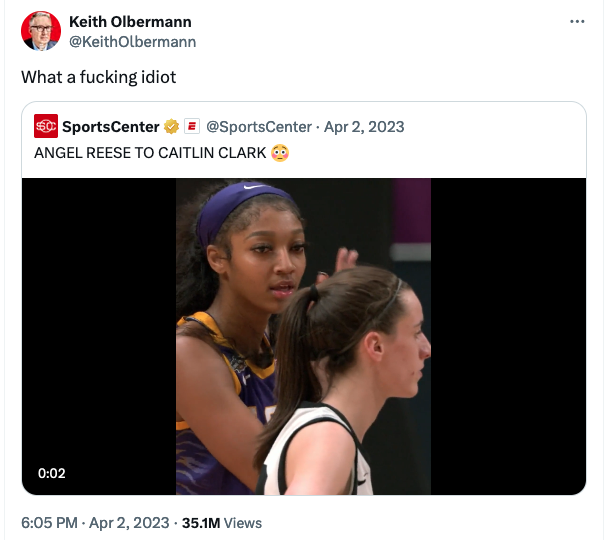
Near the end of the championship game in 2023, Angel Reese waved her hand in front of her face, stared at Iowa guard Caitlin Clark and pointed toward her ring finger. One week earlier, after nailing a three at the end of the game against Louisville to cap off a 41 point, 12 assist and 10 rebound triple-double, Clark gave Hailey Van Lith her “you can’t see me” gesture.

One week apart, two All-American players in the heat of fierce competition celebrated by talkin’ shit. That’s what ballers do… They talk shit!
But… Reese is Black and Clark is white.
Hence, Clark was celebrated and praised. She’s fierce… She’s an intense competitor…

One week later, when Reese mimicked Clark and let the Iowa star know “you can’t see me,” it sparked outrage in sports around the world. And the 20-year-old young Black woman who led her school to its first-ever championship was called classless, ghetto, and a thug by some of the most prominent white men in sports media.

In a post that has reached over 79 million viewers, Barstool Sports Dave Portnoy call young Ms. Reese a “Classless piece of shit.” Keith Olberman, formerly of ESPN and NBC labeled a Reese “a fucking idiot.” Olbermann’s post has been viewed over 35 million times.
In contemporary times, the conversation around race and sports has evolved, but the echoes of the “Great White Hope” mentality can still be observed. The term serves as a reminder of a period when sports were not just about athletic prowess but also about racial pride and prejudice. Understanding this historical context is crucial in recognizing how far society has come and how much further it needs to go in achieving true racial equality in all spheres of life, including sports.
When asked about the “you can’t see me” gesture after the game, Reese defended her response and stated, “All year, I was critiqued for who I was. I don’t fit the narrative. I don’t fit the box that ya’ll want me to be in. I’m too ‘hood. I’m too ghetto. Ya’ll told me that all year.,” Then in reference to Clark, she added, “When other people do it, ya’ll don’t say nothing. So, this is for the girls that look like me. For those that want to speak up for what they believe in. It’s unapologetically you.”
No lies detected…
Conclusion
The concept of the “Great White Hope” emerged from a specific historical context marked by intense racism and the desire to maintain white supremacy. Jack Johnson’s success as a Black heavyweight champion challenged these societal norms, prompting the search for a white boxer who could restore the perceived racial order. Today, Caitlin Clark has been charged with the immense task of restoring some sort of racial order to the world of women’s basketball. While the term has evolved and broadened in its application, its origins and continued relevance underscore the deep-seated racial dynamics that have historically shaped, and continue to influence, the world of sports.


 The Black Cager