The Enduring Virtues of the Greatest Generation in Philly Basketball

In the world of basketball, we often find ourselves captivated by the dazzling skills of today’s stars, the mesmerizing crossovers, the jaw-dropping dunks, and the high-stakes games. Yet, it is essential to remember that these thrilling moments are the result of a rich history and the legacy of those who came before. In the Greater Philadelphia region, there exists a treasure trove of basketball legends from the Greatest Generation whose virtues, sacrifices, and stories continue to shape the game we love. As an educational consultant, media content creator, and historian deeply entrenched in scholastic and collegiate basketball in this region, I’ve had the privilege of interacting with these stalwarts who played an integral role in molding not only the game but also the culture surrounding it.

(l-r) Roland Houston, Horace Owens, Dave Riddick, Geoff Arnold

The stories I’ve heard from these remarkable individuals are a testament to their resilience and determination. They used the game of basketball not merely as a sport but as a means to transform their lives and, in turn, the lives of countless others. One such tale that never fails to inspire is that of Alonzo Lewis, who, in the early 1950s, found himself as the sole Black player on a basketball court during a time when Jim Crow laws still cast a long, dark shadow over the South. His journey is a stark reminder of the racial injustices that existed, but also of the courage it took to break those barriers.
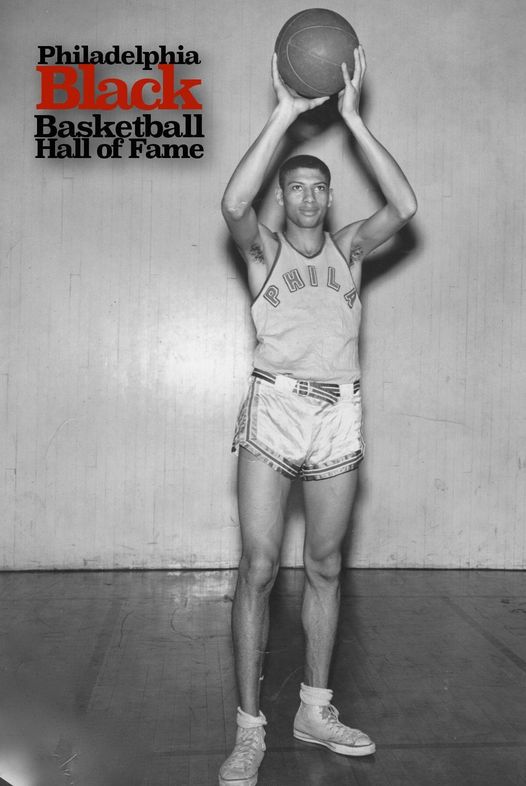
Claude Gross

Equally riveting is the story of Claude Gross, Wilt Chamberlain, and a group of young Black boys from the Christian Street YMCA, who embarked on a remarkable journey to Apartheid-era North Carolina and returned with a National Championship in 1953. Their victory transcended the basketball court; it was a triumph over bigotry and prejudice.

Dave Riddick’s tales of playing Black college basketball at Maryland-Eastern Shore during the 1950s shed light on the struggles and triumphs of athletes who navigated a segregated sports landscape. Fred Douglas, the first Black head coach in the history of the Philadelphia Catholic League, personifies the pioneers who faced adversity head-on and paved the way for future generations.

And then there’s the wisdom of John Chaney, a legendary coach who knew the importance of recognizing and honoring those who came before. His insight into who deserved to be first-ballot inductees into the Philadelphia Black Basketball Hall of Fame reflected not only his deep knowledge of the game but also his reverence for its history.

Narvie Parham

Listening to Mrs. Narvie Parham reminisce about her husband’s exploits in high school and various Philadelphia Industrial Leagues reminds us that behind every great athlete, there is a dedicated support system that often goes unrecognized.

Unfortunately, the list is growing…

John Chaney
Alonzo Lewis
Tom Gola
John Hardnett
Mike Brooks
Lewis Lloyd
Clarence Tillman
Paul Gripper
Larry Yarbray
Fred Pickett
Mik Kilgore

All of these beautiful souls are no longer with us…

As someone who has spent decades immersed in the world of basketball, I often find myself reflecting on the stark contrast between the Greatest Generation and today’s athletes. While modern players grapple with issues like NIL deals and prep school transfers, the older generation faced hardships and suffering that are unimaginable to the youth of today. They possess a different attitude and outlook on life, forged through trials and tribulations.

It’s important to recognize that every generation has its fair share of unpleasant individuals, but after countless conversations with elderly people, I’ve come to appreciate their palpable mindset. There’s a depth of knowledge and wisdom that only comes from living through challenging times, and it’s something we should treasure.

If given a choice between dining with a group of younger individuals or sitting with a group of elderly folk imparting their knowledge and wisdom, I would choose the latter without hesitation. The wisdom they share extends far beyond basketball; it encompasses life’s lessons, resilience in the face of adversity, and the importance of giving back to one’s community.

In a world where the spotlight often shines brightest on the newest and flashiest talents, it’s crucial to remember and honor those who paved the way. The Greatest Generation of Philly Basketball legends left an indelible mark on the sport, and their sacrifices made it easier for today’s athletes to chase their dreams. Their virtues and stories should serve as a guiding light, reminding us of the enduring power of dedication, perseverance, and the indomitable spirit of those who came before us.

So, here’s to the legends who are still with us, and here’s to keeping the memories of those who have passed away alive. Thank you to them all, for they are the true custodians of the game’s rich history, and their legacy will continue to inspire generations of basketball enthusiasts for years to come.

Ray Scott, Speedy Morris, Duckie Birts, Tee Parham, Sonny Hill, Tee Shields and Selina Gross I owe y’all a call.

Wilt Chamberlain: Showtime Sports Documents His Mythical Journey Through Jim Crow America

PHILADELPHIA, PA – July 13, 2023 – Philadelphia’s native son, Wilt Chamberlain, arguably the greatest basketball player of all time, led a remarkably complex life, navigating the cultural, social, legal and emotional challenges present in an overtly racist Apartheid America. Throughout his career, Chamberlain faced numerous obstacles, both on and off the court, and his journey sheds much needed light on the complexities of race, achievement, and personal choices made by prominent Black Americans in the 50’s, 60’s and 70’s. Finally, Chamberlain has received a cinematic examination worthy of the subject.

Showtime Sports will air Goliath, a docuseries examining the historic life, career and impact of, perhaps, the greatest athlete of the 20th century. Set to air as a three episode documentary, Goliath is directed by Rob Ford (The Cost of Winning) and Christopher Dillon (A Crime to Remember). It will debut on demand and on streaming on July 14 for all Paramount+ with Showtime subscribers before making its on-air debut on Showtime on July 16 at 10 p.m. ET/PT with episodes premiering each Sunday.

Today, I had the privilege of joining Chamberlain’s family and about 100 other dignitaries for a private screening of Episode 2 of the trilogy at the AMC Theater adjacent to the campus of Temple University.

St. Joe’s Prep rising junior PG, Olin Chamberlain, Jr. responds to media inquiries

After dominating scholastic basketball in the Philadelphia Public League at Overbrook High School, Chamberlain spurned over 200 other scholarship offers and chose to play at the University of Kansas. While donning the Jayhawk uniform, Chamberlain was a consensus All-American in 1957 and 1958 and Most Outstanding Player of the 1957 NCAA Tournament. However, his path to basketball stardom was not without its hurdles. In 1957, while playing for Kansas, he led his team to the NCAA National Championship game against the University of North Carolina. However, they suffered a heartbreaking loss in triple overtime. This devastating defeat fueled Chamberlain’s desire to prove himself at the professional level, prompting him to make a significant decision.

Unable to join the NBA immediately, Chamberlain opted to play for the Harlem Globetrotters, a wildly popular predominantly Black barnstorming team. The Globetrotters were well known for their emphasis on entertaining and showmanship. This move was not without controversy, as some questioned his motives and the impact it would have on his career. However, Chamberlain saw this as an opportunity to hone his skills and elevate his game before stepping onto the grand stage of the NBA.

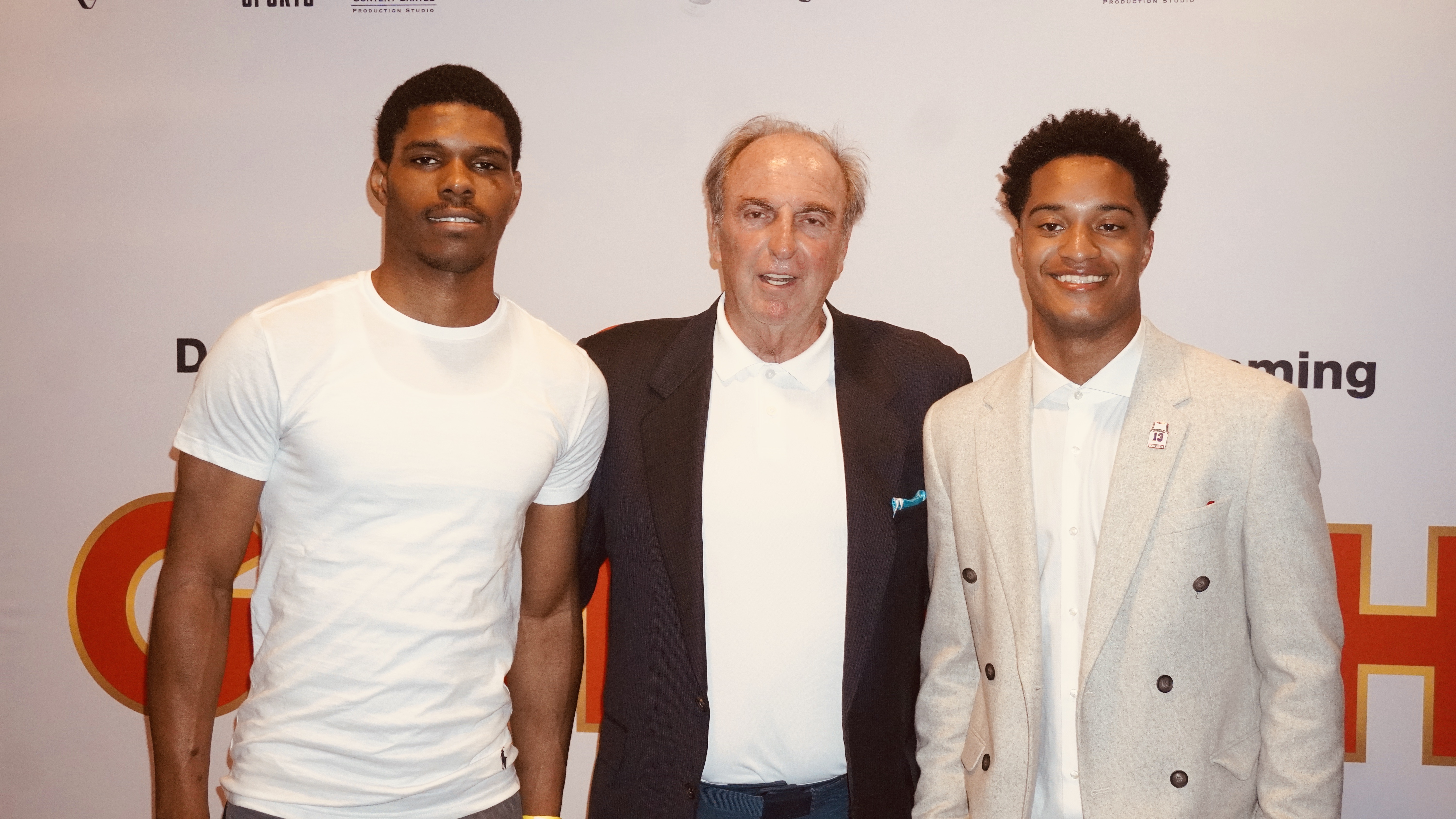
Temple PG, Hysier Miller, La Salle University Head Coach Fran Dunphy and Olin Chamberlain, Jr.

Chamberlain’s arrival in the NBA brought both admiration and criticism. His extraordinary athleticism and dominant play quickly earned him a reputation as the most talented player in the league. However, his prodigious individual statistics, such as illogical scoring records and stupefying rebounding numbers, led to accusations of selfishness and a lack of team focus. This perception was further reinforced by his repeated playoff losses to the Boston Celtics, led by the legendary Bill Russell.

It wasn’t until Chamberlain found himself on a team with comparable talent that he was able to capture the ultimate prize. In 1967, as a member of the Philadelphia 76ers, he finally won his first NBA championship. This victory was followed by another championship in 1972 when Chamberlain was part of the star-studded Los Angeles Lakers roster. These triumphs demonstrated that, given the right circumstances, Chamberlain could indeed achieve team success.

Mike Jensen, Philadelphia Inquirer, Don Hunt, Philadelphia Tribune and Delgreco Wilson, Black Cager Sports.

Beyond the basketball court, Chamberlain’s personal life was equally complex. He was often portrayed as a womanizer. At one point, he was quoted as saying that he had slept with as many as 20,000 women. While this led to him being maligned by some as a mere womanizer, The documentary acknowledges, in great detail, Chamberlain’s contributions to women’s sports. He was a generous benefactor for women’s volleyball and track and field, supporting female athletes financially and providing them with opportunities to excel.

Chamberlain’s complexity extended beyond sports and into his political beliefs. He actively supported the civil rights movement led by Dr. Martin Luther King Jr., recognizing the importance of racial equality and justice. However, his political affiliation as a Black Republican and his open campaigning for Richard Nixon raised eyebrows and sparked debates about his motivations and ideological leanings.

Selina Gross, Wilt Camberlain’s sister addressed the crowd

The life of Wilt Chamberlain serves as a compelling narrative of a man who transcended the barriers of his time. His ability to achieve greatness within the confines of a racially oppressive society highlights his resilience and determination. Chamberlain’s basketball career, though marred by controversial narratives, ultimately revealed his undeniable talent and ability to adapt when surrounded by the right supporting cast.

It is essential to view Chamberlain’s life holistically, recognizing the multifaceted nature of his achievements and choices. While his reputation as a womanizer and his political beliefs might be viewed as contradictory, they underline the complexities of his character. Wilt Chamberlain’s journey through the Jim Crow era and the subsequent changes in American society represents a compelling chapter in the history of both basketball and civil rights.

Goliath reveals an undeniable truth: Wilton Norman Chamberlain was THE “MUTHAFUCKIN” MAN.

Philadelphia Black Basketball HOF: Why?

If NOT us? Who?

As I entered my forties, I really began to treasure my relationships with my older friends. At the top the list was my relationship with Claude Gross, Sr. We shared a love of the great game of basketball, we both appreciated the role that Philadelphia played in bringing the game to international prominence and we both never shut up.

Now…I’m opinionated and outspoken. But, I can’t begin to hold a candle to the legendary loquaciousness of Claude Gross.

More than just about anything else, he loved to talk hoops. His favorite topics were how good he was as a player and a coach. He was a living, breathing embodiment of the cartoon character Commander McBragg. Except, you always knew that Commander McBragg was embellishing his accomplishments.

Claude Gross never told me a single lie.

“I beat Wilt in High School, he wasn’t ready for me…”
“We won the YMCA/AAU national championship in Jim Crow North Carolina in 1953…”
“I played professional basketball under an assumed name while I was in high school…”
“I averaged more than 40 in the industrial league…”
“Me and Tee Parham were like 800 – 0…”

Claude Gross discusses Philly players of his era

Upon initially meeting Claude and hearing all of this, one would naturally wonder if he was exaggerating… NEVER!

As his gait got slower, and his energy levels decreased, I realized that I would not have my friend forever.

Claude and his contemporaries were GIANTS in the game. As noted above, his was the only Public League team to defeat Wilt Chamberlain and Overbrook HS. He played with John Chaney in high school. He mentored Ray “Chink” Scott, Earl Monroe, Mo Howard, Andre McCarter, Gene Banks, Lionel Simmons, Nate Blackwell, Geoffrey Arnold, Donnie Carr, Bobby Johnson, BJ Johnson, Donnie Carr, Rashid Bey and hundreds of other young men the came through the Sonny Hill Community Involvement League.

Claude passed on so much knowledge about the history of the game. He was an endless font and an incredible inspiration.

Claude Gross, front row 2nd from right

It just wasn’t fair that the accomplishments of his generation weren’t memorialized.

I never really knew about the magnificent careers of Tarzan Cooper, Zach Clayton and Frank Washington until Claude explained in great detail what they had accomplished. With words, he could place you in a cramped church gym and you could actually “see” Tee Parham scoring 40, 50, 60 or even 90 points with ease.

After bouncing around the idea with Claude, Tee Parham, Dave Riddick and Ray Scott, I decided to establish the Philadelphia Black Basketball Hall of Fame. This was one of the best decisions I have ever made.

I enlisted Mo Howard and Geoffrey Arnold and we were off and running. We literally had nothing but spirit, energy and commitment.

Somehow, someway we wanted to be able to recognize the GREAT Philadelphia players, coaches, journalists and contributors that would never be otherwise recognized.

If NOT us? Who?

There is no Philadelphia Basketball Hall of Fame. These guys were banned from competition in the Big 5 solely because they were Black. Who? Who was gonna recognize and memorialize their enormous contributions?

With a nice little contribution from Lionel Simmons, we were off and running. No glitz, no glamour… Just 100 hopheads gathered in a small North Philadelphia community center with plenty of food and top shelf liquor loving and respecting one another.

ESPN’s Undefeated, the Philadelphia Tribune and the Philadelphia Inquirer provided extensive regional and national media coverage of the inaugural class. Temple and La Salle Universities were very supportive. Philadelphia Youth Basketball and Mike Horsey gave generous donations.

Nate Blackwell, Black Basketball HOF Induction Speech

The highlight… The headliner… The GRAND MASTER of the evening was my dear friend Claude Gross. He was a little weak, he wasn’t moving very well… But his mind was as sharp as ever! There were at least 20 South Philly guys in the house and they were drinking, carousing and fully supporting their leader.

Just a few weeks after his induction, Claude passed away. I can’t describe how good it felt knowing we were able to induct him into the Black Basketball Hall of Fame while he was able to fully participate and enjoy the ceremony.

Tee Parham

I have come to treasure every interaction and conversation I have with guys like Tee Parham, Ray Scott and Sonny Hill. They have given the game of basketball and the city of Philadelphia so much. We were able to present the late, great Dave Riddick with his award acknowledging his induction before he passed away. These moments are invaluable. To be able to honor the legends from yesteryear as well as my contemporaries like Nate Blackwell, Mike Anderson and Lionel Simmons meant so much to me. To see and feel the extent to which they appreciated the honor was incredible.

Roland Houston, Horace Owens PBBHOF member, Dave Riddick PBBHOF member and Geoff Arnold

I am extremely proud to have played a significant role in establishing a means of properly enshrining them and ensuring their legacies are shared with future generations.

The Philadelphia Black Basketball Hall of Fame, under the leadership of Mo Howard and Al Taylor has grown and taken on a much needed role of advocating for and providing assistance for members of the Philadelphia basketball community in need.

Again… If NOT us? Who?

I love the Philadelphia Black Basketball Hall of Fame.

The Philadelphia Black Basketball Hall of Fame matters!

Let’s Talk About Ball in Philly: Black Cager Middle School Classic

This past Saturday and Sunday, Cardinal O’Hara hosted the third leg of the Black Cager Middle School Classic. The 4 month grassroots circuit features teams from Virginia, Maryland and Pennsylvania.

Locally, we had Gratz legend Jarett Kearse’s Philly Blue Magic in action. After three stops, Philly Blue Magic is undefeated at 10-0. Blue Magic will be the number #1 seed when the playoffs get underway two weeks. The reigning Baltimore Catholic League Champion, St. Frances Academy (Baltimore, MD) will host the the playoff and Championship Games.

IMG_0511

Jarett Kearse and Philly Blue Magic

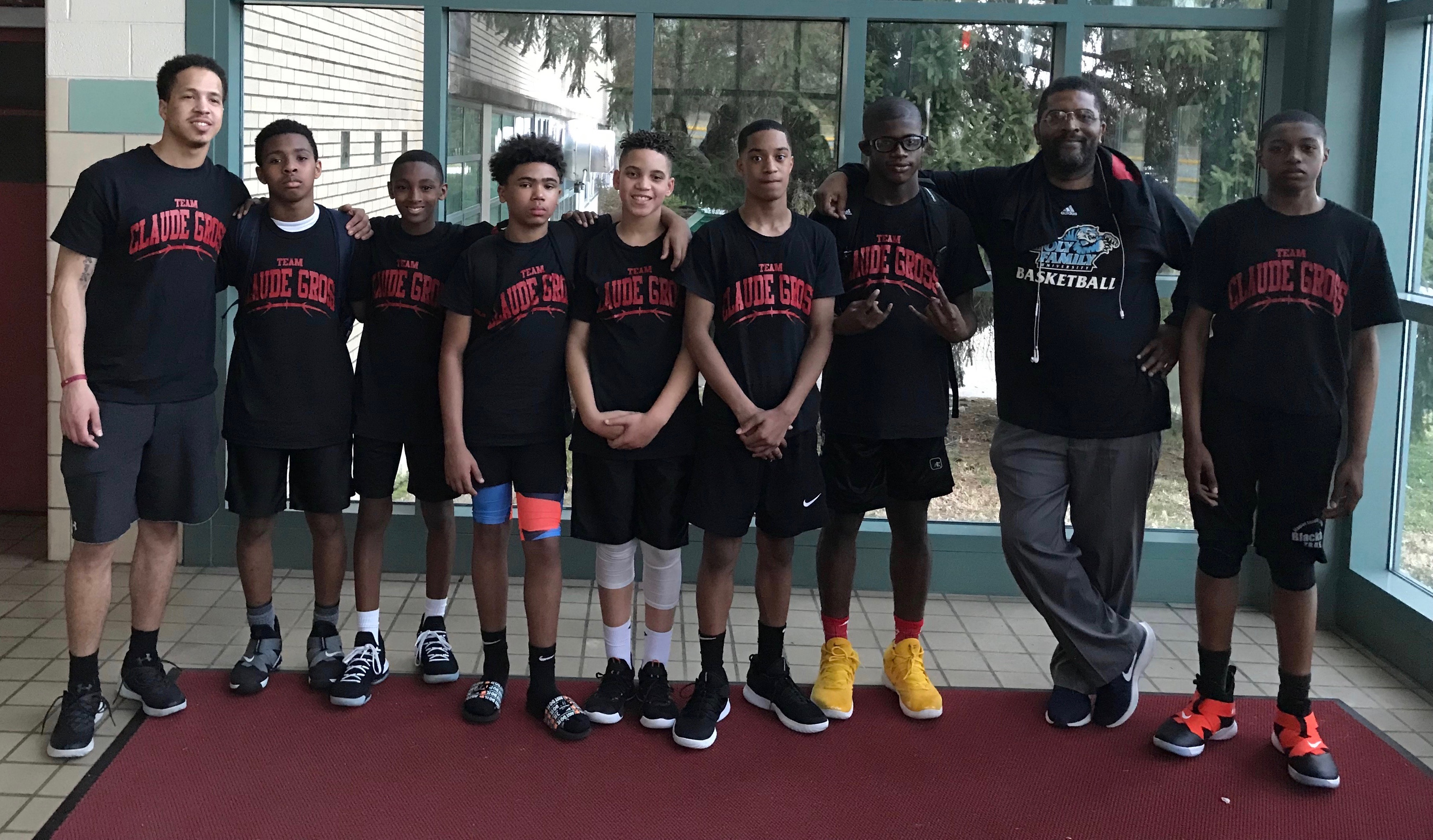
There were three other Philadelphia area entrants for this session. Team Claude Gross featured sixth grader Olin Chamberlain, Jr. Chamberlain is the nephew of both Wilt Chamberlain and the legendary Claude Gross. A long athletic point guard, Chamberlain has a tight handle, excellent vision and range out to the 3 point line. He will contribute immediately at the varsity level in three years.

56140425_2583241488368957_8736745164111872_n

Team Claude Gross

The Philly Mavericks played 4 competitive games. Haneef Hall is a big man with soft hands and a nice shooting stroke. Charles Cook is an athlete wing with very good change of pace moves. Dame Collins (below) does an excellent job with this program.

56685621_165184691068760_2407863334490603520_n

Dame Collins, Philly Mavericks

James Nelson Stewart put together the Suburban All-Stars. They had a very good little guard. That team also has a lot of length. High School coaches at private and Catholic schools should contact James.

IMG_4988

James Nelson Stewart and Bonner Assistant Joe McGinn

Each team played four games against teams like Maryland Sting, Team Melo, Crusader Nation, Thrill Black, Team Dedication and Virginia Lightning.

The Philly teams paid between $0 and $300 to participate.

The games were held at Cardinal O’Hara High School, in Springfield, PA. The Cardinal O’Hara gymnasium features two full regulation length courts and two electronic scoreboards.

United Brothers Basketball Organization provided the referees. Six referees worked 4 games each. Referees were paid between $20.00 – $30.00 per game.

Donta Scott (Imhotep CHS) managed the games. He worked 1 pm – 7pm on Saturday and 12pm – 6pm Sunday. Donta managed the games, worked the clock, kept the scorebook and supervised a 13 year old boy that manned the other table. That boy was paid $10.00 per game. Donta made between $200-$250. Jalen Hudson (Ridley HS) and an assistant worked the entrance table. They were paid between $200-$250.

We need additional workers for upcoming events. Must be willing to learn and love youth basketball.

AAU/Grassroots teams can play in gyms similar to O’Hara in Maryland, New Jersey and Delaware for $200-$300, with a 4 game guarantee. We want additional teams from the Philadelphia region.

Black Cager Sports provides media coverage to participating teams.

Refereeing is locked up. Philadelphia-based United Brothers Basketball Organization (U.B.B.O.) provides referees for Black Cager Sport youth basketball events.


55759791_564286640725023_3986869689627181056_n

U.B.B.O. Referee T. Younger

Coaches from O’Hara, Friends Central, Bonner, Roman Catholic, McDevitt, Springside-Chestnut Hill and a few other Delaware and Maryland power house programs were scouting players and meeting parents.

3DC2B73C-25F3-4523-BA7F-C51F33E6C26A

Springside-Chestnut Hill Coach Hartwell McFadden

Black Cager Sports is seeking 12U, 13U and 14U teams for additional competitive events. Those interested in working AAU/Grassroots events are encouraged to submit their resume to blackcager@gmail.com.

We look forward to hearing from interested parties.


The Traci Carter Show

I love Traci Carter… So should you!

He is a quintessential Philly point guard. Yet, Philly has only had fleeting glances of his game… That is about to change in a MAJOR way.

Why has he rarely appeared on the Philly stage? Well is a long story…

Like hundreds of great, very good and even some not so good South Philadelphia ballers that came before him, Carter studied under the “Guru.” That is where I met him in the summer of 2010. He was on the court with about a dozen or so other kids being “coached” by the legendary Philadelphia Black Basketball Hall of Famer, Claude Gross.

16804450_10211850920489454_1375838466490992322_o

Claude Gross, Philadelphia Black Basketball Hall of Famer

At the behest of Claude and 2-time Big 5 MVP, Rashid Bey, I stopped by the Marian Anderson Recreation Center to watch the South Philly contingent in the Sonny Hill Future League practice. Both were convinced they had a “special” player on that squad.

For the uninitiated, let me explain what a Claude Gross practice entailed… Claude would talk and talk and talk and then talk some more. Every so often, he would run a drill or let the players scrimmage and then he would see an error or a miscalculation… The ball would STOP and Claude would talk some more… Now agitated, his vocabulary became forceful and profanity laden to put it mildly.

For those determined to learn… For those desiring to improve… the fussing and cussing was just the price of admission – tuition, if you will – to get to the inevitable lesson. Mo Howard, Andre McCarter, Geoffrey Arnold, Nate Blackwell, Lionel Simmons and Donnie Carr are just a few of the ballers that matriculated through Basketball 101 taught by the Guru.

Traci Carter was one of the last really good players to take the class while Claude was still roaming the sidelines.

Physically, he did not stand out… In fact, while they were patiently listening to Claude’s lecture, I could not tell which one was Traci. He was skinny and very nondescript.

Then Claude let ‘em play a lil’ bit… One time up the court and it was clear which one I was supposed to be watching. His floor game was advanced. Even as a middle schooler, Carter was a dynamic and tough lead guard. He was all business… He took the game very seriously. While very slight, he already possessed the tools to be a factor on both ends of the floor. Actually, he reminded me of Bey at St. Joseph’s. His handle was VERY tight, he made good decisions and he was capable of making open threes and pull-ups alike. Perhaps, most impressive was his lightning quick first step is quick and his ability to change pace with the ball.

That day, Claude and Rashid told Traci “this is Del, he’s gonna make sure you are ok academically… Do what he tells you.”

Traci’s been my youngin from that very moment.

I eagerly awaited his high school debut. Traci enrolled at Prep Charter and I was sure he would set the Pub on fire… Then it happened… Fucking knee injury and subsequent surgery.

Shit!

He missed his entire freshman year. Given an assignment by Claude, I dared not perform my assigned duties. I kept in touch with Traci. I was impressed with his maturity and the way he was able to handle a serious injury at such a young age. He spirits remained high and he kept his grades together.

He decided to transfer to Roman Catholic for his sophomore year. Running the point on a team that featured Shep Garner, Rashann London and Manny Taylor, Traci helped Cahillites go 13-1 in the Catholic League before bowing out to Steve Vasturia, Mile Overton and St. Joseph’s Prep in the Catholic League semi-finals.

tracicarter-roman

Traci Carter at Roman Catholic

Making 3rd team All-Catholic as a sophomore, the future seemed exceedingly bright for Carter and the Cahillites.

Then he stumbled… This time off the court… A few too many youthful indiscretions resulted in another transfer.

This time, Traci relied on Donnie Carr to help guide his decision-making. I suggested that they consider Life Center Academy in Burlington.

Donnie, Traci and I met with Pastor Dave Boudwin and explained he was a good kid in need of a change of scenery and the support of the church. Pervis Ellison agreed to take on the role of coach/mentor for Traci.

Life Center Academy embraced Traci. He flourished in small class settings, regularly attended all religious gatherings, went on missions overseas and matured a great deal.

Like everyone else that fell under direction of Claude Gross, Traci followed orders. Every time he would receive his report card, he would text a picture and ask me to calculate where he stood. He took no chances.

Truth be told, Traci was a pain in the ass! Donnie Carr wasn’t a walk in the park either.

I found myself on several occasions, driving to Burlington to walk Traci through his core course GPA calculations. There was no way we would allow Traci to fall through the cracks.

On the court, he flourished. Traci earned the 90th spot in the national rankings for the class of 2015 by rivals.com. He was Rated as the 18th best point guard in the class by FOXSports.com. He averaged 16.0 points, 7.0 assists, 5.0 rebounds and 4.0 steals per game in 2014-15 and was tabbed first team all-independent. He was also a McDonald’s All-American Game nominee and was named Life Center’s most valuable player. Traci led Life Center Academy to over 40 victories in his two seasons and the team claimed the top ranking among independent teams within the state of New Jersey. He concluded his prep career with over 1,000 points and was tabbed the top player in the Hoop Hall Classic.

traci-dribbling

Traci Carter at Life Center Academy

But all of this took place in Burlington, New Jersey. Philly didn’t get to see his rise to scholastic prominence. He was off the radar screen.

College recruiters knew where to find him though… Xavier, Boston College, Pittsburgh, UConn, Creighton and a host of other high major programs were hot on his heels throughout his senior year. Traci eventually chose Marquette.

As a freshman, he did very well. Traci appeared in all 33 games and started 19. A true Philly point guard he averaged 4.6 assists and 1.4 steals per game while scoring 5.4 points in a very tough Big East Conference.

20161105_MB_1288_MB

Traci Carter at Marquette

At the start of his sophomore campaign, he began to express a little but of frustration. Nonetheless, he started 4 of the first 8 games. He was still averaging nearly 4 assists per game.

But there was pensiveness and sense of unease in our conversations that had not been there before. I encouraged him to tough it out… “Make it to the end of the school year,” I said…

Within a few days, it was all over the internet… “Carter leaves Marquette…”

John Giannini was there with open arms… He welcomed Traci… Then he also took Donnie Carr…

God is good! Thank you La Salle University!

With two years of eligibility remaining, Philly will finally get to see what I saw 8 years ago in that sweltering Marion Anderson gym. An authentic Philly point guard running a Philly team.

Local Hoopheads have been blessed… We have an overabundance of tough Philly point guards suiting up this year… Collin Gillespie is playing for Jay Wright, Stevie Jordan and Kimar Williams are at Rider, Shizz Alston sets the table at Temple, Fresh Kimble is Martelli’s coach on the floor…

But you’ve seen all these guys recently…

Physically mature and hungry to establish himself as the premier point guard in the Big 5 and the A10, my youngin is about to bring you sumthin’ a lil’ different…

The show debuts Tuesday evening at 7:30 pm at the Liacouras Center, 1776 North Broad Street.

Don’t be late… The Guru is watching…